[Click for English, which follows Spanish.]

Esa habilidad llegó a la vida de Elena Macario después de conocer a Luis Ostolaza, Guía de éxito familiar de Comunidad Promesa de la Mission a mediados de 2017. El encuentro se dio en la escuela primaria Bryant, donde estudiaban los hijos de Elena en ese tiempo.

“No sabía mucho de tecnología, como enviar un correo electrónico y en ese momento estaba en proceso de encontrar un apartamento de vivienda económica”, dice Elena, quien es oriunda de Guatemala.

Luis tomó el tiempo para enseñarle a Elena el uso de esa herramienta, consciente de que le sería útil para la obtención de recursos y para la comunicación con la escuela.

“Recuerdo las palabras de Luis ‘soy el guía, pero no todo el tiempo estaré ahí, debe aprender por sus propios medios’”, dice Elena.

Por supuesto el apoyo de Luis no se limitó al uso de la tecnología. La visión de Mission Promise Neighborhood es crear un futuro donde cada niño sobresalga y cada familia triunfe. Luis, como Guía de éxito familiar, le prestaría asistencia a Elena en dos de sus metas: obtener vivienda económica y hacerse ciudadana de Estados Unidos.

“No entendía cómo funcionaba el sistema de vivienda, sólo quería irme a un lugar para tener tranquilidad con mi hijo”, dice Elena. “Luis me ayudó con cada solicitud que hacía”.

Elena tuvo confianza en el proceso de la lotería de vivienda económica y fue persistente. Su esfuerzo tuvo frutos por partida doble ya que consiguió apartamentos para su familia y para sus padres en nuevas construcciones asequibles.

Con vivienda estable, Elena pasó a concentrarse en hacerse ciudadana de Estados Unidos. Tenía temor a la entrevista, por la barrera idiomática, pero Luis estuvo allí para ayudarle con la preparación.

La madre ahora es ciudadana y cuenta con vivienda estable. Su hijo Darwin está en noveno grado de secundaria y Jhonatan, el más pequeño, va a la escuela intermedia. Elena sigue el desempeño de sus hijos gracias a la comunicación por correo electrónico que mantiene con maestros.

“Como testigo del camino de la familia Macario, los veo como el mejor ejemplo de resiliencia”, dice Luis, quien ha estado en MPN durante seis años. “El amor por su familia y comunidad ha podido transformar a Elena y alentarla a superarse a sí misma a pesar de cualquier barrera que se le haya puesto en el camino”.

Ahora Elena usa su historia y su voz para inspirar a otras familias.

“Animo a los padres a que no tiren la toalla porque muchas cosas se pueden lograr con persistencia”, dice Elena. “Vivo con mucha tranquilidad con mis hijos, tenemos un gran espacio. Hay que seguir luchando por el sueño, hay gente que cree que es mentira, pero se puede lograr, es como buscar un trabajo, es algo que toma tiempo”.

Immigrant mother finds stability for her family with support from Mission Promise Neighborhood

Typing emailings throughout the day may be a normal task for most people working in corporate America, but when you’ve never crafted an official email before, and you don’t know what programs to start – it’s not a normal task, but a daunting one. 

Having safe internet access and learning to use email for the first time were essential for one immigrant mother who was desperately seeking and working towards stability for her and her family in San Francisco.

That new skill and ability, one many may take for granted, came into Elena Macario’s life after she met Luis Ostolaza, a Mission Promise Neighborhood (MPN) Family Success Coach, in the summer 2017. The two met at Bryant Elementary School where Elena’s children were studying at the time. 

“I didn’t know much about technology, like sending an email, and at the time I was in the process of finding an affordable housing apartment,” said Elena, who is originally from Guatemala.

MPN is a community and anti-poverty education initiative under the umbrella of Mission Economic Development Agency (MEDA), a community backbone organization. 

Luis took the time to teach Elena how to use this tool, aware it would be useful for obtaining resources and communicating with her children’s school.

“I remember Luis’ words ‘I’m the guide, but I won’t be there all the time, you have to learn by your own means,’” said Elena.

The support was not limited to teaching Elena how to format an email nor the use of technology. MPN’s vision is to create a future where every child excels and every family succeeds. Luis, as a Family Success Coach, would later assist Elena with two goals: obtaining affordable housing and becoming a United States citizen – two monumental steps in her and her family’s lives.

“I didn’t understand how the housing system worked, I just wanted to go somewhere to have peace of mind with my children,” Elena said. “Luis helped me with every application.”

Elena was confident in the affordable housing lottery process and was persistent. Her efforts paid off, undoubtedly, as she secured apartments for her family and her parents in affordable newly-constructed buildings in the Mission District.

With stable housing, Elena went on to focus on becoming a United States citizen. Due to the language barrier, she was afraid of the interview but Luis was there to help her with preparation.

She is now a citizen and has stable housing. Her son Darwin is in ninth grade and Johnatan, the youngest, is in middle school. Elena can now track how her children are doing in school thanks to email communication between teachers and officials – something she wasn’t able to do before.

“Being an eyewitness of the journey of the Macario family, I could describe it as the best example of resilience,” said Luis, who has been with MPN for six years. “How the love for her family and community has been able to transform and encourage her to overcome herself despite any barrier that may have been put in her way.”

After this experience, Elena uses her story and voice to inspire other families. 

“I encourage parents not to give up because many things can be accomplished with persistence,” says Elena. “I live very calmly with my children, we have a great space. You have to keep fighting for your dream, there are people who believe it’s a lie, but it can be achieved, it’s like looking for a job, it takes time”.
Read More

[Click for English, which follows Spanish.]

A la Comunidad Promesa de la Mission la conocí por medio de mi sobrino que estaba en un programa de Seven Tepees Youth Program, uno de los socios fundadores de la Comunidad Promesa. Era el año 2014, hubo una feria de recursos en la que personal de MEDA estaba entregando información sobre compra de vivienda y el concilio de familias. Me interesó porque en ese tiempo quería información sobre cómo comprar una casa. Hice una cita con ellos y ahí empezó todo. 

La primera persona con la trabaje en Comunidad Promesa fue con Ada Alvarado Freund, que hoy es la gerente del programa de Aprendizaje infantil. Tenía mis dos hijos pequeños y estaba buscando un programa preescolar de alta calidad. Le pedí que me ayudara a encontrar una escuelita. La verdad no conocía mucho sobre Comunidad Promesa o sobre los recursos que hay disponibles para las familias antes de esos primeros contactos con Ada y el resto de personas que trabajan en MEDA. Mi mamá trabajaba mucho cuando recién llegamos a Estados Unidos, descansaba unas cuatro horas, y no le quedaba mucho tiempo para involucrarse con la comunidad. Luego se sorprendía cuando yo le mencionaba sobre los recursos que había. Algunas vez tuvimos el apoyo de Good Samaritan, pero desconocíamos que era una organización parte de Comunidad Promesa. Es un alivio saber que alguien te puede ayudar sin tener miedo que te juzgue por necesitar un poco de apoyo para salir adelante y dar lo mejor a tu familia. 

Mi segunda gran conexión con MEDA fue a través del programa de Mission Techies. En ese tiempo trabajaba limpiando casa, que es un trabajo digno, pero también tenía otras metas. Era consciente de mis privilegios por ser bilingüe, tener un estatus migratorio regularizado, y saber operar una computadora. Debía tomar el programa porque iba a cumplir 25 años y en ese entonces sólo se aceptaban a personas entre 16 y 24 años. Mi madre y mi esposo me apoyaron bastante. Ellos iban por los niños a la escuela. Trabajaba limpiando casas de ocho a doce y media, para luego venir a Techies de una a cinco de la tarde. Fueron semanas largas, de mucho esfuerzo. 

Recibí asistencia de MEDA en la búsqueda de empleo y la primera oportunidad que apareció fue como contratista Comunidad Promesa para el programa Making Connections del Distrito Escolar de San Francisco. Aquí se enseñaba a padres o tutores de estudiantes a usar una computadora Chromebook. En un momento tuve la oportunidad de ayudar a cambiar el currículo para que fuera culturalmente relevante para nuestras familias. También me enfoqué en que tuvieran acceso a internet de bajo costo. Más adelante los conecté con el servicio de preparación gratis  de impuestos de MEDA y así empecé a trabajar con las familias. Un año después me contrataron de tiempo completo, dividía mis labores entre Making Connections y Guía de éxito familiar. Estuve asignada a Bryant Elementary,  luego a John O’Connell y después a Felton Institute. De ahí pasé a ser Especialista en participación de padres y jóvenes con la organización.

Ahora estoy en Promise City* con la meta de siempre: apoyar a las familias para que tengan una voz y un espacio donde digan lo que les está sirviendo y lo que no, lo que les está ayudando y lo que no. Siento que puedo llevar su voz a espacios en los que regularmente no son invitados.

He pasado junto a la Comunidad Promesa ocho de sus diez años. Le he dicho a mis supervisores que más allá de que hoy tenga ingresos y vivienda estable (sí, compre una casa), la Comunidad Promesa me ha ayudado a crecer en lo profesional, emocional y personal. Gracias a todos los  entrenamientos que me han dado he aprendido a conectar con las familias, entre ellas la mía.  Tengo un hijo transgénero que no quiero que crezca en la sombras por ser transgenero, quiero que vea la misma luz de los demás, que no sea tratado diferente. He aprendido a entender a mi hijo y no juzgarlo. Dejo que él me guíe en su vida y que él decida cómo quiere vivir su vida en el futuro.

Soy una madre que se involucra en el Comité asesor de padres ( English Learner Advisory Committee) de las escuelas. Con mi hija me he involucrado desde el principio. He hablado en foros públicos sobre la importancia de la interpretación. Por mi hijo fundé un pride club, en donde los niños aprenden sobre la comunidad LGTBQ. Quiero que mis hijos sepan que estoy allí por ellos, para ellos y con ellos.

La Comunidad Promesa ha sido más que un trabajo para mí.

Ahora visualizó a la Comunidad Promesa abriendo  el camino para otras comunidades en la ciudad. Las necesidades de los latinos no son tan diferentes a las necesidades de nuestros vecinos asiáticos o afroamericanos. Las familias merecen tener vivienda estable y segura para ellos y sus hijos. Me gusta el abordaje de la Comunidad Promesa porque se enfoca en el bienestar de todos, no solo una persona, por eso es importante el rol de cada socio de la Comunidad Promesa. Sabemos que se requiere de todo un pueblo para criar a un niño. 

*Promise City es una iniciativa para compartir el modelo Promise Neighborhood en todo San Francisco en consonancia con el Plan de Recuperación de la Alcaldía

Ana Avilez: My Journey Through Mission Promise Neighborhood

I first learned about Mission Promise Neighborhood (MPN) through my nephew who was in a program with Seven Tepees Youth, one of the founding partners of MPN. It was the year 2014, and there was a community fair where MEDA staff were handing out information on home buying and the family council. It interested me, because at that time, I wanted information on how to buy a house. I made an appointment with them, and that’s where it all started.

The first person I worked with at Comunidad Promesa was Ada Alvarado Freund, who is now the manager of the Early Childhood Learning program. I was looking for a high-quality preschool for my two young children. I asked Ada to help me find an escuelita. I didn’t know much about MPN or about the resources that are available to families – before those first contacts with Ada and other MEDA staff. My mom worked a lot when we first arrived in the United States, she was resting for about four hours daily, and she didn’t have much time left to get involved in the community. Later she was surprised when I mentioned to her about the resources that were available. I believe we had some support by Good Samaritan, but we were unaware that it was an organization that was part of MPN. It is a relief to know that someone can help you without being afraid that they will judge you for needing a little support to get ahead and give the best to your family.

My second big connection with MEDA was through the Mission Techies program. At that time I was working cleaning houses, which is a decent job, but I also had other goals. I was aware of my privileges for being bilingual, having regular immigration status, and knowing how to operate a computer. I had to take the program because I was going to turn 25, and at that time only people between the ages of 16 and 24 were accepted. My mother and my husband were very supportive of me. They went to pick up the children from school. I worked cleaning houses from eight to twelve thirty, and then came to Techies from one to five in the afternoon. Those were long weeks, a lot of effort.

I received job search assistance from MEDA and the first opportunity that came up was as a contractor for MPN for the Making Connections program that was funded by the San Francisco Unified School District. Here parents or guardians were taught how to use a Chromebook computer. At some point,  I had the opportunity to change the curriculum to make it culturally relevant to our families. I also focused on helping families obtain low-cost internet access. Later I connected them with MEDA’s free tax preparation service, and in a blink of an eye I was connecting families with resources. A year later I was hired full time by MEDA-MPN as a Family Success Coach, dividing my duties between Making Connections and as Family Success Coach. I was assigned to Bryant Elementary, then to John O’Connell High School, and later to Felton Institute. Later I became MPN’s Parent and Youth Engagement Specialist and was based at Plaza Adelante.

Now I work for Promise City* with the same goal: supporting families so that they have a voice and a space where they say what is working for them and what is not, what is helping them and what is not. I feel like I can bring their voices to spaces where they are not regularly invited.

I have been with MPN for eight of their ten years. First as a client and later as a team member.  I have told my supervisors that beyond the fact that today I have a steady income and stable housing (yes, I bought a house), MPN has helped me grow professionally, emotionally, and personally. Thanks to all the training they have given me, I have learned to connect with families, including mine. I have a transgender son, and I don’t want him to grow up in the shadows because he is transgender. I want him to see the same light as others, not to be treated differently. I have learned to understand my son and not judge him. I let him guide me through his life and let him decide how he wants to live his life in the future. 

I’m a parent who gets involved in the schools’ English Learner Advisory Committee. With my daughter I have been involved from the beginning. I have spoken in public forums about the importance of interpretation. I also started a pride club at my son’s school, where children can learn about the LGTBQ community. I want my children to know that I am there for them and with them.

 MPN has been more than a job for me. 

Now I envision MPN leading the way for other communities in the city. The needs of Latinos are not that different from the needs of our Asian or African American neighbors. Families deserve stable and safe housing for themselves and their children. I like the MPN approach because it focuses on the well-being of everyone, not just one person, which is why the role of each partner organization is so instrumental. We know it takes a village to raise a child. 

*Promise City is a citywide initiative to share the Promise Neighborhood model across San Francisco in alignment with the Mayor’s Recovery Plan.

Read More

[Click for English, which follows Spanish.]

Entre actividades creativas, pasabocas y fotos con Santa Claus, decenas de niños del Distrito de la Mission en San Francisco regresaron a casa con las manos llenas después de participar  en la 8va entrega de libros de La Comunidad Promesa de la Mission (MPN) el jueves 8 de diciembre.

La lluvia que cayó en la tarde en San Francisco no impidió que las familias se acercaran al teatro de la escuela primaria comunitaria Buena Vista-Horace Mann para su cita con la lectura. Este año, MPN recolectó cerca de 2,850 libros gracias a donaciones de Tandem, Partners in Early Learning, Children’s Book Project, la Biblioteca Pública de San Francisco y la Biblioteca de la Escuela Primaria Leonard R. Flynn.

En las donaciones se destacó un gran número de libros en español lo que permite a los padres inmigrantes leer junto a sus hijos en casa, además de fomentar el bilingüismo. 

“El ambiente fue excelente, tuvimos todos los grados, de 0 a 12”, dijo Luis Roberto Ostolaza, Guía de éxito familiar de MPN. “Una de las misiones que tenemos en MPN es que cada niño tenga la oportunidad de leer y aprender durante todo el proceso”.

Este año fue la tercera ocasión que la entrega anual se celebró en una escuela de la Mission. El evento se pudo llevar a cabo durante 2020 y 2021 con un pre-registro de familias como parte de los protocolos de protección contra el COVID-19.  

La novedad de este año fue tener una mesa con libros para adultos por primera vez.  

“Es un evento muy bueno porque introduce a los niños a la lectura, a los libros”, dijo Claudia Rodríguez, madre de la Mission y quien también llevó libros para su lectura personal. “Hasta mi hijo más pequeño le encantan los libros”.

Cerca de 300 personas, entre niños, padres y educadores, estuvieron presentes en el evento. 

Read All About It: Mission Promise Community Celebrates “Eighth Annual Holiday Book Giveaway”

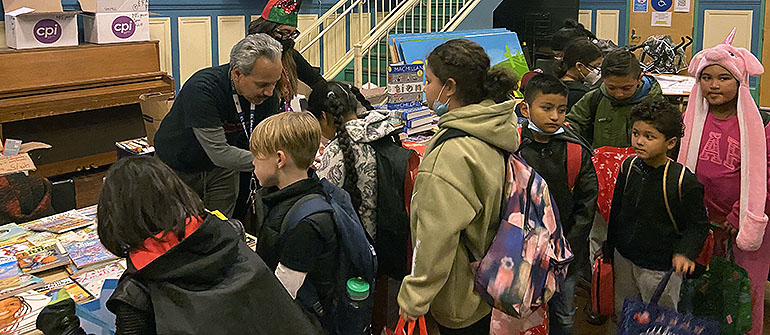
Dozens of children from San Francisco’s Mission returned home with their hands full after participating in the Mission Promise Neighborhood’s “Eighth Annual Holiday Book Giveaway” on Dec. 8. The event also included activities, snacks and the ever-popular family photo with Santa Claus.

Despite rainy skies, families headed to the theater of the Buena Vista Horace Mann K-8 Community School to discover books that would make the ideal holiday gift for their young ones. This year, MPN collected around 2,850 books thanks to in-kind donations by Tandem, Partners in Early Learning, the Children’s Book Project, the San Francisco Public Library and the Leonard R. Flynn Elementary School Library.

As always, this year’s donations included a large number of Spanish-language books, allowing immigrant parents to read with their children at home while promoting bilingualism in the community.

“The atmosphere was excellent, as we had all the grades represented, from 0 to 12,” said Luis Roberto Ostolaza, Family Success Coach for MPN. “One of the missions we have at MPN is that every child has the opportunity to read and learn.”

This year marked the third time the annual event was held at a Mission school. The giveaway was also held during the 2020 and 2021 pandemic years, with a pre-registration for families as part of the protocols against COVID-19.

A new addition to this year’s event was a table with books for adults.

“It is a very good event because it introduces the children to reading, to books,” said Claudia Rodríguez, a Mission mother who also took home some adult books for herself. “Even my youngest kid loves books.”

About 300 people, including children, parents, volunteers and educators, attended the event.

Read More

by Director of Promise City Programs and Partnerships Liz Cortez

The Mission Promise Neighborhood (MPN) team is honored to present at the 2022 StriveTogether Convening in Chicago. The title of our session is “Listen and Follow While the Community Leads.” In this session, Parent and Youth Engagement Specialist Ana Avilez and Associate Director of Data and Learning Michelle Reiss-Top will share lessons learned from the engagement of parents and youth in a human-centered design process to co-create a community report card that focuses on systems barriers and fosters our community’s ownership of data to influence systemic change.

StriveTogether, of which MPN has been a member since 2018, is a national network that supports cradle-to-career initiatives (providing prenatal to career services) across the country by providing technical assistance to backbone teams working to achieve systems transformation in their communities. StriveTogether has challenged our initiative to collect and analyze data that addresses systemic inequities. Traditionally, the main focus of our data collection across our partnership has been on behavior change of the individual (child, youth and parent) and academic scores. In addition to these traditional metrics, we are interested in developing actionable systems indicators that will help us advocate for shifting policies, practices, resources and power structures that produce more equitable prenatal-to-career outcomes in our community. This is the focus of our MPN community report card.

“Those closest to the problem are closest to the solution.”
– Community Partner

Toward the end of 2021, MPN began engaging parents and youth using the human-centered design approach. A design team comprising parents, youth and staff began a dialogue with community members and collected information via one-on-one interviews and in focus groups. To work together in a virtual format due to pandemic challenges, we provided design team members with capacity-building around using both Zoom and the Miro collaborative platform, plus we surveyed members for any technology equipment needs.

Our meetings always started with the proposition that we would co-create something that would reflect the needs and desires of the community – and that we were open to what the group would come up with in terms of what it should look like. Parents and youth became researchers and developed the questions we would ask our community through one-on-one interviews and focus groups. After those interactions, interviewers from the design team had the opportunity to share the stories they were collecting: We started to see emerging themes. 

“I appreciated having a dialogue with my community rather than collecting feedback through a survey.”
– Design Team Member 

From surviving to thriving
We learned much about what our community members are experiencing when navigating systems, especially during the pandemic. Families are concerned about academic outcomes, but shared that many needs are not being addressed, creating barriers to students and families thriving. After analyzing all the information we gathered, we developed key insights that reflect our families’ needs and barriers.

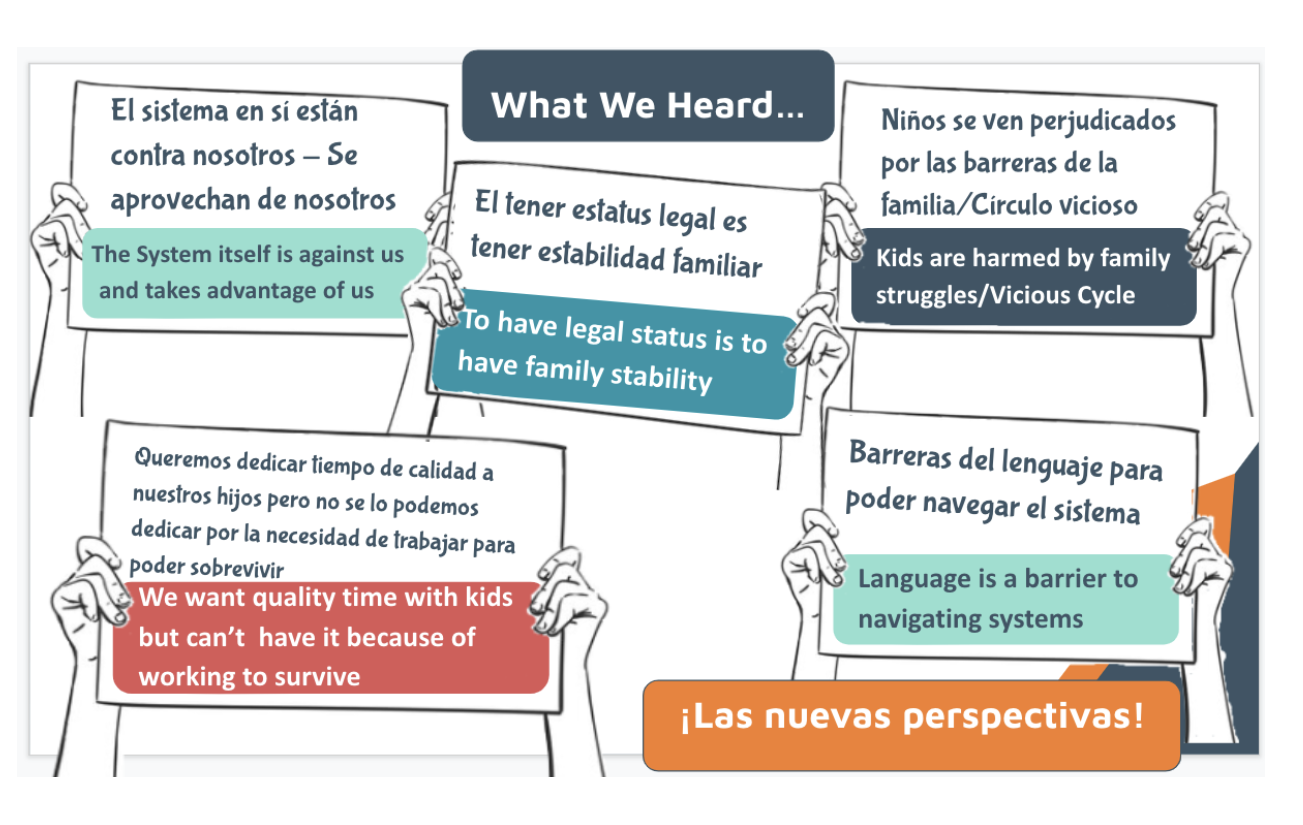
Families shared that the system works against them and even takes advantage of them. The ability to obtain legal status is at the center of whether a family can thrive. Without such legal status, coupled with English-language skills to navigate systems (e.g., schools, city agencies, employment), parents are compelled to work more than one job and cannot spend quality time with their kids, with the latter harmed by this vicious cycle.

“Who is asking these questions? I’ve never been asked about my story.”
– Community Member

Families shared that they are experiencing survey and intake fatigue. Every institution that they navigate is asking them the same questions. They also shared that they rarely get feedback: They are curious about how things are changing in the community, but the data is not coming back to the community members to make sense of it. Consequently, we thought it was important that whatever we created to demonstrate community needs and desires should be immediately available to the community.

Prototype development: An MPN App to collect community data
After months of working collaboratively, we devised an App prototype that would allow us to collect community data on barriers and desires. Our App is in the pilot stage and includes questions about community members’ experiences as they navigate systems ranging from city agencies and community-based organizations to schools and others. Additionally, the App will be a place where community members can access videos and listen to stories that community members are sharing about their experiences, needs and desires. The App will provide community members with access to the data right after completing the surveys. They can see what other community members are saying and use the data in any leadership space they are in to advocate for their needs and those of the community.

Next steps
We have just begun the data collection through the App. We envision coding the data to develop systems-level indicators that will be tracked over time and used to paint a picture of what the community is experiencing and to begin a planning process with our community partners and parents, and youth around strategies and advocacy. We envision that families will have the data that they need to advocate for their needs and help to change the systems that are not working for them. 

Stay tuned for the next exciting phase of our work.

______________________________

Community Report Card Design Team Members:
Rosario R., Parent
Abril M., College Student 
Jacqueline R., Parent
Maria G., Parent
Margarita G., Parent
Osiris L., Parent
Jacqueline H., Parent
Erick J., High School Student
Michelle Reiss-Top, Associate Director of Data and Learning
Ana Avilez, Parent and Youth Engagement Specialist
Alejandro Bautista Zugaide, Family Success Coach
Susana Gil-Duran, Early Learning Family Success Coach
Liz Cortez, Director of Promise City Programs and Partnerships

Read More

by Evaluation Fellow Maria Dominguez

Every year, Mission Promise Neighborhood (MPN) administers the School Climate Survey (SCS) to middle and high school students who go to schools in the MPN footprint and participate in onsite programs that are part of the MPN service network. We are pleased to share the key findings from the spring 2022 survey.

This is the first time MPN has been able to administer the survey in three years, due to the challenges of distance learning and families’ urgent resource needs during the COVID-19 pandemic. Two MPN partners, Jamestown and Mission Graduates, administered the survey via SurveyMonkey to students at their on-campus Beacon Centers in May 2022.

The SCS has several purposes. The US Department of Education, which has funded MPN since 2012, requires us to report annually on community indicators that we track through the SCS. Findings from the SCS also support our network partners and community members: By hearing directly from our students, the MPN network can leverage our best practices and improve upon our service model. Hearing student perspectives also amplifies the needs of young community members to our elected officials and other key stakeholders.

This year, 153 students across four MPN schools[1] – Everett Middle School, Buena Vista Horace Mann K-8 Community School, John O’Connell High School and Mission High School– participated in the survey. While the survey is anonymous, we collect core demographic data from respondents:

  • 25% of respondents were in middle school, 75% in high school
  • 40% of respondents identified as female, 56% male and 4% nonbinary/gender non-conforming 
  • 68% of students identified as Latino
  • 11% of students answered the survey in Spanish

The following sections present the key findings from the 2022 School Climate Survey across four domains: School Safety; College Readiness; Internet and Technology Access;  and Home Life.

School SafetyOur student respondents largely feel safe and supported in their school settings; however, when we disaggregate survey responses by age and gender, we see some disparate experiences among MPN students – disparate experiences that merit further inquiry.

The vast majority of survey respondents indicated that their school was a supportive environment: Eighty-one percent agreed that there was at least one teacher or staff member on whom they could rely, and 77% felt that staff and teachers treat students with respect. As Figure 1 shows, over two-thirds of MPN students feel safe at school, and traveling to/from school; however, high schoolers report feeling less safe traveling to/from school compared to middle schoolers, and are less inclined to report having a school staff member on whom they could rely. Conversely, middle schoolers were less likely to report that teachers and school personnel treat students with respect.

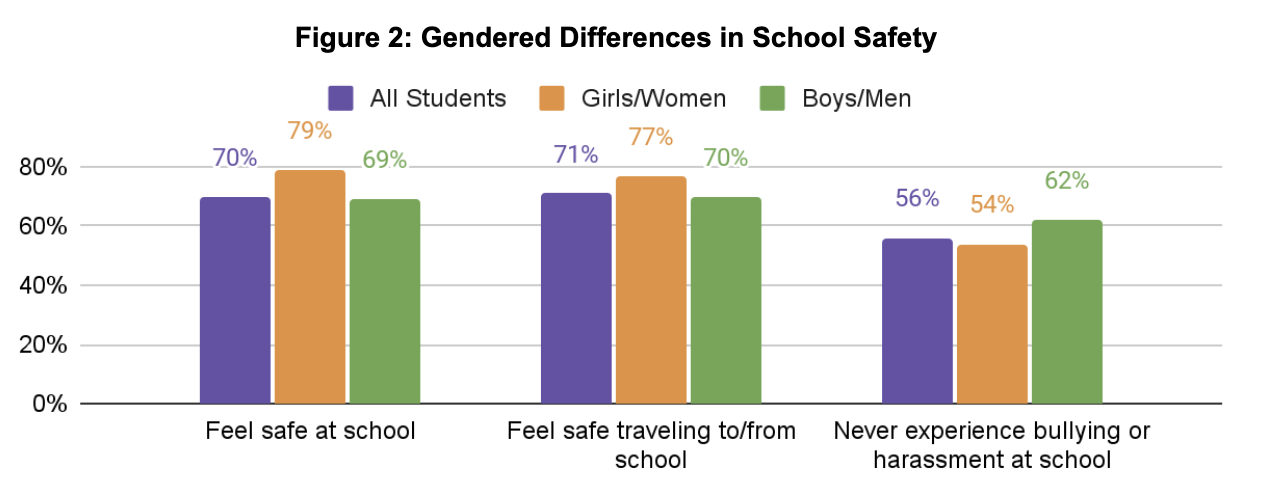
Figure 1: MPN Student Perceptions of School SafetyWhen disaggregating the data by gender, we noticed that female students are more likely to report that they have experienced bullying or harassment (see Figure 2). However, there was a contrary trend in the school safety data: Girls were more likely to report feeling safer at school and traveling to/from school than male survey-takers.

Figure 2: Gendered Differences in School SafetyAs the SCS is almost entirely multiple choice, we can only speculate why these statistical differences emerged in the data. For instance, it is possible that high schoolers feel less safe between home and school because they are less likely than middle schoolers to get a ride from their parents; and there is a chance that boys are simply less likely to report that they have been bullied, out of a sense of pride. These are intriguing findings that we will need to research further to understand more clearly.

College ReadinessThe majority of MPN students who took the SCS intend to pursue higher education; however, disaggregating the survey responses reveals that Latino and male students are less likely and less confident in seeing college as part of their future.

Over two-thirds (69%) of MPN students plan to attend a four-year college, either straight from high school or as community college transfers; however, only 62% of boys/men in high school noted that they plan to attend college, compared to 90% of girls/women. As a whole, women in the U.S. are more likely to attend college than men; however, the nationwide gender imbalance in college students is nowhere near what we see in the SCS data.

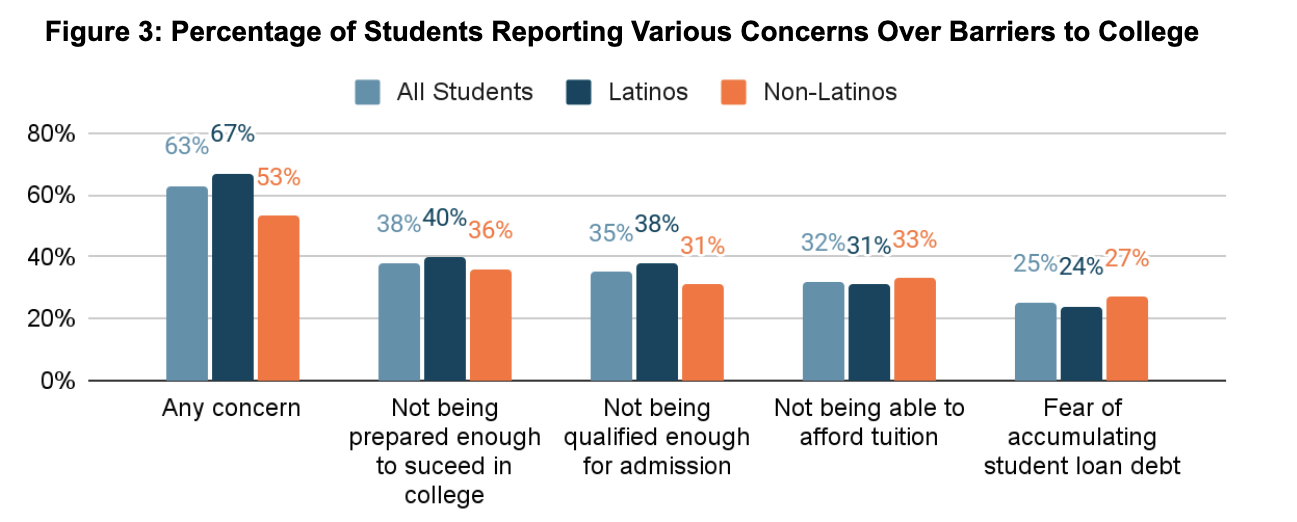
While a majority of MPN students, regardless of gender, intend to earn a bachelor’s, Latino students were far likelier than non-Latino students to report uncertainty about their ability to attend and/or succeed in college. Half of non-Latino respondents noted that they were confident in their ability to go to college, compared to just one-third of Latinos. Per Figure 3, Latino students were also more likely to report their concerns over an array of specific barriers to college success, from academic preparation to financial capability.

Figure 3: Percentage of Students Reporting Various Concerns Over Barriers to CollegeThe School Climate Survey also asked respondents to name any specific resources they thought would help them succeed in college. Notably, the most frequently cited response was access to mental health resources – perhaps an indicator of the psychological stressors youth have faced during the COVID-19 pandemic, and/or widespread understanding about the benefits of mental health care. Other common responses ranged from additional academic support to financial aid to peer mentorship.

As with the data on school safety, we will need to explore in greater detail why there was such an imbalance between male and female respondents regarding their college plans, what else MPN partners can do to support Latino students on their pathways to college and what kinds of mental health supports would best help MPN students in postsecondary education.

Internet and Technology Access Remote learning during the COVID-19 pandemic laid bare the importance of equitable access to the internet and computing devices at home. Disparate quality in home internet and personal computers could exacerbate systemic disparities in achievement for students from low-income families.

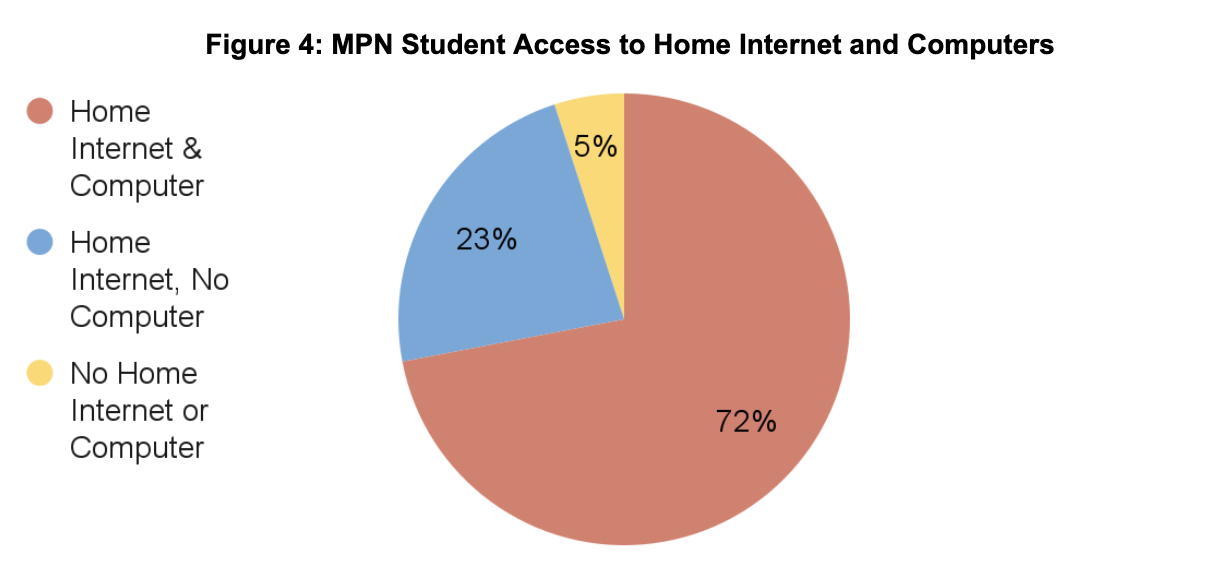
As Figure 4 below shows, nearly all (95%) MPN students have access to the internet at home; however, over one-quarter (28%) of respondents do not have access to a home computer or laptop. Students with home internet but no home computer reported that they could access the internet through their smartphone, a tablet device and/or a video game console instead. Compared to a computer, none of those devices are optimal for students to complete homework, write essays or apply to jobs/colleges.

Figure 4: MPN Student Access to Home Internet and ComputersIn this context, MPN partners could connect students without home computers and internet to onsite technology, or work with families to secure access to low-cost computing devices and internet subsidies.

Home LifeFinally, the SCS asks students about a few components of their home life and daily activities.

  • Nutrition: The majority (83%) of students eat two or more servings of fruit and vegetables a day; however, only 18% meet the Department of Education’s (DOE) benchmark of five-plus servings a day.
  • Exercise: The majority (86%) of students are engaging in regular physical activity; however, only 27% meet the DOE benchmark of 60+ minutes of daily physical activity, and even fewer Latino students meet this benchmark (19%).
  • Student Mobility: Three-quarters (73%) of MPN students have lived in the same home for the past year; however, 13% of students report having moved two or more times in the past year, which can disrupt students’ ability to learn. This is of particular concern in the Bay Area, where the housing crisis imperils many low-income families and their living situations.

Conclusion and Next StepsOverall, the SCS reveals positive trends: The majority of MPN students feel safe at school, intend to go to college and do not face housing instability. In contrast, we can also see disparities in the experiences of male and female students, and Latino and non-Latino youth. It will be important for us to delve deeper into these trends, as well as the other challenges and barriers that our respondents named.

Data from the SCS serves as a foundation for additional exploration. Because the survey is only 18 questions and mostly multiple choice, we would benefit from different kinds of data activities with students, families, MPN staff and school personnel to better understand some of the findings from this year’s survey data. For instance, we could explore further:

  • Why do high schoolers feel less safe traveling to/from school?
  • Why do female students feel safer, even though they experience more harassment?
  • Why are male MPN high schoolers far less likely to plan to attend college?
  • Why are Latinos less confident in their ability to attend college?
  • Why are mental health resources the most commonly cited need for college?

We are excited to dive deeper into these questions and learn the context for them in future analyses, including longitudinal analyses, and comparisons to statewide and national data. Be on the lookout for further analyses posted here, as well as updates on our work based on this year’s survey data. 

______________________________
[1] Ninth-graders are not represented among the survey population, which is a trend evident in past years’ responses and is reflective of who participates in the high school Beacon Center programs. James Lick Middle School students were unable to participate this year due to logistical challenges with survey administration.

Read More

[Click for English, which follows Spanish.]

Estudiantes y familias de San Francisco han contado por 10 años con una herramienta de apoyo económico que hace más posible el sueño de hacer una carrera universitaria: el programa Kindergarten to College (K2C) de la Oficina de Empoderamiento Financiero de la Ciudad y Condado de San Francisco.

La iniciativa permite a las familias tener una cuenta de ahorros que en el futuro ayudará con los costos de estudios universitarios de cada hijo. 

“Este es un programa universal que está abierto a todos los estudiantes del Distrito Escolar Unificado de San Francisco (SFUSD) sin importar estatus migratorio”, dice Elisa Rodríguez, Community Engagement Specialist del programa K2C. “Y además abrimos las cuentas automáticamente, los padres no tienen que hacer, sólo reciben una carta de bienvenida. No hay barreras”.

El programa cumple 10 años este 2022. Durante ese tiempo ha abierto más de 49,000 cuentas con más de $11 millones de dólares ahorrados para los estudiantes, según datos compartidos por K2C. 

El dinero ahorrado no sólo proviene del bolsillo de madres y padres. El programa también contribuye con una serie de incentivos, que empiezan desde que se abre la cuenta cuando la Ciudad hace un depósito inicial de $50 dólares. En este año de celebración del décimo aniversario,  K2C da un incentivo de $10 dólares por cada aportación, hasta diez veces, para un total de $100 dólares. (Conozca los incentivos).

“Queremos crear esta conciencia sobre la universidad y comenzar a ahorrar temprano para que puedan tener una garantía”, dice Rodríguez. “Tal vez no ayude a cubrir el costo total de una matrícula, pero sí podría ayudar a mitigar parte del costo”.

De acuerdo con Rodríguez, estudios han revelado que los estudiantes que conocen la existencia de una cuenta de ahorros a su nombre tienen más posibilidades de asistir a la universidad que aquellos que no la tienen. 

La Oficina de Empoderamiento Financiero de la Ciudad y Condado de San Francisco también ofrece a los padres talleres educativos y  sesiones con guías financieros. 

Esfuerzo comunitarioPese al fácil acceso y los incentivos,  K2C enfrenta desafíos dentro de algunas comunidades de inmigrantes ya que ciertas barreras culturales impiden que las familias aprovechen el programa en su totalidad. Es aquí como organizaciones como Comunidad Promesa de la Mission (MPN), Mission Graduates y Parents For Public Schools (PPS) entran a jugar un papel importante gracias a su cercanía con las familias de los estudiantes. Los guías de éxito familiar de MPN, por ejemplo, asisten a padres con la gestión de las cuentas y responden a las dudas que tengan, además de servir de intérpretes. 

“La comunidad ya tiene confianza en estas organizaciones porque han trabajado con los padres por muchos años”, dice Rodríguez.

“Tratamos de eliminar las barreras para las familias al abrir las cuentas de ahorro automáticamente sin que los padres tengan que hacerlo. Sólo tienen que registrarse en línea para tener acceso a sus cuentas y nuestro programa envía carta de bienvenida a todas las familias nuevas”.

La guía de las organizaciones comunitarias se multiplica cuando los padres que recibieron su asistencia después tienen el conocimiento para ayudar a familias recién llegadas a San Francisco o con hijos que apenas ingresan a la vida escolar. 

“Es importante  informar sobre esa cuenta para que ellos [los padres] en el futuro tengan un ahorrito para sus hijos”, dice Ana Chay, una madre con dos hijos en escuelas del Distrito Escolar de San Francisco. “Los incentivos los veo cuando miro mi cuenta. K2C es algo importante para mí porque me gustaría que mis hijos estudien y se gradúen en lo que quieran, para que tengan un buen trabajo y ganen bien”.  

El deseo de Ana es el mismo que han tenido las familias latinas por generaciones. Un hijo en la universidad es una recompensa y un ejemplo de prosperidad familiar.

“Desde que comencé a trabajar para MPN, siempre me ha sorprendido la esperanza y la pasión que tienen las familias de nuestra comunidad para que sus hijos tengan la educación adecuada para enfrentar los desafíos del futuro”, dice Luis Ostolaza, guía de éxito familiar de MPN. “Es por eso que nuestro equipo y nuestros socios aceptan nuestra misión de conectar a las familias con todas las herramientas que necesitan para tener éxito en la vida. Kindergarten to College (K2C) es una de esas herramientas en las que tenemos que informar a nuestra comunidad. Esto me da mucha alegría y estoy muy contento de poder aportar lo que sea necesario para hacer realidad sus sueños”.

Kindergarten to College: A Decade of Planting Seeds to Grow College Dreams

San Francisco students are lucky to be offered financial support toward their dreams of a college education via Kindergarten to College (K2C), a program from the City’s Office of Financial Empowerment. This initiative offers families a savings account to help with the future costs of university studies for their children.

“This is a universal program that is open to all San Francisco Unified School District (SFUSD) students, regardless of immigration status,” says Elisa Rodríguez, Community Engagement Specialist for the K2C program. “We try to remove barriers for families by opening savings accounts automatically without parents having to do so. They just need to register online to access their accounts and our program sends a welcome letter to all new families.”

The program turns 10 in 2022. During that time, K2C has opened more than 49,000 accounts with more than $11 million in savings for students.

The money saved does not come only from the pockets of mothers and fathers. The program also contributes a number of incentives (see them here), which start from the moment the account is opened with the City’s initial $50 deposit. To celebrate its tenth anniversary, K2C is giving an incentive of $10 for each contribution, up to ten times, for a total of $100 dollars.

“We want to create awareness about college and the need to start saving early so families have collateral,” Rodríguez says. “It may not help cover the full cost of tuition, but it helps mitigate some of the costs.”

According to Rodriguez, studies have shown that students who have a savings account in their name are more likely to attend college than those who do not.

The San Francisco Office of Financial Empowerment also offers educational workshops and financial guidance sessions for parents.

Community effortDespite easy access and a bonus of incentives, K2C faces challenges within immigrant communities, as cultural barriers prevent families from taking full advantage of the program. That is why organizations such as Mission Promise Neighborhood (MPN), Mission Graduates and Parents For Public Schools (PPS) play an important role, leveraging existing relationships with students and their parents. For example, MPN Family Success Coaches afford parents culturally relevant assistance around online account access, plus answer any questions they may have about how the K2C program works.

“The community already trusts these organizations because they have worked with parents for many years,” says Rodríguez. “It’s hard to break down certain barriers, but it helps to have partners in the community to help break down those obstacles.”

Guidance from community organizations is multiplied when parents who received their assistance have the knowledge to help families who are new to SFUSD or with children who are just entering the school system.

“It’s important to provide information about accounts so in the future parents have a little bit of savings for their children,” says Ana Chay, a devoted mother of two children in SFUSD schools. “I see the incentives when I look at my account. K2C is important to me because I would like my children to study and graduate in whatever subject they choose, so that they have a good job and get paid well.”

Ana’s desire is the same one that Latino families have had for generations. After all, a child in college is a reward for parents’ sacrifice – and a symbol of family prosperity.

“Since I started working for MPN, I have always been amazed at the hope and passion families in our community have for their children to have the right education to meet the challenges of the future,” says MPN Family Success Coach Luis Ostolaza (photo, far left). “That’s why our team and collaborative partners embrace our mission to connect families with all the tools they need to succeed in life. K2C is one of those tools where we have to enlighten our community. This gives me great joy and I am very happy to be able to contribute whatever is necessary to make this hope come true.”

Read More

by MEDA Chief Strategy Officer Richard Raya
(MEDA is the backbone agency of the Mission Promise Neighborhood)

I’m thrilled to announce the It Takes A Village Act, AB 2517, and grateful for Assemblymember Mia Bonta’s leadership. This legislation proposes state funding for up to 10 new and existing Promise Neighborhoods in California, at up to $3 million per community annually, along with additional funding for regional cradle-to-career networks.

Now more than ever, we must come together in our communities to support each other. I’ve seen firsthand how we came together in the Mission District to do just that. The It Takes A Village Act will scale this approach to reach even more communities, creating a vanguard for a truly equitable recovery. This initiative is being supported by a coalition consisting of End Child Poverty in CaliforniaCalifornia Promise Neighborhood NetworkStriveTogether and others.

Here in San Francisco, with Mission Promise Neighborhood, we are the quarterback for a team of 15 community-based organizations, providing a seamless web of support for low-income families. We do so by bringing together and fully coordinating early learning centers, community health clinics, the school district and the City.

We connect students and their families to affordable housing, mental health services, tenants’ rights, job training, small business loans, tax assistance and more. For example, we helped families secure $5M in tax refunds in the last year alone. Over the years, we helped families complete 26,000 affordable-housing applications, and eventually saw the kinder-readiness rate increase to 71%, compared to the neighborhood average of 41%, and the graduation rate increase from 68% to 86%.

When COVID-19 first arrived, it hit our community the hardest. Although Latinos only made up 15% of the city’s population, they were more than 50% of the COVID-positive cases because of their crowded living conditions and service-sector jobs that could not be done from home. The trust that our Promise Neighborhood built with the community, and the networked approach we had developed with other agencies, put us in a position to reach these families, and to work with the City to play a central role in distributing emergency resources to these hard-to-reach families. This included $8M in income-replacement funds to 6,000 families, allowing residents to quarantine at home when needed – and $9M in relief funds for nearly 300 small business owners.    

We came together as a community – a village – to provide for our neighbors who were in greatest need. This is good government. It’s community-driven, collaborative, data-informed and accountable to results. The It Takes a Village Act will institutionalize this approach so that it is not limited to a few lucky communities, but scaled to reach more of our hardest-hit communities. Ultimately, this movement is not only about community building, it’s also about world-building. Our hope is that we are contributing to a more just, humane and collaborative world. 

Read More

[Click for English, which follows Spanish.]

Más oportunidades para los niños de la Mission fueron desveladas el martes 18 de enero con la apertura del Solmar Learning Center (SLC) de Felton Institute, un centro de aprendizaje y cuidado que servirá a niños desde su nacimiento hasta la edad de cinco años. 

SLC firmó un contrato de arrendamiento de 30 años en el edificio Casa Adelante 2828 16th Street (antes 1990 Folsom), un inmueble 100% de vivienda económica construido por MEDA en asocio con Tenderloin Neighborhood Development Corporation (TNDC) en el sitio donde por décadas operó una panadería.

Además del SLC de Felton Institute, el edificio será sede de Galería de la Raza y HOMEY (Homies Organizing the Mission to Empower Youth), organizaciones comunitarias con larga trayectoria en la Mission. 

“Damos la bienvenida a Felton Institute a 2828 16th St.”, dijo Karoleen Feng, Directora de Bienes Raíces Comunitarios de MEDA. “Este es un día emocionante para las familias que ahora llaman hogar a este lugar. Estos residentes se verán fortalecidos por los servicios ubicados en la planta baja. Y estas organizaciones comunitarias de tradición en la Mission también tienen sus hogares permanentes. A esto lo llamamos conservación de sitios culturales”.

El nuevo centro de aprendizaje de Felton cuenta con salones de clase, estación de cunas, áreas comunes en interior y exterior, comedores, salas de esparcimiento para maestros y oficinas. 

“Para Felton, esta es una oportunidad de brindar un espacio que sea apropiado para el desarrollo en términos del medio ambiente, es un espacio que es seguro, enriquecedor y es una oportunidad para que los niños y las familias se beneficien de esta sensación de comunidad”, dijo Yohana Quiroz, Directora de Operaciones de las Divisiones de Niños, Jóvenes y Familia y Jóvenes en Edad de Transición de Felton Institute. “Los padres literalmente podrán bajar las escaleras y dejar a sus hijos en nuestro programa sabiendo que los niños estarán seguros para que ellos puedan ir a trabajar”.

Con un aproximado de 3,000 familias esperando por cuidado infantil subsidiado en San Francisco, la apertura de centros de aprendizaje como Solmar ayudan a reducir esos números y a establecer un modelo equitativo para este tipo de servicios tanto a nivel local como estatal y nacional. 

Solmar es el quinto centro de aprendizaje que Felton ha abierto en San Francisco y el segundo en el distrito de la Mission, en donde el instituto se ha concentrado en proveer servicios culturalmente relevantes para la comunidad latina. Felton es parte de Comunidad Promesa de la Mission, una iniciativa comunitaria de educación y antipobreza para la cual MEDA sirve como agencia principal.

“Felton ha sido un gran socio desde el comienzo de MPN”, dijo Liz Cortez, directora asociada de MPN.” Colectivamente, los socios de MPN han elaborado estrategias para aumentar el acceso equitativo a servicios de educación y cuidado temprano de alta calidad, especialmente para bebés y niños pequeños, que es la disparidad más alta de nuestras comunidades. El nuevo centro de Felton responde a esta necesidad”.

Quiroz hace eco de esas palabras al afirmar que “los servicios de cuidado infantil mantienen a las familias trabajando y la economía prosperando. Queremos crear una comunidad próspera y estas alianzas realmente permiten que eso suceda”.

Ribbon-Cutting for Felton Institute’s Solmar Learning Center at Casa Adelante – 2828 16th St.

There’s a brighter future for the Mission’s youngest residents with the Jan. 18 ribbon-cutting for Felton Institute‘s Solmar Learning Center (SLC), an early care and learning center ready to serve children from birth through age five.

SLC penned a 30-year lease at Casa Adelante – 2828 16th St. (formerly 1990 Folsom) a brand-new property that seamlessly integrates into the neighborhood. Casa Adelante – 2828 16th St. comprises 143 units of 100% affordable housing and was co-developed by MEDA and Tenderloin Neighborhood Development Corporation (TNDC) on the site of a long-shuttered bakery/distribution plant in what for decades was a more industrial part of the Mission. 

Joining SLC on-site will be arts organization Galería de la Raza and youth-empowering nonprofit HOMEY, both community organizations with a long history in the Mission.

“We welcome Felton Institute to 2828 16th St.,” says Karoleen Feng, MEDA’s Director of Community Real Estate. “This is an exciting day for the families who now call this home. These residents will be strengthened by the services located right downstairs. And these longtime Mission community-based organizations have permanent homes, too. We call this cultural placekeeping.”

SLC’s comprehensive learning center showcases classrooms, a crib station, indoor and outdoor common areas, cafeterias, teacher break rooms and offices.

“For Felton, this is an opportunity to provide space that is developmentally appropriate in terms of the environment – it’s a space that is safe, nurturing and is an opportunity for the children and families to benefit from this community feel,” says Yohana Quiroz, Felton’s Chief Operating Officer of Children, Youth and Family and Transitional Age Youth Divisions. “Parents are literally going to be able to walk down the stairs and drop their children to our program knowing that the children will be safe so adults can go to work.”

There are an estimated 3,000 families waiting for subsidized child care in San Francisco. The opening of learning and care centers, such as SLC, reduces those numbers, creating an equitable model for this type of service at the local, state and national levels.

SLC is the fifth learning center Felton has opened in San Francisco and the second in the Mission, the latter with the Latino community being provided culturally relevant services. Felton is a longtime partner of the Mission Promise Neighborhood (MPN), a community anti-poverty education initiative for which MEDA serves as backbone agency.

“Felton has been a great partner since the beginning of MPN. Collectively, MPN partners have strategized around increasing equitable access to high-quality early care and education services, especially for infants and toddlers – our community’s highest disparity. Felton’s new center addresses this need,” says Liz Cortez, Associate Director of MPN. 

“Early care services keep families working and the economy thriving,” echoes Quiroz. “We want to build a strong community – and these partnerships allow for that to happen.”

Read More

[Click for English, which follows Spanish.]

El espíritu navideño y las sonrisas de muchos niños regresaron a Plaza Adelante el pasado 15 de diciembre. Ese día se distribuyeron libros a 485 menores en edad escolar durante la “Séptima entrega navideña de libros” de Comunidad Promesa de la Mission (MPN). Seleccionados por los Guías de Éxito Familiar, los recipientes de los libros  fueron miembros de la comunidad con niños inscritos en cualquiera de las nueve escuelas o en varios centros de aprendizaje temprano donde tiene presencia MPN. 

Para la jornada se recolectó un total de 3,500 libros gracias a la generosidad de organizaciones como Children’s Book Project (750 libros), Tandem, Partners in Early Learning (500 libros) y la Biblioteca Pública de San Francisco (350 libros). Es el sexto año consecutivo que las tres instituciones han proporcionado este tipo de donaciones. Heyday Books donó por segundo año consecutivo, mientras que  la Comisión de Derechos Humanos (350 libros), AK Press, City Lights Booksellers and Publishers y Star Bright Books lo hicieron por primera vez.

A pesar de los desafíos planteados por la pandemia, MPN ha hecho un esfuerzo en los últimos dos años para garantizar que a nuestras familias se les ofrezca el regalo de alfabetización durante la temporada de fiestas de fin de año. El equipo de planificación de este año tuvo en cuenta la seguridad sanitaria, con el distanciamiento social garantizado al agendar espacios de 15 minutos para garantizar un flujo constante de familias. El equipo de planificación de MPN incluyó a: la gerente de apoyo familiar Celina Castro-Saelao; la gerente del programa de aprendizaje temprano Ada Alvarado Freund; el guía senior de éxito familiar Luis Ostolaza; la especialista en participación de padres y jóvenes Ana Avilez; y la guía de éxito familiar Magali Valdez-Robles.

Los organizadores agregaron un toque de familiaridad al evento: los libros se distribuyeron en coloridas bolsas reutilizables con temas navideños en las que se incluyeron rompecabezas, libros para colorear y juegos educativos como calcetines para rellenar. Los niveles de lectura de los libros iban desde pequeña infancia hasta escuela secundaria, con temas que van desde la ciencia y la empatía hasta el vocabulario de inglés como segundo idioma y la justicia racial. Por relevancia cultural, muchos libros estaban en español.

Durante la entrega de los libros se ofreció una sesión fotográfica clásica, ya que el director de programas de construcción de activos de MEDA, Ernesto Martínez, se puso una vez más un traje de Santa para preguntar a los niños si se habían portado bien este año y qué había en sus listas de regalos.

Una constante durante los últimos siete años ha sido el afán de los padres por incluir libros en la vida de sus hijos.

“Como estuvimos encerrados en casa durante todo un año, los libros nos brindaron una excelente manera de distraernos e involucrar nuestra imaginación”, explicó María, una madre de MPN. “Cuando mi hija ingresó a la escuela, los libros también me beneficiaron porque no tenía el hábito de leer. Ahora puedo enseñarle cosas que no sabía antes”.

Rubia, otra madre de MPN, dice: “[Los libros] me han ayudado mucho con mis hijos durante estos tiempos. Pude ayudar a que mi hija aprendiera el alfabeto y establecí una rutina de lectura”.

Se podría decir que en MEDA y MPN estamos “literalmente” de acuerdo con María, Rubia y todas las familias de MPN que eligieron el regalo de los libros. Gracias a todos los que hicieron realidad sus deseos en esta temporada navideña, y les deseamos lo mejor para 2022.

________________________________

Gracias por sus donaciones para la “Séptima entrega navideña de libros” de Comunidad Promesa de la Mission

Desde 2015

Children’s Book Project

San Francisco Public Library

Tandem, Partners in Early Learning

Desde 2020

Heyday Books

Nuevos donantes

AK Press

City Lights Booksellers and Publishers

Human Rights Commission

Star Bright Books

One For the Books: Mission Promise Neighborhood “Seventh Annual Holiday Book Giveaway” Collects 3,500 Titles And Distributes to 485 Children

The holiday spirit and plenty of kids’ smiles returned to MEDA’s Plaza Adelante neighborhood center on Dec. 15. That’s when donated books were distributed to 485 children during the Mission Promise Neighborhood (MPN) “Seventh Annual Holiday Book Giveaway.” Selected by Family Success Coaches, the delighted recipients were community members with kids enrolled in any of MPN’s nine schools or several early learning centers.

This year’s impressive total of 3,500 secured books was made possible by the generosity of organizations such as the Children’s Book Project (750 books), Tandem, Partners in Early Learning (500 books) and the San Francisco Public Library (350 books) – the sixth straight year all three have provided in-kind donations. Heyday Books donated for the second year running, while first-time donors were the Human Rights Commission (350 books), AK Press, City Lights Booksellers and Publishers, and Star Bright Books. 

Despite challenges posed by the pandemic, MPN has pivoted the last two years to ensure our families are offered the gift of literacy for the season. This year’s planning team kept safety front of mind, with social distancing guaranteed by having registrations for 15-minute slots to ensure a steady stream of families. The MPN planning team included: Family Support Manager Celina Castro-Saelao; Early Learning Program Manager Ada Alvarado Freund; Senior Family Success Coach Luis Ostolaza; Parent & Youth Engagement Specialist Ana Avilez; and Family Success Coach Magali Valdez-Robles. 

Organizers added a festive touch of familiarity to the event: The books were distributed in colorful, reusable holiday-themed tote bags, with puzzles, coloring books and educational games as stocking stuffers. Book reading levels ranged from infant to high school, with topics ranging from science and empathy to ESL vocabulary and racial justice. For cultural relevancy, many books were in Spanish. 

A classic photo op was offered, as MEDA Director of Asset Building Programs Ernesto Martinez once again donned a Santa outfit, asking kids if they have been good this year and what was on their gift wishlists. 

One constant over the past seven years has been parents’ eagerness to include books in their children’s lives. 

“As we were sheltering in place at home for a whole year, books provided an excellent way to distract ourselves and engage our imaginations,” explained MPN parent María. “As my daughter entered school, books benefited me, too, because I did not have a reading habit. Now, I can teach her things I didn’t know before.” 

Parent Rubia offers, “[Books] have helped me much with my children during these times. I was able to help my daughter to learn the alphabet and I have established a reading routine.” 

You could say we at MEDA and MPN “literally” agree with María, Rubia and all the MPN families who chose the gift of books. Thanks to everyone who made wishes come true this holiday season, and best for 2022.

______________________________

Thank You for the In-Kind Donations for our Mission Promise Neighborhood “Seventh Annual Holiday Book Giveaway”

Since 2015

Children’s Book Project

San Francisco Public Library

Tandem, Partners in Early Learning

Since 2020

Heyday Books

New Donors

AK Press

City Lights Booksellers and Publishers

Human Rights Commission

Star Bright Books

Read More

[Click for English, which follows Spanish.]

En los primeros meses de la pandemia, cientos de familias inmigrantes perdieron o vieron limitado un servicio del que poco se habla en las noticias: el acceso a servicios legales sin costo.

El cierre de oficinas obligó a los abogados al trabajo virtual o telefónico, una situación poco ideal cuando se trata de servir a una comunidad. La falta de acceso a computadores o conexión de internet complicó más la situación.

Consciente de esa realidad, Amanda Alvarado Ford, directora ejecutiva de La Raza Centro Legal (LRCL), encontró un espacio para la organización dentro del hub de servicios comunitarios que Latino Task Force puso en marcha en el edificio del Centro Social Obrero en 701 Alabama.

LRCL es una organización de ayuda legal que ha operado en San Francisco desde 1973 con la misión de servir a la comunidad inmigrante, hispanohablante y de recursos económicos menores. Sus abogados trabajan en programas de inmigración afirmativa (solicitudes de Green Card y renovaciones de DACA, por citar un par de ejemplos), asilo y defensa de deportación, derechos de adultos mayores y derechos de trabajadores.

“Me enteré de que el director [del Hub] necesitaba un servicio de consulta legal, especialmente uno que atendiera lo relacionado con inmigración, ya que tenían una gran demanda”, dice Alvarado Ford, quien notificó a resto de líderes de LRCL que comenzaría a ver clientes en persona en el Hub a mitad del verano de 2020. “Me sentí cómoda, fue una decisión personal, así que en los primeros días yo era la única que se reunía con los clientes.”

En el Hub, Alvarado Ford se sometía a pruebas de COVID-19 semanalmente como indicaban los protocolos de seguridad sanitaria ya que no había vacuna. La abogada recuerda que al principio atendía a cuatro personas por día, pero con el paso de los meses se llegó a atender hasta 12 personas en un periodo de cuatro horas. Al menos seis casos de asilo fueron tomados en el Hub en los últimos 18 meses.

“LRCL brindó tranquilidad a las familias inmigrantes al ajustar su enfoque con el fin de satisfacer las necesidades de la comunidad, lo que hizo que el equipo de LRCL se convirtiera en trabajadores esenciales”, dice Celina Castro-Saelao, gerente de apoyo familiar en Comunidad Promesa de la Mission. “El apoyo en casos de inmigración siguió siendo crucial durante la pandemia, y LRCL ha sido fundamental para aliviar las preocupaciones”.

A este esfuerzo se suma que LRCL atendió a cientos de clientes en consultas virtuales o telefónicas. También hubo reuniones en la calle, todo con el objetivo de tener una respuesta oportuna a los casos de clientes, especialmente cuando son de inmigración.

“Si no fuera por la rápida respuesta de mi abogada y la presentación de la solicitud, no habría podido obtener mi Green Card tan rápido”, dice uno de los clientes de LRCL. “Ella pudo comunicarse con inmigración y defender mi caso”.

Lo hecho por LRCL durante la pandemia resalta más cuando se tiene en cuenta que se hizo sin financiamiento adicional por más de un año.

“Son horas extra las que dedicamos y terminan empujando nuestro trabajo a la noche y los fines de semana”, dice Alvarado. “Fue una labor que añadimos a nuestro flujo de trabajo existente”.

Al cierre de 2021, LRCL volvió a abrir las puertas de sus oficinas a los clientes gracias a que las condiciones mejoraron con el proceso de vacunación en San Francisco. De todos modos, la pandemia dejó claro que los abogados de estas agencias sin costo son otra clase de trabajadores esenciales dentro de las comunidades inmigrantes.

“Sentimos que era muy importante ir a donde estaba la gente”, dice Alvarado. “Y si las personas iban al Hub en busca de alimentos y ayuda, sentíamos que teníamos que estar en el medio de todo para poder atender a las personas que necesitaban la ayuda”.

Mission Promise Neighborhood Partner La Raza Centro Legal’s Pandemic Response: Essential Workers Helping Essential Workers

In the initial months of the pandemic, hundreds of immigrant families lost or had limited access to an essential service barely mentioned in the news: free Spanish-language legal-aid services.

Office closures compelled legal-aid lawyers to work virtually or by phone — a less-than-ideal situation when it comes to serving the community. The community’s lack of access to computers or an internet connection further complicated matters.

Aware of this reality, Amanda Alvarado Ford (photo, top), Executive Director of La Raza Centro Legal (LRCL), found a space for the organization within the community services Hub that the Latino Task Force launched in the Centro Social Obrero building at 701 Alabama St. in the Mission.

Since 1973, LRCL has operated in San Francisco, always with a mission of empowering Latino, immigrant and low-income communities so they can advocate for their civil and human rights. LRCL attorneys focus on affirmative immigration law (e.g., Green Card applications and DACA renewals), asylum and deportation defense, elder rights and workers’ rights. 

“I learned the director [of the Hub] needed a legal consultant, especially an immigration consultant since these were very much in demand,” says Alvarado Ford, who told the rest of the LRCL leadership that she would start seeing clients in person at the Hub. “I felt comfortable putting myself out there. It was a personal decision, so in the early days I was the only one meeting with clients.”

At the Hub, Alvarado Ford took weekly COVID-19 tests, as indicated by health-security protocols, since there was not yet a vaccine. The attorney remembers that in the beginning she met around four clients a day, but, as the months passed, she was able to assist up to 12 community members in a period of four hours. This included six asylum cases.

“LRCL provided peace of mind to immigrant families by adjusting their approach to meet the needs of the community and by LRCL staff becoming essential workers,” says Celina Castro-Saelao, Family Support Manager at Mission Promise Neighborhood. “Immigration support continued to be crucial during the pandemic, and LRCL has been pivotal in alleviating concerns.”

LRCL complemented this in-person service by serving hundreds of clients via virtual or phone consultations. There were even some meetings on the street, all with the aim of having a timely response to client cases, especially those related to immigration.

“If it wasn’t for my attorney’s rapid response and application submission, I wouldn’t have been able to so quickly get my Green Card,” explained one LRCL client. “She was able to get through to immigration and plead my case.”

LRCL’s work for the community during the pandemic stands out all the more because this work was done without additional funding for more than a year.

“It’s just extra hours that we are putting in and it ends up pushing our work into the evening and weekends,” says Alvarado Ford. “The extra work is  just squeezed into our existing workflow.”

At the end of 2021, LRCL reopened the doors of its clients offices when public health conditions improved because of the development and release of COVID-19 vaccines. The pandemic made it clear that attorneys for these nonprofit agencies are another type of essential worker within immigrant communities.

“We believed that it was important to get out into the community to meet people where they are at,” concludes Alvarado. “And if people were going to the Hub for food items and help, we knew we needed to be right in the middle, helping people where they needed the help.”

Read More

MONTHLY ARCHIVE

Contact

Email
info@missionpromise.org
 
Phone
(415) 569-2699
 
Address
2301 Mission Street, Suite 304
San Francisco, CA 94110

Newsletter
Get the latest news and information on
what’s happening in your neighborhood.

SIGN UP