Homeless BlogBeing a family success coach for the Mission Promise Neighborhood (MPN) team is an exciting, impactful job, with its goal of guiding kids on a cradle-to-college-to-career continuum. This federal program is based on the successful Harlem Children’s Zone in New York, now replicated by MEDA and 26 community partners at a quartet of poor-performing schools in San Francisco’s Mission District.

The job does come with myriad challenges, including families in financial and emotional distress, making it difficult for a child to study and achieve.

One of the main causes of such distress is the ongoing San Francisco housing crunch, especially evidenced in the increasingly popular Mission District.

How can a student stay focused and successfully remain on the road to a bright future when their family’s living situation is unstable?

By the numbers
In the worst case scenario, a student’s family is in transitional housing. A recent study by the San Francisco Unified School District (SFUSD) discovered a shocking statistic: 141 MPN students in the four Mission District schools are in such transitional housing, with 118 of those students Latino. This unsettling statistic was determined by the city’s Families & Youth in Transition (FYIT) program.

Transitional housing was broken down into the following categories, by number of students:
Temporarily doubled up: 89
Temporary shelters: 36
Hotels/motels: 12
Temporarily unsheltered: 1
Temporarily doubled up (pre-natal): 1
Other: 2

These statistics showcase the depth of the housing issue in San Francisco.

Family issues
Danielle Winford, a native San Franciscan who grew up in the Ingleside neighborhood, deals every day with the issue of schoolchildren in transition. As the SFUSD FYIT District Coordinator, it is her job to help students through this difficult time. Winford has actually heard an anecdote of eight families living in one unit, with kids sleeping in the hallway.

Thanks to the McKinney–Vento Homeless Assistance Act, passed in 1987, every student has the right to stay in their school of origin.

McKinney-Vento Act gives transition students the right to:

  • Remain in the same school even if their family moves
  • Enroll in a new school without such typically required records as proof of residency, immunizations, school records or other documents
  • Receive transportation to school
  • Obtain site-based services at school
  • Challenge decisions made by the schools and districts

It is Winford’s job to ensure that the McKinney-Vento Assistance Act is met, even if a child needs to commute a long distance. “After housing, the main request I get from families is for transportation. I work to get students free MUNI Fast Passes or BART passes. Whatever it takes to ensure they have a way to get to school,” explains Winford.

A main element of Winford’s job is coordination of services. She works closely with school nurses and social workers to get students–and their families–the services they need to ensure the youngster’s success, despite their being in transition with regard to housing.

“I started as a teacher and later got my Masters in Social Work. The truth is that you can’t be a teacher without being a social worker,” states Winford.

Those skills come in handy as Winford deals with the ongoing challenges of keeping students in their school of choice . . . and on the road to success.

Mission Promise Neighborhood family in crisis
Hard-working single mother Manuela E. has sole onus for the care of her 10- and 13-year-old daughters. The eldest, Sophia, attends Everett Middle School, part of the Mission Promise Neighborhood.

4. Roberto AparicioMPN Family Success Coach Roberto Aparicio has been guiding the Mission District family through a difficult time, as they are being evicted from their residence of seven years on Capp and 20th streets, with all residents of the property being displaced.

Manuela’s friends and family are surprised that this is happening to someone like her–a community activist as a member of the collectiva. She prides herself on being involved and always knowing her rights.

It is happening. By September 1st, the family will be forced out of their home, having to temporarily double up with Manuela’s sister in her apartment across town in the Presidio. Manuela and her two children are about to become a statistic.

This situation has also created the issue of a total loss of household income, as Manuela has been running a permitted daycare center in her residence (she is legally allowed to care for up to eight children.) These clients will not follow Manuela to another part of town. Even if she can somehow find an apartment rental in the next six weeks, new permits and licensing will need to be garnered, adding to an already taxing situation.

And then there is Sophia, removed from the comfort of home, away from her friends, school and community.

Interestingly, Aparicio did not hear of this story until the eviction process had begun. The reason was that Sophia has somehow managed to do well in school through this family crisis. Her grades are good. Her behavior is exemplary. She is off the radar.

Yet when Sophia comes home, the teenager is prone to bouts of depression, having internalized the stress of losing the place she calls home.

Aparicio became availed of this family’s story when he attended an SFUSD training in March—a training geared around youths who were in transitional housing. Sophia’s English teacher had read an essay the youngster wrote about her family’s prospective eviction and asked if she would be willing to read it at this meeting. Sophia agreed.

As her words of despair and frustration spilled forth, tears rolled down Sophia’s face. She wasn’t the only one. 

Service integration
Aparicio has since been of service to the family in their desperate attempt to find  affordable housing in a city of ever-increasing rents.

To better her credit score—essential for landlords to even think about renting to you–Aparicio steered Manuela back to MEDA Financial Capability Coach M. Teresa Garcia. Manuela first met Garcia back in 2005 when the coach helped her get a city grant to buy toys and equipment for her new childcare business.

This time, Garcia’s strategy was to set Manuela up with a Secured Credit Card—a strategy that worked, as that credit score rose to 649 after only three months. This reduced Manuela’s stress, as she thought she could now find a new rental.

This has yet to happen.

On Garcia’s counsel, Manuela tried becoming part of a rental co-op called Baker’s Dozen, located in the city’s Western Addition neighborhood. Manuela was not picked. Garcia conjectures this is because it would be three persons in one room.

Then Manuela tried another co-op, Parker Street Cooperative, despite it being across the Bay in Berkeley. Once again, she was turned down.

Manuela searches for a new home for her family every day, but hope is slipping away as each week passes. Daughter Sophia fears an uncertain future.

Hoping for the best; preparing for the worst
Family Success Coach Aparicio explains his task as follows: “My job is to connect the dots so that MPN families know all of the appropriate services out there. With so many families having housing issues, family success coaches have realized the need for a partner that offers shelter space so that we can get our families immediately placed. That is the reality of the situation for far too many MPN families today. Manuela puts a face on a tragic problem.”

Aparicio is now researching family shelters with the best reputation in San Francisco, as it appears Manuela’s story may not end well.

As Aparicio does so, he fears another call from an MPN family finding themselves in a housing crisis.



Read More

Evaluation BlogEvaluation (noun)
assessment, appraisal, judgment, gauging, rating, estimation, consideration; analysis, examination, checkup, workup, test, review.

When MEDA worked with San Francisco city agencies and a cadre of community nonprofit service providers to obtain a $30 million federal grant to start the Mission Promise Neighborhood, based on the successful Harlem’s Children Zone in New York, it was clear that an expert evaluation team was needed. This was partly due to federal mandates for collecting data about the impact of the initiative on the participants in the four schools of MPN, plus the surrounding Mission District community. The other need came about because the 18 of the 26 MPN partners that serve clients do not have the data and evaluation capacity to compile data. The funding these agencies received was earmarked for providing services, not for collecting data on the impact of their programs.

So, the MEDA Evaluation Team was tasked with offering capacity building to all partners, thereby ensuring optimized services for clients.

The Need
To ascertain the partners’ ability to meet data requirements, MEDA conducted a data-capacity assessment.

Of the MPN partners that serve children, youths and families (18),

  • Four out of 18 track outgoing or incoming referral information.
  • All collect outputs, but fewer collect data that depicts quality of effort (16 of 18) or quality of effect (15 of 18).

All 26 partners collect important information about their programs, from activities to participant demographics; however, the main barriers to fully utilizing their data to demonstrate impact were low staff capacity, dearth of in-house evaluation expertise and lack of useful data-management systems.

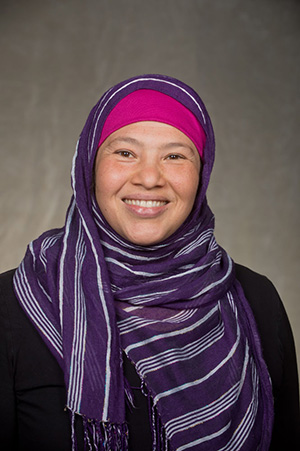
Eliza BaezaExplains MEDA Evaluator Elisa Baeza, “Our data capacity assessment was motivated by the need to ensure the sustainability of our partner agencies that do amazing work serving the Mission District community.”

The goal? To lift up partner agencies by building up their capacity to collect and utilize data to analyze, learn from and enhance their programs and services, with the hope that through such technical support, partners will adopt a common practice of strategically using data to make informed decisions about how their services are being implemented.

Continues Baeza, “It doesn’t mean doing more work to get there; it simply means doing the work differently so that organizations may flourish and participants benefit.”

Partner Case
Parents for Public Schools-San Francisco (PPS-SF) needed a streamlined process for collecting demographic information about their participants, which in turn limited their capacity to tailor services to their client base. MEDA’s evaluation team helped PPS-SF create an intake form that would capture essential demographic information on their clients so that they can better understand who is accessing their services, offer more targeted services and enhance their ability to offer funders the pertinent client data they require.

Masharika Maddison, Executive Director, explains her organization’s need: “At PPS-SF, we’re committed to supporting student success through our parent-facing programs and services. Informed parents are better equipped to support their student learners through their academic journey. Meaningful intake forms are a critical first step in ensuring we have the most valuable data possible to align our resources to our parent program participants.”

1. Monica E. LopezDr. Monica Lopez, Associate Director of Evaluation, further explains: “An agency’s ability to communicate the work that they do and the impact that this work is having on the populations they serve in numbers and figures – or data – is extremely important. Being able to utilize data to effectively communicate the value of a program to diverse stakeholders and funders can influence an agency’s ability to remain sustainable. Data utilized effectively can also help improve the quality of programs and services. It is a win-win for everybody. For agencies to be effective advocates for their programs and services, they need data . . . and collecting the right set of data is a task that requires both resources and know-how – this is what we refer to as Data Capacity and this is what we here at the Mission Promise Neighborhood are trying to build for all of our partners.”

Recognition in the field
The team of Lopez and Baeza are working on identifying avenues for sharing their data capacity work with other Promise Neighborhoods. The pair were recently brainstorming at the Promise Neighborhoods National Network Conference, held a couple of weeks ago in Arlington, VA.

There are now discussions about a Webinar, in collaboration with PolicyLink. The date is to be determined.

Another honor bestowed on Lopez and Baeza is their being asked to present this November 15-19 at the American Public Health Association (APHA) National Conference in New Orleans. Getting an abstract accepted is a difficult process, making this honor all the greater.

This year’s conference focuses on healthography, the study of how where you live affects your health. Lopez will be presenting on the impact of the Affordable Care Act on patient enrollment at the Mission Neighborhood Health Center, a project that she and MEDA’s Amelia M. Martinez Cantos are trying to get off the ground; this project endeavors to take into account contextual factors within the changing Mission community.

Baeza will be the lead presenter, with Lopez as backup, on the data capacity work MEDA has been conducting with partners as it contributes to building systems that can track health outcomes for MPN clients.

“It is an honor for Elisa and I to be able to share our work, which is always evolving and being refined. Our evaluation team is dedicated to putting forth the best data available to help MEDA and its partners best serve clients in the Mission,” concludes Lopez.

Presentation links:

Impact of the Affordable Care Act on a Community Clinic serving immigrant Latinos: The role of health policy, community needs, and gentrification on sustainability

From the ground up: Assessing and building the data capacity of community-based agencies in the Mission Promise Neighborhood collaborative

Read More

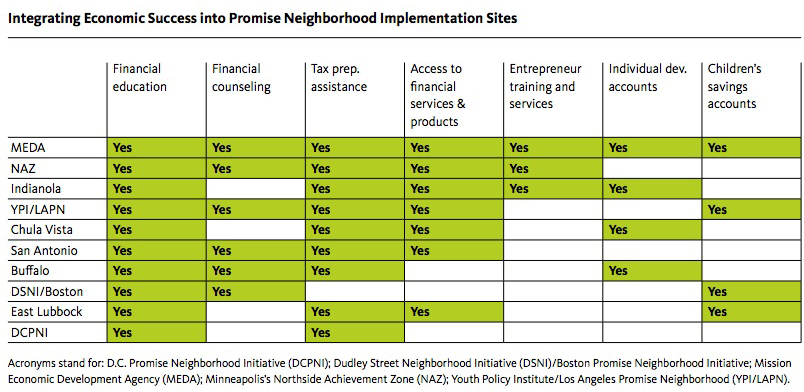
PolicyLink Blog #2 BlogWhen MEDA received a federal grant in December 2012 to start a Promise Neighborhood at a quartet of low-performing schools in San Francisco’s Mission District, the four-decades-old agency remained at the vanguard of nonprofit best practices by implementing a comprehensive service integration strategy, whereby the families of students are offered free asset-building services. The aim is that every family succeeds and every student achieves, as these two outcomes are intricately linked. Staff know that the stressors of a family in economic distress create obstacles to a student’s academic success.

MEDA is proud to announce that its Mission Promise Neighborhood efforts have been recognized as part of a just-released, 50-page guide from PolicyLink, the Oakland-based, national research and action institute advancing economic and social equity. Entitled Integrating Family Financial Security into Promise Neighborhoods: A Resource and Implementation Guide, this influential work “aims to describe the programs, policies and practices that set families on a path to financial security while achieving prescribed Promise Neighborhoods results.” This guide is part of the Growing Assets Program—generously funded by The Citi Foundation—with the goal of incorporating essential asset-building strategies into the network of Promise Neighborhoods across the nation.

The Citi Foundation offers the needed support so that myriad programs can allow community partners to test, deliver and scale innovative approaches to asset building. These programs are designed to provide consumers with the tools and support they need to achieve their fiscal goals, morphing financial ken into efficacious action. Financial coaching and counseling programs abet consumers to implement financial plans, make payments, increase their savings, reduce debt and build their credit.

The report was co-authored by Alexandra Bastien and Solana Rice. Bastien, the current program associate at PolicyLink, conducts research on policy solutions to address the racial wealth gap and maintains a compendium of resources on strategies to achieve financial security for all. Rice was an associate director for over five years at PolicyLink, where she directed research on asset building and other strategies focused on enhancing economic security in financially challenged communities, particularly communities of color.

Bastien explains the guide’s purpose as follows: “There is substantial research that shows that low-income families can save. Savings and assets are the tools that allow families to withstand financial crisis and invest in their future. In addition, children with a savings account in their own name are 2.5 times more likely to enroll in college than children with no account.”

Pages 30-34 of the guide showcase the case study of MEDA’s best practices relating to the nonprofit’s innovative service integration model that aims to create assets for its low-income, mostly Latino families, who are often immigrants. The guide advises that this insightful case study should serve as an example other Promise Neighborhoods should follow.

Chart

One powerful quote from the MEDA case study claims: “Bringing financial education ‘in-house’ to select schools and hubs is filling a significant gap in clients’ knowledge and services. This approach of ‘meeting people where they are’ is proving to be a valuable one and is facilitating MEDA’s entry into new areas of the community and the recruitment of families into the MPN pipeline.“

To start sharing this report’s important data, MEDA’s Director of Asset Building Programs, Christi Baker, has been tasked with leading a presentation on this PolicyLink guide at the Promise Neighborhoods National Network Conference, being held this week in Arlington, Virginia.

Also, PolicyLink will be conducting a Webinar July 10th at 11am PT, with information in the guidebook being delved into further. Check back for details.

Read More

Sergio Romo BlogMEDA staff was part of a mass gathering last night for a hallowed event at the Mission District’s Episcopal Church of St. John the Evangelist. The occasion? 33 youths, who some deemed did not have a prayer of getting into college, proved their naysayers wrong as triumphant participants in nonprofit Mission Graduates’ “College Connect” program. A joyous ceremony celebrated the transition of 25 high schoolers–donned in a rainbow of graduation gowns from various San Francisco educational institutions–into the start of their college careers. There were also eight others who had just graduated from prestigious schools of higher learning.

The advent of Mission Graduates was over four decades ago, when it began as more of an after-school program at the church. Mission Graduates today is an integral part of MEDA’s Mission Promise Neighborhood (MPN) initiative to take Mission kids on a successful cradle-to-college-to-career continuum. MPN family success coaches can enlist the services of Mission Graduates, one of 26 partners in the community, when a student is seen as at risk of not succeeding academically and lacking the initiative to go to college. Mission Graduates staff and volunteers mentor the youths, pointing them on the right path to achievement in higher education.

Two such volunteers have been MEDA Evaluator Elisa Baeza and Family Success Coach Lead Amelia Martinez. Baeza has volunteered as a writing coach, teaching students how to optimize their personal statements for college applications. She also acted as a mentor to steer a student onto a successful college path.

Martinez has mentored a trio of participants of the Mission Graduates program. Martinez explained how the “College Connect” program works: “You typically start mentoring youths when they are juniors. Almost all are the children of immigrant families. Mission Graduates attempts to match you with the student. For example, if the student aspires to go to Stanford, they’ll try to find a Stanford grad. If the student is interested in the sciences, they will attempt to find a mentor working in that field. It’s a powerful program that will help MPN reach its goal whereby every family succeeds and every student achieves.”

One challenging aspect of the Mission Graduates program is that these kids are the first in their family to attend college. While their parents want their kids to do well in school and go on to college–part of the reason they came to this country–these well-intentioned mothers and fathers generally do not have the understanding of the system to guide their offspring into academia. That is where community services, such as MPN and Mission Graduates, are vital to positive outcomes.

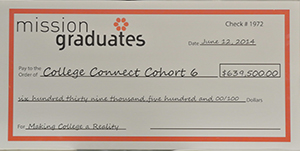
CheckMission Graduates takes into account more than just motivational aspects of academic success—there are always the monetary realities of higher education. These realties can be daunting for families that may be in financial dire straits. To meet this fiscal challenge, Mission Graduates extends the partner web by garnering funding for scholarships from other groups, to wit the $639K for this year’s 25 high school graduates (that averages over $25K per student).

Catherine Marroquin

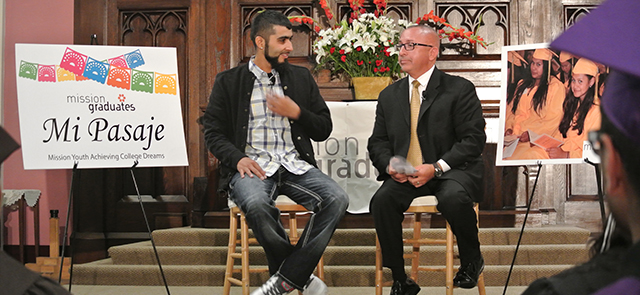
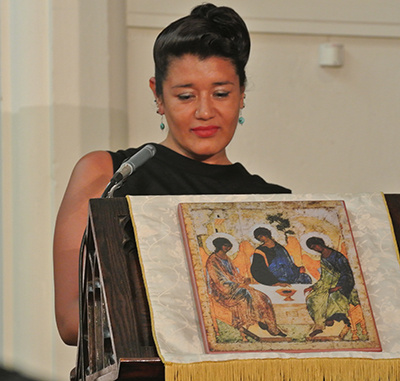
Last night’s ceremony, appropriately entitled “Mi Pasaje” (“My Journey”), featured numerous inspiring speeches. Program Director Catherine Marroquin, who goes by the endearing moniker “Mama Cat,” warmly welcomed attendees; she explained the importance to Latin culture of ceremony around transitions.

Eddie Kaufmann

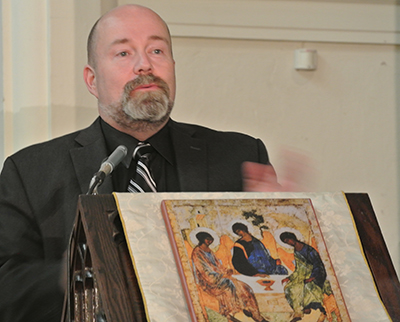
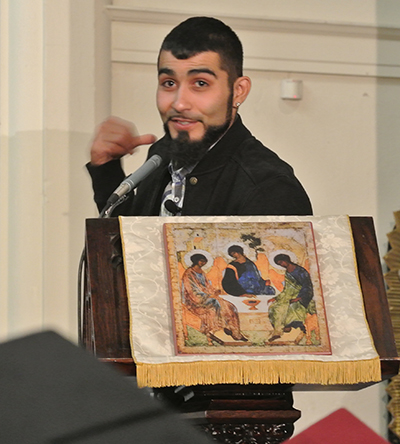
Executive Director Eddie Kaufman, pride showing on his face as he spoke of this year’s graduating group, followed Marroquin. After two graduates of the program, plus one parent, shared their stories, guest of honor Sergio Romo took to the stage to be interviewed by Damian Trujillo of NBC News. It was only fitting that an athlete deemed one of the best closers in baseball would close out this ceremony.

First-generation Mexican-American Romo, a strong supporter of the nation’s estimated two million undocumented students having the chance to pursue their college dreams through “The Dream Is Now” campaign, talked of his humble upbringing in the sleepy farming town of Brawley in Imperial County. He explained that not many get out of Brawley, so much so that when he embarked to college in Arizona to play baseball he was told by a chorus of his hometown’s pessimistic denizens that “he would be back.”

“Oh, I did come back,” stated a soft-spoken Romo as he showcased his famous ear-to-ear grin. “I came back as the only Mexican with two World Series rings.”

Romo extolled the praises of his beloved father, Frank, who toiled in the sweltering Southern California lettuce, sugar beet and alfalfa fields.

“My father always supported me. He taught me self respect . . . to be the man I knew I could be,” stated a thankful Romo.

Perhaps the best piece of advice Romo gave was when he entreated the youngsters to never give up, despite the obstacles they will invariably face. It was interesting to see that in person Romo is a reserved man of relatively slight build for a professional athlete; this counters the emotional and physical prowess he demonstrates on the mound as he faces the best hitters in the game. Romo explained that he harnesses his emotion to counterbalance the obstacle of his lack of stature.

The greatest obstacle to Romo came when he was in college in Alabama and faced racism. His doting father would call him after each game to see how his son had fared that day, but, sadly, the younger Romo habitually started the conversation with heartrending details of the discrimination he was facing in the Deep South.

Sergio Romo non-Slider“Stand up for who you are. It starts with self-respect. Never quit and your dreams can become a reality, too,” Romo advised the graduates.

Their journey complete, these 33 young adults are poised to take on the world. This would never have been possible without the guidance of Mission Graduates.

MPN is proud to be partnered with this renowned organization doing such empowering work for Latinos in the Mission community. In the words of MEDA’s Martinez: “Since ‘it takes a village,’ MPN is lucky to have such a great neighbor!”

Read More

MPN Survey BlogAs the lead agency of the Mission Promise Neighborhood (MPN), MEDA partners with 26 nonprofit organizations and government agencies to launch a cradle-to-college-to-career continuum of services that empowers every Mission District family to succeed economically and achieve academically. MPN recently conducted an extensive neighborhood survey, details of which follow.


Survey Strategist Interview:

Carolina Guzman
Director of Evaluation
Mission Economic Development Agency (MEDA)

Why did you undertake the Mission Promise Neighborhood survey?
The MPN survey was a mandate of the federal Department of Education as part of the Promise Neighborhood Initiative. The goal is to understand how the initiative is affecting the community, since it is not just about the schools. How are things being impacted? After all, this is the place people live, work and go to school.

This survey is required every other year, with data gathered from residents living within the MPN footprint. This is the way to capture changes in perception in the Mission. Is my neighborhood safer? Are the kids thriving?

What was the biggest issue you faced in conducting this intensive survey?
It was difficult to find where people actually live. Many Mission residents live in overcrowded conditions. Also, because this is still a working-class neighborhood, it was difficult to find people at home during the day, when our surveyors were canvasing the neighborhood. To tap into the people in the most dire straits is difficult when they are out all day working at two jobs.

Another problem was how many students attending our four MPN schools no longer live in the Mission. Their families have moved, mostly because of financial issues, as the neighborhood has become all the more expensive. Here are the stats: of the 1,636 students enrolled in MPN focus schools, only 39% lived within MPN’s geographic boundaries, with 61% residing outside the boundaries.

Finally, the survey was conducting over five weeks, so you need to come up with ways to keep your workers and volunteers engaged in the project.

Who exactly were these workers and volunteers?
It was a comprehensive team. We had 50 staff volunteers from MEDA, 15 community volunteers, 10 youth workers and six promotoras/es. Promotoras/es are an integral part of Latino culture overseas and here in the Mission. They started as healthcare outreach workers, but that later expanded to being community teachers about such topics as education and domestic violence. Think of it as the “it takes a village” approach.

The promotoras/es are a great resource because they know how to speak to families, how to safely walk the streets and how to engage without influencing. The latter is vital when asking questions—we need unbiased answers.

What MPN survey question revealed the most surprising answer?
It was shocking to discover how many families put just about their entire paycheck toward rent. That is how expensive the Mission District has become. There is little or nothing to put toward savings. This creates an impediment to sending your child to college.

MPN Survey Leo SosaWe were pleased to learn how committed parents were to their child’s academic success; however, many of the families have no idea how to help their child in this regard, from an economic side, but also from a logistical side. How do you apply for financial aid or a scholarship? Things like that.

Our data will be available in August, so my hardworking evaluation team looks forward to sharing it with everyone.

What improvements would you like to see for the next survey?
I would like to see more community involvement. While we were privileged to have 15 neighborhood volunteers, but it would be great to have more. I would like to take the survey to another level of community involvement in actual implementation. I know what we learned from 2014’s experience will help us garner even better data in 2016, so that our service-integration strategy can be honed.


Read More

Calle 24 Blog 2In a neighborhood where the high-end restaurant is becoming more common than the once-ubiquitous taqueria, MEDA backs the creation of the Calle 24 Latino Cultural District.

District 9 Supervisor David Campos, born in Guatemala and now representing the Mission District, was at the vanguard of pushing this resolution, which was passed unanimously by the San Francisco Board of Supervisors yesterday. The idea is to preserve the rapidly changing Mission District, much the way the city’s Japantown was created near Geary Boulevard in the 1960’s.

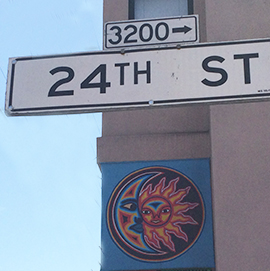
24th Street with Sun MuralSpanning fourteen city blocks, Calle 24 comprises the stretch of 24th Street bounded by Mission to the west, Potrero to the east, 22nd to the north and 25th to the south. A walk down this street today reveals a bustling scene, with mostly Latino shoppers filling the aisles of small businesses that cater to this community. Many of these consumers are the 5,000+ clients of MEDA, with 24th Street the main commercial hub for families of the quartet of Mission Promise Neighborhood schools.

“This is a chance to preserve the flavor of the Mission. Now, when an item comes before the Planning Commission, there will be an extra conditional-use process to specifically benefit businesses, cultural institutions and events that market to the Latino community,” explains MEDA’s Policy Manager Gabriel Medina.

Mystical CollectionsOne microbusiness in the corridor that will benefit will be Mystical Collections, at the northeast corner of 24th and South Van Ness and owned by Mexican immigrant Patricia Torres. One of the first entrepreneurs to start her business at El Mercadito, the microbusiness incubator at MEDA’s Plaza Adelante,  Patricia’s business idea was to sell holistic products–an idea that came about after her son’s adverse reaction to medication. Able to move her business to nearby 24th Street after only 18 months, Patricia then doubled her store size by using the business acumen garnered from MEDA’s free Business Development program. Patricia has since created a strong customer base and has hired employees. The creation of Calle 24 will ensure Patricia’s business remains strong and where she wants it to be, serving the Latino community she loves.

Concludes MEDA’s Medina, “The creation of the Calle 24 Latino Cultural District is a proactive approach to addressing the needs of Latinos in the Mission. It challenges the notion that the Mission only opposes projects and that groups in the Mission are unable to collaborate with consensus.”

A celebratory press conference to announce the district is planned for Friday, May 23rd, starting at 2pm. Mayor Lee and Supervisor Campos will be at the corner of Harrison and 24th streets to cut the liston rojo (red ribbon).

Read More

Google & Client Blog“These technologies can make life easier, can let us touch people we might not otherwise.” So said the late Apple visionary and driving force, Steve Jobs. Yet a walk down one of the main drags of San Francisco’s Mission District reveals two worlds attempting to coexist.

At 24th and Valencia, scores of young tech workers clutch strongly brewed coffees as they wait for the bus to take them to the Silicon Valley offices where the world’s next great thing is being developed. Few conversations are had, with most focused on answering their twentieth text on an already-overworked smartphone, even though it’s just 8am.

A short two blocks away on the corner of 22nd Street, a line just as long has formed at the neighborhood Social Security office. A disheveled woman in a wheelchair fronts the queue, already clutching the pen she’ll need to fill out the reams of paperwork that can possibly garner enough federal funds to keep her–one of the community’s many disenfranchised–afloat for another month. Tech gadgets are hard to spot. Perhaps the occasional smartphone can be seen, but it is most likely being used only to answers calls, with no opposable thumbs in rapid-fire motion here.

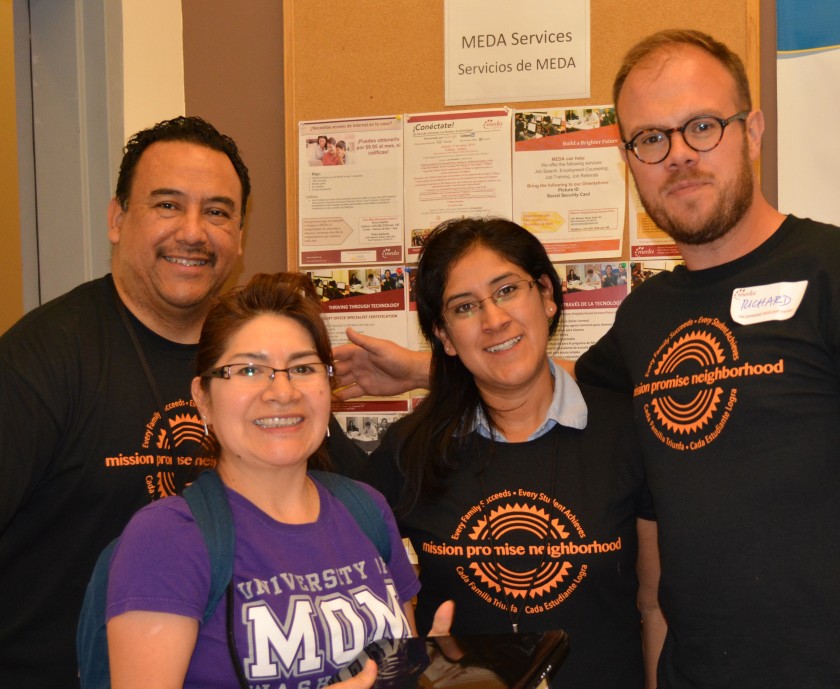
Ramos FamilyHow to bring these worlds together? Today, the Mission Economic Development Agency (MEDA) invited both groups to its Plaza Adelante for a “Get Connected!” event. The brainchild of the nonprofit’s Technology Manager Richard Abisla, the original meaning of this event referred to the agency’s goal of having every household in the Mission connected to low-cost internet and a computing device by 2018. A look around this neighborhood center today revealed a secondary meaning of “Get Connected!,” with tech volunteers generously donating their day off–if they are ever really off the clock–to spend time teaching varying levels of digital literacy to the Mission’s financially challenged, primarily Latino families.

“I am honored to be the impetus behind today’s event, which is part of MEDA’s vision for its federally funded Mission Promise Neighborhood, one of just 12 such programs in the nation.” explained Abisla. “Without access to low-cost broadband, the odds of a student’s academic and economic success are slim. Our family success coaches are based at Cesar Chavez and Bryant elementary schools, Everett Middle School and O’Connell High School, but my mission is to have the entire Mission connected. Technology is for everyone.”

Presented by Google and LinkedIn, with Cisco Meraki and Square also generously taking part, “Get Connected!” had a turnout that exceeded expectations, with over 175 attendees. The 20 volunteers came from throughout the tech world, and even hail from throughout the world. Originally from Germany, Martin Thormann exemplifies the volunteer spirit that helped make today a reality. Martin works as a Senior Software Solutions Advisor with Echo Technologies  Solutions in SoMa. His wife was raised in Colombia and the young couple lives in the Mission. “I’ve been in San Francisco for a decade. I’m always looking for volunteer opportunities in the neighborhood. Today presented the perfect opportunity to give back,” said Thormann.

Then there is Google employee Ben Hutchinson, originally from Australia, who spoke of how honored he was to give back to his new community of choice. As he sat down in MEDA’s Workforce Development Department to help a fellow Mission resident hone a rudimentary resume, Ben extolled his respect for San Francisco’s diversity, much evident in the halls of Plaza Adelante today.

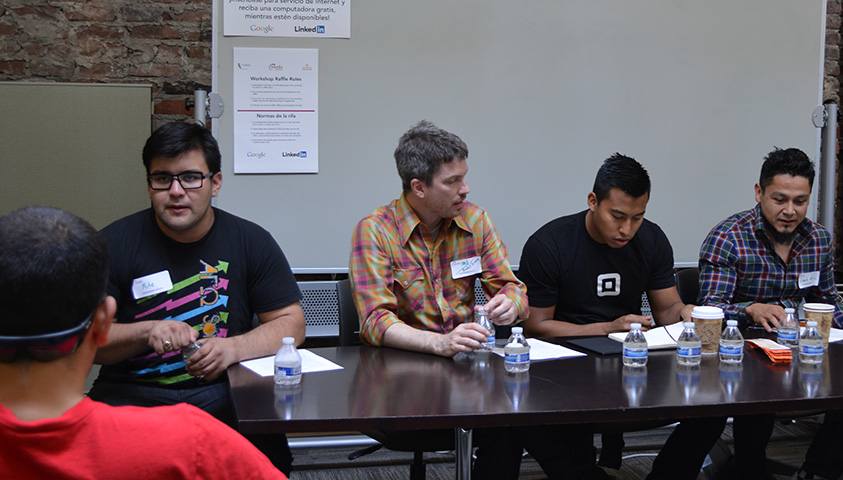
Latino Career PanelOne highlight of the day was the Latino Career Panel, which showcased six major players in the tech world: Hector Mujica, Social Responsibility Strategist at Google; Mike Ponce, Operations Coordinator at Google; Matt McGraw, founder of Rocket Science Consulting;  Luis Carillo, Risk Operations and New Markets at Square; Jackie Garrido, Onboarding Program Manager at Facebook; and Roberto Mejia, IT Support Engineer at Jones IT. The day’s moderator was Aileen Hernandez, TechSF Senior Workforce Development Program Officer for the City and County of San Francisco, with MEDA’s Amelia Martinez acting as translator. An interesting discussion spilled forth, with stories from these influential panel members definitely inspiring hope that the current dearth of Latinos in the tech industry could soon become a thing of the past.

One memorable quote of the day came from Facebook’s Garrido when she emphatically stated, “Don’t underestimate the power of Spanish in tech. The Latino market is growing rapidly.” This statement was backed up by Square’s Carillo, who informed the crowd that the tech company recently launched a complete point of sale and suite of business tools in Spanish for the growing number of Latino sellers across the United States.

The panel’s Roberto Mejia of Jones IT Consulting had an interesting story to tell. Born in El Salvador, he came to the United States as a youngster and, despite having an inherent interest in computers, he never saw a career in tech as an option for a Latino. “There were no role models for me, so I saw a tech career as unattainable. I actually graduated from the University of San Francisco in 2006 with a degree in marketing and communications. I transitioned to an IT career only because a good friend from USF gave me a shot. I am loving it and am proud to now serve as a role model for other Latinos.”

One young adult inspired by the Latino Career Panel was nineteen-year-old Emiliano, who summed it up: “I always felt I couldn’t be part of the tech world. I see all those buses in the neighborhood now. I see people out to change the world. This panel made me realize I can be part of that, too. I learned that MEDA offers free computer classes, so I plan on checking that out soon.”

Workshop participants were appreciative of raffles for supermarket gift cards. Even more appreciation was had for the raffling of 21 computers, which were all donated to MEDA for this event. Also, ReliaTech, which works with  nonprofits, was on hand to sell refurbished computers for just $159; they even fixed computers at no charge.

Computer WinnerResource tables were strewn about Plaza Adelante’s paseo, with MEDA partners availing Mission residents of the free services available. MEDA had its own table, with staff volunteers explaining the nonprofit’s effective service integration model that runs the gamut from financial capability and job training to business development and free tax preparation.

There are two more “Get Connected!” events this year, with the next one right before the school year starts in August. MEDA is proud to offer solutions, bringing together two worlds that do not intersect as often as they should, with connections being made in more ways than one.

Read More

MPN Survey REPRINTED. 

Watch the news video.

Interested in volunteering for the MPN Survey? Email us.

Correspondent: Leanne Melendez, KGO Channel 7 News San Francisco

SAN FRANCISCO (KGO) — People, who live in San Francisco’s Mission District, may get an unexpected knock on the door from people conducting a survey.

The purpose is to assess the needs of low-income families with children in local public schools.

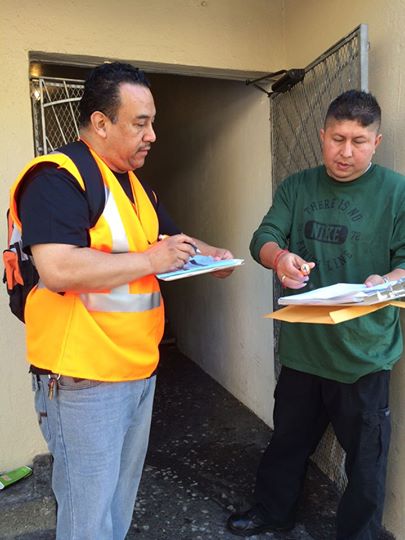
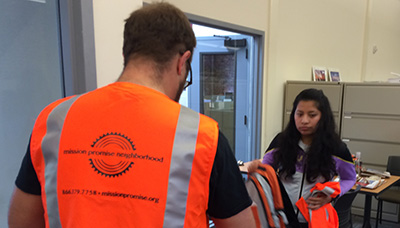
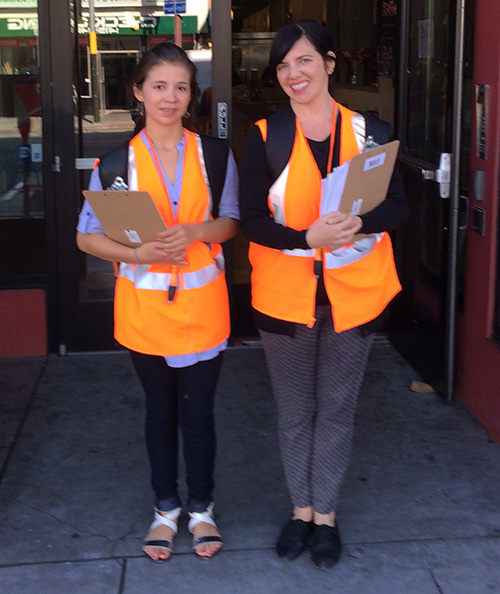
Monday at 9 a.m., several teams with orange vests and clipboards in hand were out conducting the survey.

“So, we’ve divided the neighborhood into zones so that we can go survey these areas, where there is a majority of families that go to our four Promise schools,” said MEDA Director of Evaluation Carolina Guzman.

Those so-called Promise Schools are participating in a federal program where the goal is to guarantee that children in the Mission have the necessary tools to succeed in school.

For the next five weeks families will answer a long questionnaire with topics ranging from health care, to housing and the quality of their schools. The families are predominantly Hispanic.

“This is about how to figure out, how to improve schools and our services so that children, you know, go to school ready and graduate and go to college,” said Guzman.

The survey is being done by MEDA, the Mission Economic Development Agency and funded by the United States Department of Education. The findings will help MEDA and its partners decide where help is needed and how to fund programs to support these children.

“The interview went really well, I think. She was very happy to share information,” said MEDA staff member Teresa Morales.

But, today not every family was willing to be so forthcoming. Some were not at home or didn’t feel comfortable participating.

“And, we had some other people say they would make appointments in the future for us to come back but they weren’t available at the moment,” said MEDA staff member Richard Abisla.

“They have a packet of information that they can leave, right away, so if you have any questions my phone number is in there so they can call me. But, yeah, we’re asking people to, ‘please hear us out a little bit and learn about the survey,'” said Guzman.

MEDA will conduct three surveys over the next five years to see how much progress is being made.

(Copyright ©2014 KGO-TV. All Rights Reserved.)

Read More

MPN Surveyors Blog Hero Shot

The Mission District will be awash in a sea of orange starting today. No, it’s not that autumn came early this year. It’s actually the sea of orange vests and backpacks worn by the zealous teams conducting the Mission Promise Neighborhood (MPN) survey of 1,000 households in this primarily Latino community.

MPN Surveyors #3

Bilingual duos will be visiting homes in a rectangular area bordered by Duboce Avenue to the north, Cesar Chavez Street to the south, Portrero Avenue to the east and Dolores Street to the west. This extensive survey was coordinated with Harder + Company Community Research, tapping into Vice President Kym Dorman’s advanced skills in qualitative and quantitative research methods.

MPN, a program overseen by the Mission Economic Development Agency (MEDA), is one of just a dozen such federal programs in the entire nation. The goal is to take children on a cradle-to-college-to-career continuum, based on results-driven data of family success. Ascertaining the issues affecting these families, via a broad survey, will help MPN better target services and address community needs.

States MEDA Executive Director Luis Granados, “While the Mission Promise Neighborhood Survey is federally mandated, it is actually something I have wanted to put in motion for years. To send out a dedicated team of staff and volunteers to ask 1,000 Mission District families about their concerns and issues translates to MEDA better understanding the service integration necessary to foster asset building in the community. This is a win for MEDA and the Mission’s Latino residents—the constituents we have been serving the past four decades.”

The first group left MEDA’s Mission neighborhood center, Plaza Adelante, this morning, fully trained and armed with surveys. Questions will be asked about children’s issues, nutrition, housing and fiscal matters, with all queries answered anonymously. While the federal government mandates that a consent form be signed, it is not tied to the survey, as the latter has no name attached.

MPN Survey #4Volunteers were found through community outreach efforts by MEDA staff, especially Volunteer Coordinator Leah Cerri (photo right). One such volunteer, a young Latina named Jennifer (photo left), was donning her vest and backpack this morning, ready to pound the pavement. When asked why she had volunteered, Jennifer proclaimed, “I am going to be volunteering five days a week for a month as a way to give back to my community.”

MEDA’s Director of Evaluation Carolina Guzman (top photo, center), who is overseeing the survey, praised volunteers such as Jennifer by stating, “It is an honor for me to lead this vital survey that will offer needed insight to the Mission neighborhood’s issues. The enthusiasm I have seen from MPN staff and community volunteers is uplifting. This cadre of volunteers is trained and ready to hit the ground running to gather the information needed. Our volunteer program has recruited over 30 volunteers, 10 promotoras (Hispanic community outreach members) and 15 youths to participate in these data-collection efforts.”

The MPN survey will take place through May 30th, so you may hear a friendly knock on your door this spring. Thanks in advance to the Mission District for welcoming these MPN surveyors so that they can gain a more comprehensive understanding of what is going on in the neighborhood. This is possible only as a joint effort between MPN and Mission District residents.


Read More

Richard Abisla Mission Tech

MEDA’s Richard Abisla Named “2014 Broadband Champion”

MEDA is proud to announce that the renowned California Emerging Technology Fund (CETF) has named our Technology Manager, Richard Abisla, a “2014 Broadband Champion.” Richard is being recognized for his hard work to close the growing digital divide. The champions were selected by CETF in consultation with dozens of broadband leaders, community advocates and policymakers.

Richard’s first foray into closing the digital divide was when he worked with an indigenous rights group in the Central American nation of Honduras to set up a computer lab and create project-based computer training curricula. This experience laid the groundwork for his current role as project manager of MEDA’s Latino Tech-Net. Richard has the laudable goal of getting every family in the neighborhood digital access.

“MEDA is committed to making sure low-income families have affordable broadband access at home,” zealously exclaims Abisla. “We’ve helped over 150 neighborhood families get connected and we’re working hard to make sure that EVERY student and family in the Mission has access.”

“Really this award is for the whole great technology team we have in place here at MEDA, including Erica Castillo, our Broadband Coach, and Leo Sosa, our Technology Training Coordinator,” Richard explains.

“Erica works tirelessly every day to help families evaluate if they can afford broadband—the answer is usually ‘yes’, with our low-cost offers—and sign up for service, and Leo does a fantastic job making sure that our classes create savvy new users of technology.”

Richard was the impetus behind MEDA’s successful “Get Connected!” classes, with the next such FREE event scheduled for Saturday, May 17th, at Plaza Adelante. This popular event brings in tech-industry and other interested volunteers to teach basic digital skills to low- and middle-income Mission District residents.

“Our ‘Get Connected!’ event in February trained over 100 adults and kids. We are hoping to connect even more Mission families at our May event. These classes are a big part of our vision of having the entire neighborhood enter the digital world,” states Richard.

What are the results so far? Here are some numbers for the last six months of 2013:
Trained: 1,216
Open Lab Access: 753
Certifications: 82
New Broadband Subscriptions: 140
Jobs: 50

Keep up the great work, Richard! MEDA is about solutions.

Read More

MONTHLY ARCHIVE

Contact

Email
info@missionpromise.org
 
Phone
(415) 569-2699
 
Address
2301 Mission Street, Suite 304
San Francisco, CA 94110

Newsletter
Get the latest news and information on
what’s happening in your neighborhood.

SIGN UP