Blogby Early Learning Manager Liz Cortez

The Mission Promise Neighborhood, a cradle-to-college, collective-impact initiative, is rolling out an Early Literacy Campaign for families with children ages birth to fifth grade. With only 32 percent of third-grade students and 43 percent of fifth-grade students reaching proficiency in English Language Arts at Mission District schools, there is much more that needs to be done in our community to prepare students for the transition to middle school, high school and beyond. We know that reading and writing does not begin in kindergarten or first grade; developing language and literacy skills begins at birth through everyday interactions, such as sharing books, telling stories, singing songs and talking to one another. And that is why we are starting early — at birth.

The Early Literacy Campaign builds on the existing early literacy work at schools (preschools and elementary schools) and community-based organizations, such as Tandem, Partners in Early Learning. We are also reaching families with young children that are not yet part of an early care and education setting or an elementary school.

How Mission Promise Neighborhood is improving early literacy

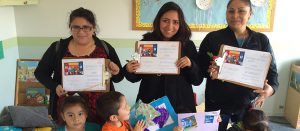
  1. Parents building the capacity of parents. Early literacy workshops for parents are led by parents that have received the Literacy Champions Certification through Tandem. A group of parents and promotoras have been certified through this intensive, three-day capacity-building opportunity. In addition to providing a workshop on early literacy, participants of the workshops will receive books and a literacy-rich environments checklist to support the promotion of literacy at home. Over the next year, eight parents and promotoras will become Certified Literacy Champions through Tandem. They will engage 300 parents in early literacy workshops, plus one-to-one conversations where families will receive books and a literacy rich-environment checklist to support the promotion of literacy at home. Parents will sign a pledge, making a commitment to talk, read and sing with their child at least 15 minutes a day, every day. Parents will also pledge to advocate for more and higher-quality early care and education programs.
  2. Promoting the Talk, Read, Sing campaign. The Mission Promise Neighborhood will be partnering with the San Francisco Public Library to leverage the Talk, Read, Sing Campaign as a means to close the “word gap” for Mission children. Harnessing the power of the campaign, we will promote the use of existing routines to encourage parents to talk, read and sing to their children — the foundation for literacy. At the beginning of the 2017-2018 program year, 400 families at the Mission Promise Neighborhood’s four preschool programs will receive Talk, Read, Sing campaign materials to promote literacy in their home and community.
  3. Scaling parent-education programs. In April, and in partnership with First 5 San Francisco, Mission Promise Neighborhood early learning partners will participate in the Abriendo Puertas/Opening Doors training. The added staff training will double the amount of families accessing the program by 2018. Abriendo Puertas/Opening Doors is the only evidence-based parent education program for Latino parents with children birth to age 5. According to the UC Berkeley Institute of Human Development, this program “empowers them to transform cultural strengths into the tangible tools they need to build solid foundations.” Parents showcase significant increases in their knowledge of language and literacy development, social-emotional development, health development and school preparation.

More families of the Mission Promise Neighborhood have increased the amount of time they are reading to their children and/or encouraging reading outside of school, according to the MPN Neighborhood Survey. In 2016, 77 percent of parents reported reading to their children three or more times a week and 91 percent reported encouraging older children to read outside of school.

Mission Promise Neighborhood is building on this positive trend to ensure that children succeed in school, complete college and have many career options.

____________________________________________________________

About Mission Promise Neighborhood

The Mission Promise Neighborhood is a citywide community partnership that was created to support kids and families living, working and attending school in the Mission District. It brings together schools, colleges, community organizations and community leaders to help kids graduate and families achieve financial stability.


Read More

­­

Blog

Christopher Gil
Senior Content Marketing Manager
Mission Economic Development Agency (MEDA)
(415) 282-3334 ext. 152
cgil@medasf.org

FOR IMMEDIATE RELEASE
March 22, 2017

Timely Mission Promise Neighborhood Survey Released
Showcases the continued need to strengthen the Mission’s Latino community

San Francisco, Calif. — The Mission Promise Neighborhood (MPN) has released a report, “The Story of the Mission Promise Neighborhood Community: Results and Trends from the 2014 & 2016 MPN Neighborhood Survey,” offering an in-depth analysis of ongoing neighborhood need. Families living in the Mission or with a child going to school in the Mission were included in the analyses for this report, representing nearly 600 families and 1,300 children under the age of 24.

The survey evidenced some major achievements of the MPN education initiative. For example, there are now 13 percent more families reading to infants or toddlers at least three times a week, and over 91 percent of students from kindergarten to eighth grade reading to themselves for that amount of time. Graduations have increased 10 percent at MPN’s John O’Connell High School — closing the gap with the San Francisco Unified District’s citywide rate — with a college-going culture at home becoming the norm.

“MPN’s work has delivered true impact. That must continue, as the need to strengthen our families is more important than ever with the nation’s political climate shift. I challenge the community at large to come into the fold and become part of MPN’s work moving forward,” states MPN Director Raquel Donoso.

This critical report’s salient findings also put forth data verifying many of the ongoing issues in San Francisco’s Mission District. For example, it is a common topic of conversation that there is a widening income gap in the neighborhood, showcased by the fact that San Francisco’s median household income of $78,378 is more than twice that of the $35,000 or less earned by 77 percent of MPN families. While the City likes to tout its historically low unemployment rate of 3.4 percent, the survey indicated that 14 percent of respondents are unemployed; therefore, based upon their income and level of educational attainment, it can be inferred that they are not benefitting as much from San Francisco’s tech boom. The survey even found that 31 percent of MPN families do not have a bank account, compared to 6.2 percent statewide.

With regard to the Mission’s ongoing housing crisis, it was determined that 61 percent of MPN families are cost burdened by the monthly price of shelter (HUD defines a “cost burden” as housing costs that exceed 30 percent of monthly income.) No wonder that 40 percent of survey respondents – of which 92 percent are renters — claimed they often worried about being forced to move due to increased rent or cost of living.

San Francisco’s Mission District has been facing — and continues to face — one of the most severe housing crises of any neighborhood in the nation, with about 8,000 people displaced from this community in the last decade. That’s over 25 percent. Displacement has recently become an even greater threat to the community, pushing vulnerable families out of our Sanctuary City, with its safeguards and legal representation from immigration officials, universal healthcare with Healthy SF, tenants’ rights and rent control, and culturally relevant access to services to help working families succeed.

Combatting such issues is why the MPN education initiative started back in 2013, with over 20 community-based organizations ensuring that families succeed so students achieve. The need to continue the impactful work of MPN is quite apparent while poring over the pages of this comprehensive report.

Press and those writing papers are welcome to use data from the report (citation: Mission Promise Neighborhood. (2017). The Story of the Mission Promise Neighborhood Community: Results and Trends from the 2014 & 2016 MPN Neighborhood Survey.)

###

About Mission Promise Neighborhood (MPN)
The Mission Promise Neighborhood is a citywide community partnership that was created to support kids and families living, working and attending school in the Mission District. It brings together schools, colleges, community organizations and community leaders to help kids graduate and families achieve financial stability.
missionpromise.org


Read More

PrintAt crowd-filled Cease & Desist last night, the community came together to Start & Donate at the first of a trio of planned 2017 fundraisers for the Mission Promise Neighborhood Scholarship Fund. This initial event was called “Tips for Tuition.”

The result? A terrific start, with $3,000 raised. (Donate on Razoo.)

The need
The Mission Promise Neighborhood Scholarship Fund started a year ago, helping send four deserving John O’Connell High School seniors to college. All matriculated in fall 2016, their college dreams and career aspirations now within reach.

This scholarship fund is now entering its second year, as we look to send more Mission youth on to postsecondary education.
There is a definite need for such a fund. The education initiative has worked hard to create a college-going culture at home, plus provide mentoring via partners such as Mission Graduates; however, 77 percent of Mission Promise Neighborhood families earn less than $35,000 a year household income (survey, page 11). That translates to paying for daily necessities being a struggle in an expensive city like San Francisco, leaving little to nothing to set aside in a college fund.

The fundraiser
With the throng filling the back-bar area, tip jars quickly showcased 10’s and 20’s as guest bartenders, donning Mission Promise Neighborhood T-shirts, poured for attendees. A special shout out to those guest bartenders, including: Jill Marinelli of Mission Graduates; Amy Abero from John O’Connell High School; Lucia Obregon and Ernesto Martinez of MEDA; Juaquín Sims, a MEDA Junior Board Member; and DoubleDutch’s Claire Sands, who is also a MEDA Junior Board Member.

Plenty of money was raised via raffles, with generous donations from Tartine BakeryMateo’s TaqueriaGiordano Bros.Mitchell’s Ice Cream and Alamo Drafthouse Cinema. A bevy of volunteers circled the room to meet the demand of those looking to engage in a game of chance, all for a great cause. Our lucky winners — Darius, Ryan, David, April, Cat and Abraham — are going to be eating well real soon.

Stay tuned for news of upcoming fundraisers for the Mission Promise Neighborhood Scholarship Fund, and thanks to all in the community for the ongoing support of this worthy cause.

____________________________________________________________

Can you make college dreams come true for another deserving Mission Promise Neighborhood student?

Please donate today on Razoo.

____________________________________________________________

About Mission Promise Neighborhood

The Mission Promise Neighborhood is a citywide community partnership that was created to support kids and families living, working and attending school in the Mission District. It brings together schools, colleges, community organizations and community leaders to help kids graduate and families achieve financial stability.

Read More

BlogThe Mission Promise Neighborhood Scholarship Fund started last spring, helping send four deserving John O’Connell High School seniors to college. This scholarship fund is now entering its second year, as we look to send more Mission youth on to postsecondary education.

Update #1: Ivonne Villanueva (photo), San Francisco State. (Original story.)

What have you been learning at school? What is your major?
I’ve been learning many new things at school about health equity, plus social and educational justice. My major is Business Administration.

What has been your biggest challenge at college?
My biggest challenge at college is to keep paying for my tuition and for several books that are required for my classes.

How does it feel to have the Mission community’s support for your attending college?
It feels really great having the Mission community support me because of the scholarships I’ve been offered — scholarships that have helped me pay for my tuition and books.

Are you still on the same career track or have you changed your career path?
I am still on the same career track of owning my own beauty salon in the Mission District. That means getting my Business Administration degree and my Cosmetology certificate.

Where do you see yourself in four years, upon graduation from college?
In four years, I see myself in working at a beauty salon, but also in the process of opening my own beauty salon in the Mission District.

Update #2: Karen Guzman, Holy Names University. (Original story.)

What have you been learning at school? What is your major?
At Holy Names University, I learn how communication is a fundamental part of life.

What has been your biggest challenge at college?
My biggest challenge can be organizing my schedule and knowing that I have a four-hour commute to come to school every day next year.

How does it feel to have the Mission community’s support for your attending college?
I feel like I have this amazing support that is encouraging me to get a college degree.

Are you still on the same career track or have you changed your career path?
I have now decided that instead of going into public relations I would like to be an events manager for a hotel.

Where do you see yourself in four years, upon graduation from college?
Upon graduation, I have debated joining the Peace Corps or applying to hotels.

Update #3: Elwood Mac Murray, UC Merced. (Original story.)

What have you been learning at school? What is your major?
At my time here at UC Merced, every day has been a learning experience. Being my first year here at UCM, I haven’t been able to get too deep into my major, but for the majority I have just been learning how to be successful in my classes.

What has been your biggest challenge at college?
One of the biggest challenges I have faced since coming to college is self discipline. In college, you decide what to do with your time, which is hard because that wasn’t something I was used to in high school. It’s tough to just start studying for a class without the motivation or discipline. So, I would have to say time management would be my biggest struggle — just to know when to say I should start working on school assignments.

How does it feel to have the Mission community’s support for your attending college?
If it wasn’t for the Mission community’s support, I wouldn’t have been able to buy textbooks, a laptop and basic supplies. Without having a laptop or the money for textbooks, it wouldn’t even be possible for me to participate in any of my classes.

Are you still on the same career track or have you changed your career path?
As of now, I am still on the same career track from when I started. There have been some reconsiderations because it has been difficult, but nothing in life is easy if it’s worth something.

Where do you see yourself in four years, upon graduation from college?
In four years, I see myself walking across a stage ready to receive my diploma. Then I see myself applying everything I learned to real world problems and doing what I’ve wanted to do my whole life.

Update #4: Anahi Velazquez, San Francisco State. (Original story.)

What have you been learning at school? What is your major?
As an now, I am working on my general ed classes, but I am also taking the classes required to be admitted into the nursing program.

What has been your biggest challenge at college?
The only hard thing for me is getting used to the campus, since my John O’Connell High School was smaller.

How does it feel to have the Mission community’s support for your attending college?
It’s been good because it has helped me pay for my books, and part of the tuition that wasn’t cover by Cal grant.

Are you still on the same career track or have you changed your career path?
I am still on the same career path, working hard to get in the nursing program provided at State.

Where do you see yourself in four years, upon graduation from college?
I really want to see myself in nursing school.

____________________________________________________________

Can you make college dreams come true for another deserving Mission Promise Neighborhood student?

Please donate today on Razoo.

____________________________________________________________

About Mission Promise Neighborhood

The Mission Promise Neighborhood is a citywide community partnership that was created to support kids and families living, working and attending school in the Mission District. It brings together schools, colleges, community organizations and community leaders to help kids graduate and families achieve financial stability.

Read More

Blogby MEDA Director of Community Real Estate Karoleen Feng
Contributed to by MEDA Senior Project Manager Elaine Yee, 
Mission Promise Neighborhood Program Manager Liz Cortez and MEDA Financial Capability Coach Teresa Garcia

Most parents know that finding quality care and education for your child is not easy. For immigrant, working families of the Mission Promise Neighborhood, it’s even more challenging, as showcased by the erroneous ICE raid at partner agency Good Samaritan Family Resource Center on Jan. 26. Turns out ICE was actually looking for somebody next door, but they nevertheless created an atmosphere of fear that morning for parents simply dropping off their children.

Finding quality care is particularly tough for those with infants and toddlers, where the demand for affordable quality care greatly outstrips the demand. Securing that care near home would be a dream come true.

For MEDA, early care and education is critical not just for our parents who daily come in through our doors — and Mission Promise Neighborhood (MPN) partners’ doors. Early care and education is also an important means of livelihood for a significant portion of the women business owners we serve.  For these home-based licensed child care providers, the housing eviction crisis has meant the loss of a home and a business in one fell swoop. We share the City of San Francisco’s vision for early care because it makes perfect academic and economic sense for our families.

Part of the reason for MEDA’s establishment of a Community Real Estate team was to rebuild the pipeline for affordable housing in the Mission and to deepen the community assets in that neighborhood. Being the lead agency of the Mission Promise Neighborhood helped MEDA to realize the critical importance of early child development and for each of our 100 percent affordable, family-housing properties that we have been awarded by the City, I have purposely placed such services as part of the programming.

I have also directly advocated that as part of our lead role for the Mission Action Plan 2020, planning code and city incentives be established so that market-rate developers also meet the need for on-site early care and education in the neighborhood.

According to the San Francisco Early Care and Education Needs Assessment for 2012-2013, there are 4,100 children ages zero to five in the Mission. Approximately 2,300 are infants and toddlers (ages zero to two) and 1,800 are of preschool age (ages three to five). There is a huge disparity in the capacity to serve those infants and toddlers: There are 250 licensed family child care and center slots available, leaving 2,050 infants and toddlers without access to a formal licensed program.

The preschool population, on the other hand, has more access to slots. Of the 1,800 preschool-age children, the Mission has the capacity to serve 1,300. November 2016  data from the San Francisco Children’s Council shows that 351 children ages zero to five were waiting for an opportunity to access an early care and education program. The number of children on the list does not include all families that are eligible, just the number of families that are aware of the San Francisco Child Care Connection (SF3C) and continue to stay active on that list. In fact, in 2012, there were 224 available subsides for infants and toddlers in the Mission, but the number of eligible families was just 853 (earnings below 70 percent of the State Median Income). The difference in unmet need for eligible children was 629 (74 percent).

Strategies at 2060 Folsom and 1990 Folsom
The first 100 percent affordable-housing development that was awarded to MEDA by the Mayor’s Office of Housing and Community Development (MOHCD) was 2060 Folsom, which will offer 127 units for families, including 20 percent set aside for transitional-aged youth.

As part of our proposal with our co-developer Chinatown CDC, I intentionally incorporated MPN’s vision of taking Mission children and youth on a cradle-to-college-to-career continuum. The plan was to couple services from Mission Neighborhood Center’s zero to three programs with Good Samaritan Family Resource Center’s pre-K work — a seamless bridge for the creation of a zero five child development center. The goal is eight infant, 12 toddler and 24 pre-school slots. To best meet these two agencies’ requirements to maximize services, MEDA staff has been collaborating carefully with these partners so that their needs will be met before ever coming into the building.

Knowing that we need more slots than the facility-based care could provide, and in keeping with MEDA’s work supporting child care businesses, we have designed a pair of two-bedroom residential units for a combination home-work space which will open out to a private courtyard for these estimated six to 12 kids.

Jamestown Community Center, a longtime provider of after-school programs, will also be moving its headquarters to the ground floor of the housing. PODER, which will also relocate its offices to the site, offers a youth component. This organization fought long and hard for the brand-new park that will anchor the 260 Folsom development.

Mirroring the strategy at 2060 Folsom, MEDA later submitted its RFP for nearby 143-unit 1990 Folsom, with the idea of incorporating early care and education services also part of the proposal. MOHCD awarded MEDA this project in September 2016.

The property at 1990 Folsom addresses the neighborhood’s substantive mismatch between supply and demand by dedicating approximately 3,000 square feet of space at the ground floor for a child-development center to be jointly managed by Mission Neighborhood Centers and Good Samaritan Family Resource Center. Additionally, there will once again be two units set aside for tenants running a childcare business, for a combined total of six to 12 children.

Looking forward
As 2017 begins, my Community Real Estate team will continue to strategize with MEDA’s Business Development team, MPN staff and partners, as a means to provide updates from various areas of expertise and then shape the future development of early care and education facilities. We are hoping to place home-based providers in some of our smaller apartment buildings acquired through the Small Sites Program, so that they can be embedded in the community.

Also, MEDA aims to align with the vision of San Francisco’s Office of Early Care and Education (OECE), created in 2012 and headed by Director September Jarrett. Community Real Estate and MPN have been having discussions with OECE to make sure that all developments are in synch with the agency’s goal, which is as follows:

OCEC is charged with aligning and coordinating federal, state and local funding streams to improve access to high quality early care and education for children zero to five, to address the needs of the early care and education workforce, and to build early care and education system capacity.

Topics of discussion include learning more about lease-up process for child care providers and more. It’s all about ironing out the process.

I know this is essential as we move forward to ensure that all Mission children have access to early learning/child care programs.

____________________________________________________________

About Mission Promise Neighborhood

The Mission Promise Neighborhood is a citywide community partnership that was created to support kids and families living, working and attending school in the Mission District. It brings together schools, colleges, community organizations and community leaders to help kids graduate and families achieve financial stability.

Read More

Julio Alvarado chose San Francisco’s Mission as his adopted home when he emigrated from Guatemala back in 2000. He felt immediately welcomed in his new community, so much so that when he married and had two kids, the family planted roots in the neighborhood.

That comforting sense of place became tenuous when Alvarado and his spouse, Jennifer, got an official-looking letter from their landlord.

“I wasn’t fully clear on what the letter meant, so I came to talk to Mission Promise Neighborhood Family Success Coach Celina Ramos-Castro. I knew it wasn’t good,” explains Alvarado (photo, right).

Turns out Alvarado’s 12-unit building on Cesar Chavez Street was going to be gutted, with his apartment being taken off the market. Translation: The family had eight months to leave their two-bedroom apartment and try to find another affordable housing rental in San Francisco. A daunting task.

Alvarado and his wife were extremely worried. This led to depression once they crunched the numbers, comparing what they could afford in San Francisco versus a move to the East Bay, the latter having the additional cost of transportation back and forth to their jobs in the city and, worse yet, meaning little time to spend with their kids. With all seeming lost, the Alvarados considered moving out of state.

Daughters 10-year-old Kimberly and 12-year-old Shirley were equally stressed, their grades dropping because of an uncertain future. The children were constantly questioning their parents about where they were all going to reside; they even said they would be willing to live in a one-room flat if it meant they could stay in their current schools and not have to leave their lifelong friends and neighborhood.

Ramos-Castro (photo, left) connected Alvarado to neighborhood partner Causa Justa :: Just Cause, who sent the family to a lawyer, availed the tenants of their rights and organized the residents.

Alvarado then came to MEDA, the lead agency of the Mission Promise Neighborhood. Housing Opportunities Coach Diana Mayorga worked with the family to explore below-market-rate (BMR) housing lotteries via the Mayor’s Office of Housing and Community Development (MOHCD).

The first thing to do was to put in for a Certificate of Preference based on the Alvarado family’s impending Ellis Act eviction. This paperwork greatly increases the odds of winning the housing lottery.

Mayorga also made sure the family was rental ready, meaning they had a good credit score (must be better than 650), didn’t have any collections (must be under $500) and met BMR income guidelines for the developments to which they were applying (vary by property). When clients don’t meet these requirements, a MEDA coach works with them to develop a plan to become rental ready. The good news was that the Alvarados were in decent financial shape.

Then it was time to apply for lotteries. Mayorga helped the Alvarados fill out the paperwork and send in submissions to eight BMR apartment rental developments in San Francisco. Due to the Certificate of Preference, they won the lottery at four properties, choosing 200 Buchanan as their new home.

The Alvarados will be paying just $1,264 for a two-bedroom apartment — this in a city with a staggering $4,510 median price for that size unit, according to the latest data from real estate site Zumper.

“My family chose 200 Buchanan because it was brand new and in a safe, clean neighborhood. When we took a tour, my daughters were so happy. They couldn’t believe we were going to live there. They also knew we had found stable housing, they could stay at their schools and that we were still very close to the Mission,” states Alvarado.

The family’s relatively short move will take place this weekend.

Concludes Alvarado, “The stress is gone. I felt so supported by the community — and we never felt alone. My family is truly thankful to everyone who helped us get into our new home.”

____________________________________________________________

About Mission Promise Neighborhood

The Mission Promise Neighborhood is a citywide community partnership that was created to support kids and families living, working and attending school in the Mission District. It brings together schools, colleges, community organizations and community leaders to help kids graduate and families achieve financial stability.

Read More

Luz Bourne-RuizLuz Bourne-Ruiz is an energetic, single mother of 7-year-old Nathan, who attends Alvarado Elementary School in San Francisco. The immigrant from Mexico operates her own business, the New Alternatives Cafe, a cozy, neighborhood eatery serving breakfast and lunch on Guerrero near 28th. Featuring a convivial environment, there’s even a piano, guitar and congas for musically inclined customers to break out in spontaneous song after enjoying open-faced bagels and classic egg dishes.

Bourne-Ruiz originally came to MEDA, the lead agency of the Mission Promise Neighborhood, seeking homeownership opportunities. She took the First-Time Homebuyers workshop — held in English and Spanish on the second Saturday of each month — to create stable, long-term housing for her small family. It was discovered that Bourne-Ruiz’s self-employment income, after expenses and deductions on her tax returns, was too low to obtain a sustainable below-market-rate (BMR) mortgage loan.

Then Bourne-Ruiz’ worst fears were realized when her landlord stopped by last March with an ominous-looking letter: a 60-day eviction notice. When Bourne-Ruiz asked questions, the landlord stated coldly, “Everything you need to know is in the letter,” as he abruptly departed.

This impending owner move-in meant Bourne-Ruiz and her child would soon be forced out of her beloved home of over a decade, with her foisted into one of the most pricey apartment-rental markets in the nation. Bourne-Ruiz was distressed, to say the least.

That’s when Housing Opportunities Coach Diana Mayorga came into the picture, immediately ramping up efforts to get her client into a BMR rental. Bourne-Ruiz was already what MEDA deems rental ready, meaning she had a good credit score (must be better than 650), didn’t have any collections (must be under $500) and met BMR income guidelines for the developments to which she was applying (vary by property). When clients don’t meet these requirements, a MEDA coach works with them to develop a plan to become rental ready.

Bourne-Ruiz simultaneously worked with Causa Justa :: Just Cause, located in MEDA’s Plaza Adelante neighborhood center, and successfully obtained an extension on her eviction timeframe. That community-based organization also helped her apply for the Displaced Tenant Housing Preference certificate through the San Francisco Mayor’s Office of Housing and Community Development (MOHCD). That preference greatly increases the odds of winning a BMR rental lottery.

Mayorga assisted with submitting applications for numerous BMR rental properties: Sweeney Apartments in neighboring Daly City; and 480 Potrero, 125 Mason, 200 Buchanan, 280 Brighton and 1401 Mission, all in San Francisco. While this process can seem daunting, especially with an imminent eviction hanging over your head, Mayorga counseled Bourne-Ruiz to keep the faith, be patient and remain diligent.

The good news? Bourne-Ruiz eventually won the lottery … on her sixth try.

At the end of December, she and her son moved into 1401 Mission, which is a brand-new property called Olume in the community straddling the Mission-SoMa border. Olume was awarded “Best New Development of 2016” by the San Francisco Apartment Association. There’s a rooftop deck with 360-degree views of San Francisco.  Fire pits to break the evening chill. Even an on-site pet park.

Interiors are pretty swank, with everything from sliding bedroom doors to quartz kitchen countertops to vessel sinks in the bathroom. There are 18 BMR rentals, with Bourne-Ruiz’s rent affordable at around $1,250 per month for her family’s two-bedroom unit.

“I am incredibly grateful for the City’s BMR rental program, as well as for the Mission Promise Neighborhood’s assistance in helping me apply for lotteries and coaching me about affordable-housing options. I am excited to be in my BMR apartment, which is safe, clean and new. My son loves it, too!” explains a grateful, and relieved, Bourne-Ruiz.

____________________________________________________________

About Mission Promise Neighborhood

The Mission Promise Neighborhood is a citywide community partnership that was created to support kids and families living, working and attending school in the Mission District. It brings together schools, colleges, community organizations and community leaders to help kids graduate and families achieve financial stability.

Read More

Blogby Director, Mission Promise Neighborhood Raquel Donoso


On a fluke, I attended a Barack Obama rally in Oakland back in 2006. The affable senator from Illinois was not yet running for president, but he drew an impressive crowd.

Obama was magnetic. His audience was electrified.

I left that day filled with incredible hope. That feeling carried forward into the 2008 presidential campaign, with the word “HOPE” emblazoned in capital letters on posters hung in windows and planted in lawns across the land. Many downplayed my early support, claiming Obama’s time had not yet come. They were proved wrong that November.

This Friday, as our nation ushers in its 45th president, it is the perfect time to reflect on the past eight years of a historic presidency. Let’s applaud the legacy of success of President Obama.

Immediately upon taking the helm, President Obama was tasked with the enormous challenge of an economy in dire straits. Not since the Great Depression eight decades earlier had things seemed so shaky. It was time to act with resolve.

One core piece of President Obama’s economic strategy was the initiation of a set of place-based programs and funding to redefine how low-income neighborhoods fight poverty. These programs — Promise Neighborhoods, Choice Neighborhoods and Promise Zones — have created a model for achieving results. This model needs to carry on.

As the director of San Francisco’s Mission Promise Neighborhood, which is one of 18 federally funded Promise Neighborhood implementation sites, I know firsthand the continued need for such an innovative,  place-based initiative. The Mission District is San Francisco’s historically Latino, immigrant community, overflowing with the promise of a better future for the young families and children living in the neighborhood. Sadly, it was once all too often the case that our families’ aspirations were not coupled with tangible prospects.

The Mission Promise Neighborhood has been changing that reality … block by block, family by family, student by student.

In just four years, we have seen graduation rates at our target high school increase by 10 percent (now 78 percent), nearly reaching the average for San Francisco Unified School District (SFUSD) as a whole. Our middle school is now deemed one of the most improved and sought after in the district. At the elementary level, last year both of our target schools had major gains in third- and fifth-grade English Language Arts proficiency — a true high point.  Our schools have also seen major increases in attendance, accompanied by decreases in chronic absenteeism and expulsions.

These improvements have been possible because of President Obama’s vision of a whole-community, results-focused approach.

Perhaps President Obama’s greatest legacy is that there are now hundreds of thousands of parents, students and community leaders who have forever been impacted by the investments he pushed forward. Families are gaining momentum, working in new ways to ensure every child receives impactful schooling, with the opportunity for a post-secondary education. This translates to success on so many levels.

Thank you, President Obama, for having the foresight and courage to tackle neighborhood poverty as a way to strengthen our communities. Your legacy will live on through the creation and sustainability of Promise Neighborhoods, Choice Neighborhoods and Promise Zones. The seeds have been planted, and now is our time to scale and strengthen the cradle-to-college-to-career pipeline that is already working in so many neighborhoods across the country. Our nation’s future depends on it.

Let’s keep “HOPE” alive.

____________________________________________________________

About Mission Promise Neighborhood

The Mission Promise Neighborhood is a citywide community partnership that was created to support kids and families living, working and attending school in the Mission District. It brings together schools, colleges, community organizations and community leaders to help kids graduate and families achieve financial stability.

Read More

You’re invited to be a “Part of the Promise” this year, as we collectively work improve the lives of our students.

It’s easy. Just donate to a cause in the Mission in lieu of purchasing gifts, or ask your friends and family to make your holiday gift a tax-deductible donation.

There are many impactful Mission-based organizations providing access to critical services and information for families, and public schools serving as bilingual hubs for the community.

Immediate classroom and school needs
If you’re interested in directly donating to a classroom or school, we are excited to announce a few ways that you can support Mission students to close out the year.

Various projects are up on Donors Choose — a website that allow you to enhance the everyday learning experience for our Mission students by funding specific projects. Donations, of all sizes, help teachers get the supplies they need for the upcoming second semester.

Here’s a list so that you can find a project that taps into your educational passion and meets a community need.

Elementary School Projects

Secondary School Projects

*these projects expire before Jan. 1

A little or a lot. Give your time. Gain a community.
Prefer to donate your time as you get more involved in the community in the New Year? Resolve to help students reach their learning goals next semester.

At Cesar Chavez Elementary School, located at Shotwell and 23rd streets, Reading Partners will train you on building specific literacy skills and pair you up with a student to read with each week. Sam and Megan did so and changed their own perspective as a neighbor, while providing invaluable support to accelerate a student’s learning. Join our team! Take a few minutes to sign up for a training so that you can get started when students return from the winter break.

Alternatively, the San Francisco Education Fund clears volunteers to get involved at Everett Middle School and O’Connell High School. There are top-priority opportunities to support students’ growth in math at both schools — especially Algebra for high school freshmen. Get started by attending an orientation in person or online, and give yourself a few weeks to brush up on your math skills before getting in the classroom.

For more information about how you can support the academic success of our students in the Mission District, contact the Mission Promise Neighborhood: (866) 379-7758; info@missionpromise.org.

Welcome to the community, and thank you for being “Part of the Promise!”

____________________________________________________________

About Mission Promise Neighborhood

The Mission Promise Neighborhood is a citywide community partnership that was created to support kids and families living, working and attending school in the Mission District. It brings together schools, colleges, community organizations and community leaders to help kids graduate and families achieve financial stability.

Read More

The importance of reading can never be underestimated. The staff of the Mission Promise Neighborhood always keep this fact front of mind when speaking to our families, whether at community-based organizations or in the four schools that comprise this federal education initiative.

To ensure that everyone in our community has the books they need to help their children thrive, the “Second Annual Mission Promise Neighborhood Holiday Book Giveaway & Resource Fair” was held Friday at MEDA’s Plaza Adelante. (MEDA is the lead agency of the Mission Promise Neighborhood.)

Family Success Coach Manager Amelia M. Martinéz C. and her team have been hard at work planning the event.

“Our Mission Promise Neighborhood families were so appreciative of the donated books at the first holiday book giveaway last year, so I knew we had to hold another event this season. It definitely gets everyone in the holiday spirit and is a means for parents to learn how to foster their children’s reading skills,” explains Martinéz.

Collaboration with partners is always needed. That meant donations of hundreds of books — for infants to eighth-graders — from the San Francisco Public Library and Tandem, Partners in Early Learning, the latter having a designated room to hold storytime for infants to 6-year-olds. This activity was a definite success, based on the abundance of smiles on the faces of kids … and their parents.

Also joining as part of the resource fair were four partners. Good Samaritan Family Resource Center and Mission Neighborhood Centers availed parents of child care services, while the San Francisco Public Library and One Degree helped families connect to resources online and assisted those without an email to open an account.

In MEDA’s Digital Opportunity Center, parents with library cards were assisted in downloading free tickets to popular neighborhood attractions, including the Exploratorium. Holiday outings will definitely be amazing this December because of this “Discover and Go” activity.

To add a holiday touch, Papa Noel showed up (a.k.a. Executive Director Eddie Kaufman of Mission Graduates). Kids excitedly toting their new books took a picture with Santa. Kaufmann masterfully played his role, enthralling the youngsters.

To complete the community effort, volunteers from John O’Connell High School and promotoras were on hand.

¡Felices pascuas y próspero año nuevo!

____________________________________________________________

About Mission Promise Neighborhood

The Mission Promise Neighborhood is a citywide community partnership that was created to support kids and families living, working and attending school in the Mission District. It brings together schools, colleges, community organizations and community leaders to help kids graduate and families achieve financial stability.

Read More

MONTHLY ARCHIVE

Contact

Email
info@missionpromise.org
 
Phone
(415) 569-2699
 
Address
2301 Mission Street, Suite 304
San Francisco, CA 94110

Newsletter
Get the latest news and information on
what’s happening in your neighborhood.

SIGN UP