(English follows Spanish)

1. ¿Cuando es el evento?
Sabado, 28 de Julio, de 9:30 a,m, to 2:30 p.m. Registración comienza a las 9 a.m.

2. ¿En donde se llevará a cabo el evento?
City College of San Francisco-Mission Campus, 1125 Valencia St., San Francisco.

3. ¿Que es el Foro Educativo?
El objetivo del Foro Educativo es reunir organización de la comunidad y a padres para intercambiar conocimientos y opiniones sobre temas importantes para la comunidad. Durante el día, los padres eligen dos talleres para asistir  de temas que les interesan mas. Los padres también tendran la oportunidad de platicar con organización que ofrecen recursos y aprender como pueden obtener eso recursos.

4. ¿Necesito registrarme antes del evento para poder asistir?
No es requerido registrarse antes del día del evento.

5. Quién puede atender este evento?
Familias que viven o asistan escuelas en el Distrito de la Mission.

6. ¿Cuántas mochilas podré recibir?
El dia del evento recibirá el máximo de 4 brazaletes, que es el mismo número máximo de mochilas que podrá recibir.

7. ¿Tienen que estar presentes mis niños para recibir las mochilas?
No es necesario que estén presentes para recibir sus mochilas.

8. ¿Habra cuidado de niño?
Proveeremos actividad para niños de 5 a 12 años.

9. ¿Habra comida?
Ofreceremos pequeños bocadillos en la mañana de desayuno. En la tarde daremos un almuerzo que se pueda llevar.

10. Dónde puedo recibir más información sobre el evento.
Puede llamar al (415) 282-3334 ext. 149; missionpromise.org.

Frequently Asked Questions, Education Forum 2018

1. When is the event?
Saturday, July 28, 9:30 a.m. to 2:30 p.m.. Registration starts at 9 a.m.

2. Where will the event take place?
City College of San Francisco-Mission Campus, 1125 Valencia St., San Francisco.

3. What is an Education Forum?
The purpose of the Education Forum is to bring community partners and parents together to exchange knowledge and opinion about topics important to the community. During the day, parents choose two workshops to attend around topics that interest them. Parents also get to connect with community partners offering resources.

4. Do I have to pre-register for the event?
No, you do not need to pre-register to attend this event.

5. Who can attend this event?
Families that live or attend schools in the Mission District.

6. How many backpacks can I receive?
Four bracelets is the maximum per family — equivalent to the number of backpacks you can get.

7. Do my kids need to be present to receive a backpack?
No, kids do not need to be physically present.

8. Will there be child care?
Children’s activities will be provided for ages 5 to 12.

9. Will there be food?
There will be a light morning snack and a to-go lunch in the afternoon.

10. Where can I get more information?
You can call (415) 282-3334 ext. 149missionpromise.org.

Read More

Started spring 2016, the MPN Scholarship Fund celebrates deserving college-bound seniors at John O’Connell High School with scholarships to attain a postsecondary education. Now in its third year and in partnership with Mission Graduates, MPN has set a bold goal to raise $12,500 in scholarship funds to support more Mission youth toward academic achievement.

Here is update #3 of 3 showcasing what our previous scholarship recipients are up to at college.

Maria Zaragoza
City College of San Francisco
(photo, center)

What is your major and why did you choose this career path?
My career I have chosen is to one day be a registered nurse.

What has been your biggest lesson as you wrap up your first year of college?
When starting college it might be tough because you don’t exactly know what you’re getting yourself into, but when attending make sure to do homework on time, communicate with your teacher, and be on time for class and on assignments.

What has been your favorite aspect of college?
My favorite part of college is learning how to manage my time.

How does it feel to have the Mission community’s support to further your education?
Having the Mission community’s support made me realize that, no matter what, there’s always help out there, and it’s better when you have connections.

Are you still on the same career track or have you changed your career path?
My career plans haven’t changed since my junior year of high school.

Where do you see yourself in four years, upon graduation from college?
In four years I see myself finishing school, ready to move on to my next step to accomplish my career goals.

_____________________________

Can you support deserving Mission students, like Maria, so they can make college a reality this fall?
Give today to the MPN Scholarship Fund and empower more students toward academic success.

Read More

Started spring 2016, the MPN Scholarship Fund celebrates deserving college-bound seniors at John O’Connell High School with scholarships to attain a postsecondary education. Now in its third year and in partnership with Mission Graduates, MPN has set a bold goal to raise $12,500 in scholarship funds to support more Mission youth toward academic achievement.

Here is update #2 of 3 showcasing what our previous scholarship recipients are up to at college.

Alicia Rodriguez,
UC Merced
(photo, left)

What is your major and why did you choose this career path?
My major right now is Psychology. The reason why I chose it is because I always wanted to either work with little kids or be a counselor to other students who struggle with school.

What has been your biggest lesson as you wrap up your first year of college?
My biggest lesson has been to never leave things until the last minute or think that you can get something done quickly. College is very different than high school, and when you get behind with one assignment then it’s a struggle to catch up with the rest.

What has been your favorite aspect of college?
My favorite aspect of college is being able to meet other college students who have already finished their freshman year and getting a few tips from them on how to be successful in college.

How does it feel to have the Mission community’s support to further your education?
I feel honored and grateful that the Mission community helped me be where I am today. Without the Mission community’s support, I would not be at university right now — and probably not trying to continue with my education.

Are you still on the same career track or have you changed your career path?
Although I know that I want to work with kids, I don’t know what age group I want to work with yet. I do know that I want my career to be in the psychology field.

Where do you see yourself in four years, upon graduation from college?
In four years I see myself graduating but also have an idea as to whether I want to move back home and look for a job there or move somewhere else. I do see myself being prepared for the real world.
_____________________________

Can you support deserving Mission students, like Alicia, so they can make college a reality this fall?
Give today to the MPN Scholarship Fund and empower more students toward academic success.


Read More

Co-authored by
MEDA Community Leadership Development Manager Lucia Obregon
Mission Promise Neighborhood Early Learning Program Manager Ada Alvarado

Wednesday was an important day in San Francisco, as the “Eighth Annual Walk Around the Block” took place. Enthusiastic families — accompanied by staff from child care centers and early education programs — gathered on City Hall’s steps to make their collective voices heard.

The ask? That local leaders fully support the funding of quality child care and early education in San Francisco.

Why early education matters
Early education is essential for children ages 0-5 because our little ones are born ready to learn, with 80 percent of the human brain developed in the first three years of life. This is a crucial period for our young children, and they are at of risk not reaching developmental milestones if there is not a proper support system in place.

An affluent city such as San Francisco needs to invest in our most vulnerable population. With the proper support of parents, early learning educators and an invested community, we can foster lifelong learners when our young children receive the cognitive stimulation in a quality early learning program.

The need
There is a dire need for more child care slots in San Francisco: Over 2,500 children are on the waiting list for subsidized care, with low- and moderate-income families struggling to pay the exorbitant costs of such care. It is estimated that early care actually exceeds the price of attending a California State University.

The Mission is a microcosm of the need. For children under age 5, there are currently 579 families awaiting early learning care — all of whom would qualify for subsidy care if Prop C passes. Children’s Council San Francisco data indicates that since March 2018 there have been 222 children in the 94110 ZIP code waiting to be placed in an early learning program (that’s 9 percent of the SF3C waitlist.) Close to 15 percent of children in the 94110 ZIP code are receiving subsidy care, including those in Mission Neighborhood Center’s Head Start programs.

This isn’t just about the kids who deserve quality education — it is also about their dedicated teachers. According to the San Francisco Child Care Providers’ Association, early learning educators on average earn $19 an hour, which is $7.60 an hour below the San Francisco self-sufficiency wage for a single adult in San Francisco. That average hourly rate is considerably less than an SFUSD teacher with a bachelor’s degree earns in their first year of teaching.

“Eighth Annual Walk Around the Block” event
One of the most impactful scenes at the “Eighth Annual Walk Around the Block” event were the Collective Action Network panels, made by the Early Care and Education Network. These panels described the extraordinary lengths to which child care educators go to stay in the San Francisco to pursue the job they love.

A profound message on a panel stated:
“We love our jobs! We love teaching children skills they will use all their lives, how to get along and love learning! But I can’t afford to stay! With my experience and education, I’m qualified for higher-paying job!”

Prop C
A June 2018 ballot initiative, Prop C, aims to close the gap of early childhood learning. The event’s speakers included Board of Supervisor Norman Yee, who co-authored Prop C, and Sandra Lee Fewer, a supporter of the measure.

They both expounded their hopes for Prop C to:

  1. Bring high-quality early care and education for families in San Francisco earning up to 200 percent of the Area Median Income AMI.
  2. Clear the existing waitlist that has been growing in San Francisco. Most of the families on the waiting list are at or below the 85 percent AMI.
  3. Increase wages for early care and education providers to ensure a well-trained, stable, quality workforce.
  4. Invest in comprehensive Early Childhood Education (ECE) services that support physical, emotional and cognitive development of children under the age of 6.

The overall message: we can do better for our kids and educators.

______________________________

Do you think the City of San Francisco should do more to ensure that our youngest children get the early education they need?  We encourage you to learn more about Prop C.

Read More

MEDA and Mission Promise Neighborhood are fulfilling our vision by keeping families in San Francisco via connections to viable options for stable and affordable housing. We are solving the affordable-housing crisis through collective solutions. In addition to connecting families to eviction-protection services and the below-market-rate (BMR) apartment lottery, Mission Promise Neighborhood Family Success Coaches connect families to affordable housing that MEDA is purchasing through the City of San Francisco’s innovative Small Sites Program. To date, MEDA has purchased 20 buildings comprising 128 homes and 16 commercial spaces — with all units kept affordable. Nearly 30 Mission Promise Neighborhood families have been housed as part of this program.

Due to the skyrocketing cost of housing and no new affordable housing having been built, the Mission District saw 8,000 Latinos displaced since the year 2000 — over 25 percent of this community. Since Mission Promise Neighborhood began working in schools, the student mobility rate has actually gone down, from 13.9 percent in 2012 to 7.9 percent in 2017. Student mobility reflects when students unexpectedly change schools, often as a result of eviction or other changes in housing. Stability is important to academic performance, adolescent development, and students’ relationships with peers and teachers. In addition to Causa Justa :: Just Cause, Mission Promise Neighborhood partner La Raza Centro Legal has been key in helping inform our families of their tenants’ rights.

One family’s story
Elena Macario emigrated from Guatemala in 2001, making San Francisco her new home. She dreamt of a better life, despite initially living in cramped quarters with her parents and three brothers on Revere Avenue in the Bayview.

In 2014, her firstborn Jonathan joined the Bryant Elementary School family upon his entering kindergarten. Bryant is one of a duo of Mission District elementary schools in which the Mission Promise Neighborhood has a focus. Life was moving along just fine.

The situation changed for the worse in early 2016 when the family was faced with an all-too-common issue for Mission Promise Neighborhood families: securing affordable and stable housing. That’s because Elena and her children (Jonathan has a brother, Darwin, two years his junior) were vulnerable to losing their home, even though she invariably paid her share of the monthly rent. Turns out two of Elena’s three siblings failed to pay their share each month, thereby making all residents a target for eviction by the landlord. After receiving several warnings of eviction by the verbally intimidating owner, Elena hesitantly accepted a monetary offer to voluntarily vacate the premises — an offer she accepted solely to prevent having to go through an eviction ordeal.

Elena was fearful for her family, uncertain she had made the right choice. That’s when she quickly pivoted and turned that fear into action.

Elena sought the assistance of Mission Promise Neighborhood Family Success Coach Luis Ostolaza, who strengthens families at Bryant Elementary School. Ostolaza offered culturally relevant information on tenants’ rights in San Francisco, referring Elena to community-based organization Causa Justa :: Just Cause for additional support.

Causa Justa :: Just Cause helped Elena find a pro bono lawyer who alleviated her concerns by explaining that the prospective time frame was around one year for an eviction to occur in San Francisco. He also helped her wade through the steps of the typical eviction process, later representing Elena during her October 2016 eviction trial.

Knowing there was a year before an eviction could take place, Ostolaza began working with Elena on applying for BMR lotteries in San Francisco. Additionally, he helped her garner a Displaced Tenant Housing Preference (DTHP) — based on her being evicted — which offers far better chances of winning the BMR lottery.

The other part of the equation was getting Elena rental ready, which meant bettering her credit and building savings for the required security deposit.

The good news? At the end of December, Elena was called in for an interview for a BMR apartment at Trinity Phase 2 at 1190 Market St. Ostolaza accompanied her to the property to complete the final step of her BMR rental application.

A few weeks later, Elena was contacted with good news: Her household was selected for a one-bedroom BMR apartment.

Now with a signed rental contract, Elena says, “I can’t believe I now have a place for my kids and me to rest and study.”


Read More

Started spring 2016, the MPN Scholarship Fund celebrates deserving college-bound seniors at John O’Connell High School with scholarships to attain a postsecondary education. Now in its third year and in partnership with Mission Graduates, MPN has set a bold goal to raise $12,500 in scholarship funds to support more Mission youth towards academic achievement.

Here is update #1 of 3 showcasing what our previous scholarship recipients are up to at college.

Gisselle Ortega Perez
Holy Names University
(photo, right)

What is your major and why did you choose this career path?
I am majoring in biology because I want to attend medicine school and study the field of women and children.

What has been your biggest lesson as you wrap up your first year of college?
My biggest lesson from my first year in college is to follow your dreams, even if they seem impossible, work hard for what you want. All the battles you face will be worth something big.

What has been your favorite aspect of college?
Having freedom to choose what type of classes I want to take and get a degree on a subject I love is my favorite aspect of college.

How does it feel to have the Mission community’s support to further your education?
Having only one person that supports me is great, but having the community support me is even better. It motivates me to continue with what I’m doing and give back to my community.

Are you still on the same career track or have you changed your career path?
All I know is that I want to work with children in women, but I am not sure in what type of career.

Where do you see yourself in four years, upon graduation from college?
In four years I see myself working for something that I love to do and giving me and my family a stable life.

_____________________________

Can you support deserving Mission students, like Gisselle, so they can make college a reality this fall?
Give today to the MPN Scholarship Fund and empower more students toward academic success.

Read More

by MPN Director Richard Raya

All San Franciscans should be dismayed by the Chronicle story [“A child left behind: SF student failed every class in high school,” March 28, 2018 ], which showcased a student who Booker T. Washington Community Service Center agency staff claim garnered straight F’s over many years — without intervention — while attending Washington High School in the Outer Richmond District. We implore the populace to demand students and parents of our most-underserved schools be given the tools they need to succeed. That means equitable allocation of funding, staffing and family support dollars, with a prioritization of our children’s futures in San Francisco’s robust $10+ billion annual budget.

The 20 community partners of the Mission Promise Neighborhood — an education initiative working in a quartet of Mission District schools — know of the endemic challenges our primarily low-income students face. But we vehemently disagree with the statement in the article that: “Nothing has changed in years and years. There’s no help. There’s no intervention.”

Our students’ narrative is different.

With Mission Promise Neighborhood’s network of support, our students are definitely not slipping through the cracks. That is because each school, a family success coach and neighborhood partners lock arms to serve as a supportive community for students and families who are most in need. We work collaboratively to identify at-risk students — and focus our resources to meet the needs of those students and their families. Individualized action plans are developed to meet students’ academic goals, including connecting these youth and their families to health care (mental/physical), housing, child care, employment and more. Most importantly, we meet regularly to set goals, measure our results and hold ourselves accountable to getting the work done.

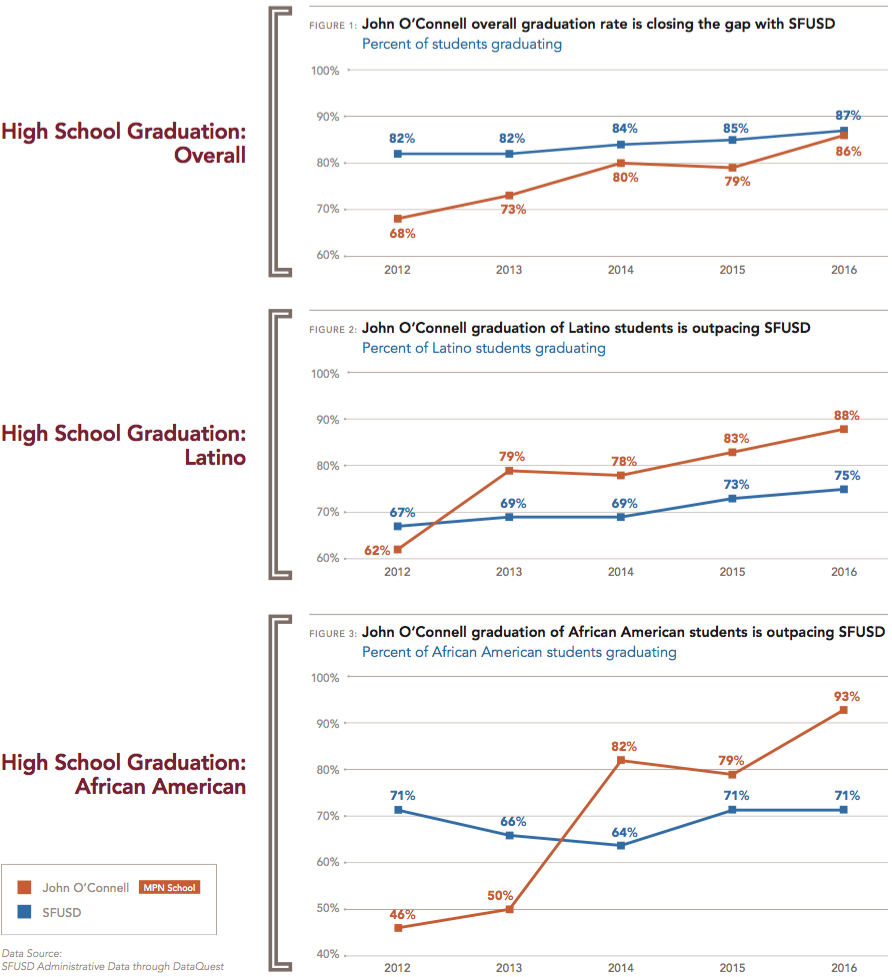
During our five-year initiative in partnership with SFUSD, John O’Connell High School graduation rates for our Latino students increased from 62 percent to 88 percent, and graduation rates for our African American students increased from 46 percent to 93 percent. These are dramatic numbers, showcasing the fact that something “has changed.”

The article mentioned that communication between the child’s school and parents was limited. In contrast, Mission Promise Neighborhood provides trauma-informed, culturally responsive programming. Surveys indicate that more than 94 percent of our parents feel welcome at our elementary schools. At our middle and high school, the percentage of parents who feel welcome is 92 percent and 93 percent, respectively.  

All kids are resilient and want to succeed: This belief in the ability of our children is part of the foundation of the national Promise Neighborhood movement. The first Promise Neighborhood was started in New York City’s Harlem neighborhood by Geoffrey Canada, when he made a promise that every child in his community can graduate prepared for college.

In San Francisco Unified’s Promise Neighborhood, we’re keeping that promise, and it’s only the beginning.

_______________________________

About Mission Promise Neighborhood

The Mission Promise Neighborhood is a citywide community partnership that was created to support kids and families living, working and attending school in the Mission District. It brings together schools, colleges, community organizations and community leaders to help kids graduate and families achieve financial stability.

Read More

The Montoya-Alcocer Family. Josue Alcocer is a 2017 John O’Connell High School graduate.
He is now attending City College.
Photo credit: Madeleine Bair

Co-authored by:
MPN Director of Program Evaluation, Learning & Impact Morgan Buras-Finlay
John O’Connell High School Principal Susan Ryan

There is some great news coming out of John O’Connell High School: Graduation rates have increased, with Latino and African American students now graduating at higher rates than from the San Francisco Unified School District (SFUSD).

(Read full data brief.)

By the numbers
Check out the impressive numbers for John O’Connell High School:

  • 86 percent of students graduated in 2016 (just one percent shy of SFUSD’s overall rate).
  • 88 percent of Latino students graduated in 2016 (compared to 75 percent of Latinos in SFUSD).
  • 93 percent of African American students graduated in 2016 (22 percent higher than the rate for African Americans in SFUSD).

These results occurred via a concerted effort, built over 15 years, with the final part of the equation the addition of the Mission Promise Neighborhood. This education initiative brought together 25+ community-based partners to engage in a collective struggle to overcome the predictive power of demographics. John O’Connell High School students arrive having faced disproportionate challenges of inequitable access to academic and economic opportunity. Fifty percent of students come with low attendance and GPAs in 8th grade, both early warning indicators.

Collective strategy: co-teaching approach
John O’Connell High School and the Mission Promise Neighborhood have jointly adopted a multidisciplinary co-teaching approach.

Says John O’Connell Principal Susan Ryan of this community strategy: “Our College and Career Center offers a holistic model for assisting students. It is an innovative partnership with multiple partner organizations, with the common goal of ensuring that all students are prepared to thrive in the professional world. This collaboration is unique in that each partner has staff embedded in the classroom, working alongside credentialed teachers.”

Team co-planning and co-teaching among classroom teachers and partner program staff has enabled John O’Connell High School to support students’ academic and socio-emotional development, ultimately building a school culture that does not wait for students to struggle and instead helps students expeditiously reach their goals.

Part of this strategy is harnessing the power of a trio of tried-and-true programs: SFUSD’s Mentoring for Success, Student Success Coaches and Mission Graduates’ college access program. Integrating supportive adults into the school day contributes to increases in feelings of safety and adult support among John O’Connell students.

As Mission Graduates Executive Director Eddie Kaufman explains, “John O’Connell’s model of partners working with students in the school day was aligned with our approach to college access: that our program’s foundation is the relationships built with students. Working with students in their classes throughout high school meant we had four years to develop their college-going expectations.”

Additionally, the family success coach, community school coordinator and student success coach work daily to build a college-going culture, strengthening student and parent comfort levels with navigating what can be a daunting process. This is especially true of our newcomer parents, for whom the college requirement, application and financial aid processes are intimidating.

Explains Community School Coordinator Paola Zuniga, “These changes offered a unique opportunity for O’Connell staff and partners for shifting services away from disconnected programs serving targeted groups, toward a cohesive program serving all students at each grade level. In this manner, partners and staff embed with teacher teams to support positive behavior systems, provide academic coaching and offer individualized attention as needed.”

Bettered graduation rates are an important piece of the cradle-to-college-to-career continuum on which our Mission Promise Neighborhood kids travel.

And here’s another important number: In 2017, 76 percent of students at John O’Connell said they planned to attend a two- or four-year college after graduating.

The Promise Neighborhood initiative was inspired by New York’s Harlem Children’s Zone Director Geoffrey Canada’s promise that every kid, no matter their background, had the capacity to do well in school and graduate.

“In San Francisco, we are keeping the promise,” sums up Ryan.

_______________________________

About Mission Promise Neighborhood

The Mission Promise Neighborhood is a citywide community partnership that was created to support kids and families living, working and attending school in the Mission District. It brings together schools, colleges, community organizations and community leaders to help kids graduate and families achieve financial stability.

Read More

In December 2012, MEDA worked with city agencies and 25 neighborhood partners to replicate New York’s successful Harlem Children’s Zone in the Mission District of San Francisco. The goal of the Mission Promise Neighborhood (MPN) is to guide students on a cradle-to-college-to-career continuum, while helping their families achieve economic success.

Director, Mission Promise Neighborhood Richard Raya (photo, lower right) is now spearheading this innovative initiative.

What background do you bring to leading the Mission Promise Neighborhood?
I’m a third-generation Bay Area native who grew up in one of California’s largest Section 8 housing complexes. After dropping out of my predominantly Latino high school, I went to community college, then transferred to the University of California, Berkeley, where I earned a bachelor’s in English and a master’s in Public Policy. I dedicated my life to helping transform lives the way my life was transformed. The Promise Neighborhood initiative is the embodiment of why I went to college: to help low-income families and communities of color maximize their extraordinary capacity to survive and thrive.

Over the past two decades, I’ve worked with elected officials, administrators and community leaders on data-driven, interagency collaboratives focused on improving program results in low-income communities, as well as on equitable development efforts resulting in affordable housing, below-market retail space and local-hire goals. My positions included director of administrative services for the Alameda County Public Health Department, executive director of Youth Radio and chief of staff for an Oakland city councilmember.

What is the greatest challenge of the Mission Promise Neighborhood?
The greatest challenge of the Mission Promise Neighborhood is that we are trying to solve a problem that no single organization can solve on its own — the challenge of getting every kid in the neighborhood to graduate prepared for college or career. Our collective impact approach of working with partners to provide wraparound services requires a great deal of trust between partner organizations, data sharing, coordination and communication. An additional challenge is that we’re doing all of this while also attempting to prevent these students from being displaced by the massive economic forces reshaping the face of San Francisco, and national policies threatening some of our immigrant families. Lastly, our initial federal grant is in its sunset phase; although we will be applying for an extension grant when it is released in the next few months, this award is not guaranteed. Our challenges are many, but we have the team, partners and infrastructure to meet these challenges.

What are the greatest successes of the Mission Promise Neighborhood to date?
A lot of people say they are working on collective impact, but few are pulling it off. The partners of the Mission Promise Neighborhood are pulling it off — collaborating and building relationships across silos and service system barriers, and using a common database to share information and provide wraparound services. In addition, MPN is also working with families to help them develop the assets to control their destinies, and preserving and building affordable housing to keep families in place and stabilize our community.

The high school graduation results are in: Rates increased dramatically for Latino and African American students. Over the five years of the MPN partnership, Latino graduation rates increased from 62 percent to 88 percent at John O’Connell High School, and African American graduation rates went from 46 percent to 93 percent.

It’s always going to be difficult to take direct credit for outcomes in a collective impact approach. The greatest success may be the relationships built among providers — the schools, the community agencies — and the buy-in to use a common referral system and share data.

MPN created a referral tool for partners to use to provide wraparound services to students and their families. After 2.5 years of collecting referral data (January 2014-August 2017), the MPN partners generated 4,389 referrals and impacted 2,303 individual families. (Read data brief.)

MPN has also built an awesome team. Our family success coaches have gotten to know students, families and school principals, and are responsible for making the referrals to community partners. Combined with our administrative and evaluation staff, this forms the backbone of the collective impact work. I’ve heard it said that with the right team you can accomplish anything. I feel that way with this team.

What is your vision for Mission Promise Neighborhood for 2018 and beyond?
The Mission District is one of the greatest neighborhoods in San Francisco, which itself is one of the greatest cities in the world. It’s an honor for San Francisco to host a flagship initiative such as a Promise Neighborhood. San Francisco has an opportunity now to decide what the next version of its Promise Neighborhood will look like. My vision is that we will double down on the collective impact infrastructure built by MPN, build on the relationships developed with partners, and expand services to more students and their families. This vision is not mine alone; it was developed by the MPN partners in a sustainability planning session last summer. Our vision is that we will continue sharing data across agencies as a means to make program decisions, while holding ourselves accountable to measured results, all framed by the agreement that we are responsible for each other’s children. In addition, we will strive to be guided by authentic community voice, and strengthen the ties of MPN to our broader MEDA asset building, affordable housing and parent leadership work. It’s an exciting time.

In my first four weeks, I’ve met dozens of partners, and I’ve visited all four of our Promise Neighborhood campuses: John O’Connell High School, Everett Middle School, and Bryant and César Chávez elementary schools. Our schools are the centers of our community, the fulcrum of our collaboration and the best places to meet our young people and their families. There is a lot that happens before children even enter school, so I’ve also toured the Felton Family Development Center, one of our early learning partners. This outreach will continue throughout the next few months, culminating in a report this spring sharing the considerable accomplishments of our collaborative over the past years, and where we hope to go from here, together. Please email rraya@medasf.org if you’d like to arrange a meeting with me.

There is so much going on in a Promise Neighborhood, so many moving parts, that communication is key. Our team will be redoubling our efforts in using this blog to provide you with regular updates on the great work that our schools and partners are doing.

____________________________________________________________

About Mission Promise Neighborhood

The Mission Promise Neighborhood is a citywide community partnership that was created to support kids and families living, working and attending school in the Mission District. It brings together schools, colleges, community organizations and community leaders to help kids graduate and families achieve financial stability.

Read More

by Director of Program Evaluation, Learning and Impact Morgan Buras-Finlay


The seemingly innocuous “referral” is a mainstay of nonprofits — the most-basic way organizations ensure they meet the needs of the communities they serve. Such referrals support individuals and families as they navigate the ever-complex and changing network of nonprofits, government agencies and institutions.

Yet even in 2018 the majority of referrals are still shared via fax, phone or paper, hindering accountability and leading to a paucity of insights into the services offered.

From its inception in 2012, the Mission Promise Neighborhood (MPN) education initiative has taken a collective-impact approach to community engagement and service delivery. The defining factor was the creation of a 20-partner network supporting families and their children along a continuum of asset building and academic achievement.

It was imperative that MPN require a method for measuring the health of the partner network, thereby providing accountability as it relates to service integration. This need evolved into MPN’s Referral Network Tool.

“I have firsthand seen the power of the implementation of the Referral Network Tool. Our partners no longer work in silos, and impact is now all the greater, as we strengthen our families,” explains Family Support Manager Celina Ramos-Castro.

After 2.5 years of collecting referral data, MPN is now able to see trends and speak to lessons learned.

The numbers tell the story: The MPN network generated 4,389 referrals and impacted 2,303 individual families between Jan. 1, 2014 and Aug. 1, 2017.

During that time, the following lessons were learned around three main topics:

  1. Digital Referral Networks. These networks are where hardware (technology) meets software (real people), and both must be mutually reinforcing. Ensuring that the human needs are being met will make certain the technological solution takes hold.
  2. Network hubs. Think of this as spokes on a wheel. It is crucial to have a few designated individuals out in the field and dedicated to connecting families.
  3. Service Areas. Networks must include the services areas most needed by the community. Data on referrals will illuminate these service areas.

View the full brief.

Note: The article was presented as a poster at USF Data Institute Conference in November, 2017.

Read More

MONTHLY ARCHIVE

Contact

Email
info@missionpromise.org
 
Phone
(415) 569-2699
 
Address
2301 Mission Street, Suite 304
San Francisco, CA 94110

Newsletter
Get the latest news and information on
what’s happening in your neighborhood.

SIGN UP