Warriors-BlogNobody can deny that the Golden State Warriors are winners. With a league-leading 53-13 record, these guys definitely know how to rise above the competition.

Look at the stats. Stephen Curry averages over 23 points per game and has an over 90 percent free throw average. Draymond Green takes down over eight rebounds per game. Andrew Bogut hits over 55 percent of his field goals. Impressive, indeed.

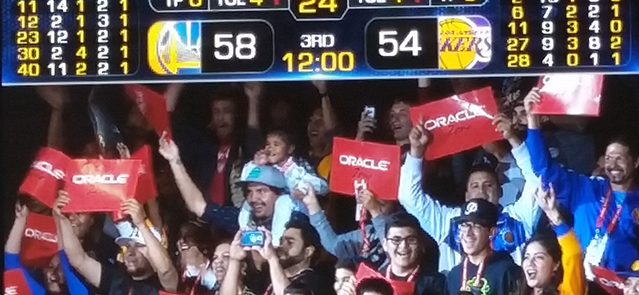
It’s also important to be deemed winners in the community, and the Warriors last night once again showcased that is definitely the case, with “Noche en Ene-Be-A” the theme celebrating Latino pride at the home game against the rival Los Angeles Lakers.

According to their website, the Warriors’ ”vision is put into action through programs focused on education, health & fitness, social responsibility and cultural diversity & arts. We remain committed to maintaining strong and impactful relationships with the Bay Area community and will continue to foster new ties that create additional opportunities for us to help others and strengthen our bond throughout the region.”

There were 40 tickets given out to a contingent representing the Mission Promise Neighborhood (MPN), the community initiative for which MEDA is the lead agency. Clients from such valued partners as Good Samaritan, Jamestown Community Center and Mission Graduates headed over to Oracle Arena to meet the players before the game. The group was treated to a VIP tour these young adults won’t soon forget.

Also joining was one of the displaced families from the recent conflagration at Mission and 22nd streets on January 28th. It was their first game.

Warriors Backpack GiveawayThis isn’t the first time the Warriors teamed up with MPN to help the community. The team also took part in the MPN Backpack Giveaway at John O’Connell High School last August.

States Director, Mission Promise Neighborhood Raquel Donoso, “The Warriors rolled out the red carpet for MPN, making it possible for dozens of Mission students and their families to enjoy a courtside warm-up and an exciting game. The Warriors exemplify the community spirit that is MPN. The team is a beloved part of our community. ”

A great time was had by all, especially with the team taking down the Lakers by a score of 108-105. The Warriors even sealed a playoff berth, making an already special night even extra special. When the videoboard displayed “CLINCHED,” the fans in the sold-out arena gave the Warriors a well-deserved standing ovation, with the MPN contingent part of this celebration.

These guys are true winners in our book—you can bank on the Warriors.

Read More

Alfaro-BlogSingle mother Ana Alfaro made the difficult decision to leave her native Guatemala with her son, Jose, with the hope of a better life for her small family. The transition proved traumatic for Jose; this was coupled with a speech impediment that led to the monolingual Spanish-speaking adolescent having a hard time fitting in with fellow students at the eighth-grader’s new place of learning, San Francisco’s Everett Middle School.

These issues led to a referral from the Special Education Department to Mission Promise Neighborhood’s Roberto Aparicio, one of a quartet of highly trained family success coaches, whose job it is to help families succeed so that students can achieve.

“My role is to connect families to needed services in the community, at MEDA’s Plaza Adelante and 26 partners in the Mission,” explains Aparicio.

That is exactly what Aparico did for the Alfaro family, leading to important referrals to services.

“Being able to speak their language and to relate culturally helped Ana and Jose relate to me,” continues Aparicio.

Jose was connected to an after-school program for accelerated academic support.

Ana accessed MPN partner Support for Families of Children with Disabilities, where she learned to advocate for Jose at Independent Education Plan (IEP) meetings, plus she was connected with a caseworker. Aparicio also counseled Ana to go to Taxes Plus: Go Further with MEDA, where free tax preparation was available. This was Ana’s initial foray into doing taxes—and a big step forward on the path to financial health.

The good news: Jose is now fitting in more during his second year of schooling in the U.S. Aparicio continues to work with the young man, with the ultimate goal of ensuring the latter eventually graduates from a four-year college. That would be a dream come true for Ana, who sacrificed so much so that Jose could have a better life.

Ana remains an ardent advocate for her son’s education. She is now transferring her experience into disseminating information in the Mission as a promotora for MPN, under the guidance of Community Engagement Manager Teresa Morales.

Sums up Morales: “Ana was instrumental in reaching families for MPN’s neighborhood survey last spring. She also participated at last August’s “Backpack Giveaway,” where over 2,000 Mission families received items to start the school year off right. Ana is succeeding, and now she is definitely paying it forward!”


Read More

Tech

Interview with Miguel A. Gamiño Jr., CPA
Chief Information Officer (CIO), City & County of San Francisco (appointed 12/4/14)
Executive Director of the Department of Technology

Miguel A Gamiño Jr. provides strategic direction for San Francisco’s use of technology. He counsels Mayor Lee, the Board of Supervisors and city departments regarding opportunities to leverage technology to improve government services. Gamiño is also a successful tech entrepreneur, having launched two successful IT companies in El Paso, Texas before heading to the Bay Area.

MEDA: First off, congratulations on your new position as CIO for the City and County of San Francisco. What do you see as the focus of this important role?
MG: I see my job as having a two-pronged focus. As San Francisco’s CIO, I am charged with leading the strategy and advising Mayor Lee and the Board of Supervisors on the ever-evolving tech landscape and how the city should be leveraging tech to improve City services and community engagement. As the Executive Director of the Department of Technology, I have the operational responsibility to deliver on that strategy.

Historically, technology has been mostly internally consumed, but we are starting to see that tech is becoming public facing, which also requires the need for greater transparency. Tech has evolved and woven into traditional civic services—a key to the delivery of such traditional services as public safety, transportation, and collecting taxes. Tech has become a consumer product, becoming the service itself. For example, #SFWiFi, our free public WiFi service, is a consumer service, not just something being supported by tech.

MEDA: It is great to see a Latino in such a position of power regarding tech. This makes you a role model for the community. We appreciated your sitting on our “Latino Career Panel” at our last “Get Connected!” event. How do you see yourself putting a face on how Latinos and tech can be one?
MG: There’s much talk around diversity–the tech sector suffers from that challenge. Coming from El Paso where the University of Texas El Paso was the #1 engineering school for Latinos, in some ways, I took this for granted. The divide is more apparent in San Francisco. I want to inspire Latinos, ensure there is a seat at the table for us in the tech sector, and that I live up to the responsibility for the community I represent. If you go to the consumer side of things, the Latino population is one of the fastest-growing groups in the U.S., so tech service providers would be smart to recognize that wave.

I see this divide on a global level, too. I recently helped to form a City CIO’s Club in conjunction with my colleague in Barcelona, Spain. This group is worldwide, but it was interesting to sense the urgency from CIO’s in Spanish-speaking nations including Chile, Colombia and Mexico. They are action oriented and do not want their populations to be left behind. I hope to influence and motivate these countries to step up their tech game.

MEDA: Our Mission Promise Neighborhood “School Climate Survey” indicated that 23 percent of students at our four target schools do not have high-speed internet in their home. When you worked in city government in Texas, you spearheaded “Digital El Paso.” Can you explain how that worked and could potentially be replicated in San Francisco?
MG: It took a community effort, bringing together tech companies, City leaders, the community colleges and neighborhood influencers. This started as a digital divide project when I was still a tech entrepreneur. Once I joined the public sector, I was able to continue this work from the other side. El Paso has one of the poorest neighborhoods in the nation, called Segundo Barrio. We were able to build out WiFi in that neighborhood, educating residents on the importance of high-speed internet.

We also started a project at local community colleges, whereby students learned skills as they refurbished donated computers, with these devices then being donated back to the low-income community. I learned a lot about what connectivity could do for a community, but that the connectivity had to be delivered in a way that was meaningful and approachable if you really want to impact the “Digital Divide”. I think we are doing a great job in San Francisco of staying aware of the diverse communities and focusing on delivering connectivity. We are seeing good user adoption of #SFWiFi on Market Street and the 30+ parks and recreation centers. We’re moving forward with further expansion. It is often the most popular topic I’m asked about at various industry conferences. Clearly broadband connectivity is a priority across the nation, and around the world.

MEDA: Finally, what do you see as the biggest challenges as CIO?
MG: There are two main challenges. The first is taking care of the underlying, yet critical, infrastructure. Balancing the need to deliver public-facing service improvements and innovations, with the less exciting foundational “plumbing” that nobody sees. It’s the newsworthy balanced with the gritty.

The second challenge is managing the tug of war between the fast pace of tech and the slower pace and conservative nature of government bureaucracy. Recruiting and retaining IT talent is tough, leading city government to support responsible risk-taking of a startup culture, and implementing the right technology at the right time to make a meaningful and timely impact on City services and operations. It also takes longer for things to happen, so if I am planning for something a year out, I have to figure what the latest and greatest tech thing will be down the road and build enough flexibility into the process to adapt along the way. These challenges are difficult, but it’s all part of my job, as I work to make every facet of San Francisco life tech savvy.

MEDA: Anything you would like to say to Latino community organizations?
MG: I’m still relatively new to my hometown of San Francisco, and as a Latino in a tech and civic leadership role with our City, I feel a strong sense of responsibility to the community.  I’m eager to participate in the strong Latino community organizations, like MEDA. Consider this an open invitation to other Latino leaders to help me get engaged with our community in a meaningful way!

Contact Miguel A. Gamiño Jr.:
(415) 581-4082
miguel.gamino@sfgov.org
https://www.linkedin.com/in/miguelgamino
@SFCityCIO
sfgov.org/dt

 

Read More

FAFSA-Slider1-760x337Thinking about heading off to college can be daunting, for students and parents alike. Especially when it comes to paying for that degree.

Most students needs some sort of financing package and that’s where Free Applications for Federal Student Aid (FAFSA) comes in.

Think of FAFSA as the gateway to money for higher education. Not only is FAFSA used to apply for federal student aid–the Federal Pell Grant, Federal Work-Study, Federal Perkins Loans and Federal Stafford Loans–it is also used to apply for student financial aid from state governments and most colleges/universities.

According to the U.S. Department of Education, the federal government annually awards about $150 billion in the form of grants, work-study funds and low-interest loans to help millions of students pay for college.

It is a big mistake for a student to fail to apply for FAFSA. While January 1st is the initial day you can submit your form, it is better to have income tax returns filed before tackling  a FAFSA application. Don’t wait too long: students who apply in the first quarter of the year obtain more money than those applying later.

In California,  a March 2nd online submission date, or postmark on a mailed application, is the deadline for many state financial aid programs.

According to the U.S. Department of Education website, there are four misconceptions around qualifying for financial aid for college.

To dispel these myths, note that the following are not true:

  1. I (or my parents) make too much money, so I won’t qualify for aid.
  2. Only students with good grades get financial aid.
  3. I’m too old to get financial aid.
  4. The form is too hard to fill out.

While the last point may seem true, with 103 questions to be answered on this year’s form, you don’t need to go it alone.

To help Mission Promise Neighborhood students and parents wade through this 10-page application, come to MEDA’s FAFSA Preparation Assistance Night on Wednesday, February 25th, from 6pm to 8pm at Plaza Adelante. Bank of the West is sponsoring this free event and will be sending volunteers to sit with applicants and help them submit their FAFSA forms (pre-register). All participants will be entered in a raffle to win a Nexus 7 tablet–perfect for taking to college.

Think of FAFSA as the first step to a successful college experience.

Read More

640x339px_DonosoIn December 2012, MEDA worked with city agencies and 26 neighborhood partners to be the honored recipient of a $30-million federal Department of Education grant to replicate New York’s successful Harlem Children’s Zone in the Mission District of San Francisco. The goal of the Mission Promise Neighborhood (MPN) is to guide students on a cradle-to-college-to-career continuum, while helping their families achieve economic success.

Raquel Donoso, Director, Mission Promise Neighborhood, is now spearheading this innovative initiative.

What background do you bring to leading the Mission Promise Neighborhood?
I was a mom at 18 when I was an undergrad at UCLA. This meant I had to weave my way through a maze of public assistance, from Medi-Cal to WIC. I also received state-subsidized childcare. Luckily, staff at UCLA helped me find my way. I see my personal experience at UCLA as a microcosm of what we are trying to do with the four target schools of the Mission Promise Neighborhood. Once I had my son, I switched my field of study from Biology to Anthropology and Chicano Studies. I then earned a Masters in Public Health. When I am now at policy meetings, I can literally bring to the table my experience in applying for services. I empathize with how overwhelming this can feel for our families. My goal is to remove barriers and increase opportunity, as was done for me.

What is the greatest challenge of the Mission Promise Neighborhood?
The gentrification in the Mission has added an extra layer of complexity to the Mission Promise Neighborhood. Many of our families have children who go to school in the Mission, but live elsewhere. It then becomes difficult to avail the families of services. Our Family Success Coaches work with many people who are losing their homes. These families are then left with the difficult choice of whether they should move away to somewhere more affordable. A lack of stable housing creates a challenge for the implementation of a place-based strategy.

What are the greatest successes of the Mission Promise Neighborhood to date?
We have been able to rally dozens of organizations, the school district and people at City Hall, so that everyone sees the possibility of positive outcomes for our families and students. It takes time to build a foundation, but this is in the works. The tech tools we have for our Evaluation team means pertinent data can now be had about our clients. This is being rolled out to our Mission Promise Neighborhood partners. We are also focused on a two-generation approach, providing financial opportunities for parents and educational support for their children, leading to even greater community sustainability. Integrating family financial support is a contribution MEDA brings to the table, demonstrating a model for other neighborhoods.

What is your vision for Mission Promise Neighborhood after its initial five-year grant?
I know that with the support of the community, great things will happen. There will be a fully integrated, shared database to better examine the comprehensive community need. We will be able to look at things at a granular level–for example, knowing that a student has started to showcase chronic absenteeism–so that there can be early intervention for an issue before it becomes a chronic problem. There will also be increased support for a college-going culture. That is already starting. With our two-generational approach, as families succeed the students achieve. This is a simultaneous process. Students begin to see opportunities. They then seize these opportunities. That is my vision.


Read More

NALCAB-Sub-Grant-BlogChristopher Gil, Senior Content Marketing Specialist
(415) 282-3334 ext. 152
cgil@medasf.org

FOR IMMEDIATE RELEASE
February 5, 2015

Education on Street Safety the Goal of Mission Promise Neighborhood Grant
Sense of urgency after recent accidents in Mission neighborhood

San Francisco, CA –The Mission Promise Neighborhood (MPN) has announced its receipt of a grant to foster street safety for Mission District residents.

The Department of Public Health and the San Francisco Municipal Transit Authority have partnered with agencies serving corridors of high pedestrian injury to bring awareness about street safety. In 2014, the MTA rolled out this initiative with an ad campaign on buses, light rails, in bus shelters and at light-rail stations, with the goal to promote awareness about street safety.

Last year’s pedestrian statistics showcase the need for education, with 800 struck and 21 killed in San Francisco.

This year has not started off any better. On January 10th, a motorcyclist suffered fatal injuries after colliding with a pedestrian on Van Ness Avenue and McAllister Street, right near City Hall. The pedestrian survived.

The Mission District has not fared any better in 2015, with two incidents of note last week. On January 29th, in broad daylight, a three-year-old was struck by a car while crossing at Mission and 21st streets. The following day at the nearby, bustling intersection of Mission and 16th streets, a MUNI bus and a car collided, with pedestrians scrambling to avoid being struck.

“These recent incidents showcase the need for community engagement on the issue of pedestrian safety,” explains Avni Desai, MPN Community Health and Safety Program Manager. “Education is a step in the right direction. Our aim is to start a downward trend in pedestrian injuries and deaths in San Francisco. Now is the time to start.”

One innovative approach to be employed by the Mission Promise Neighborhood is to disseminate information on pedestrian awareness via promotoras, who have a long history in the Latino community of outreach on safety issues.

MEDA will also be convening a community forum on this issue in March, with the Department of Public Health and the San Francisco Municipal Transit Authority invited.

Mission Promise Neighborhood logoAbout Mission Promise Neighborhood
The Mission Promise Neighborhood is a citywide community partnership that was created to support kids and families living, working and attending school in the Mission District. It brings together schools, colleges, community organizations and community leaders to help kids graduate and families achieve financial stability.

####

Read More

MLK-BlogMLK’s legacy in the Latino community
As we take time today to ponder the legacy of the late Martin Luther King Jr., it is important to note that the civil rights leader was fighting for justice for all Americans. That includes Latinos.

There is even more to commemorate this year, which marks the 50th anniversary of the civil rights marches in Alabama–from Selma to Montgomery–that helped spur the passage of the historic 1965 Voting Rights Act.

King based his idea of nonviolent protest on Mahatma Gandhi’s strategy for India’s independence from British Empire decades before. The important farmworkers’ protests, led by Cesar Chavez and Dolores Huerta, followed King’s model.

MLK was more than an inspiring symbol: he provided emotional and public relations succor to the Latino Civil Rights Movement.

King’s inspiration can still be drawn upon today, as the fight for economic and social justice continues.

The national example of impact on the Latino community
To showcase King’s impact on the Latino community, one need look no further than San Antonio, Texas. That’s correct: the seventh-largest city in the nation, boasting a Latino population of a whopping 63 percent, with just seven percent African-Americans, holds what is deemed the largest MLK celebration in the country.

This celebration is not a one-day affair. It spans 12 days and is aptly named “DreamWeek.”

DreamWeek’s mission is “to continue to advance and modernize the teachings set forth by Dr. Martin Luther King, Jr.’s vision by creating dialogue across cultures and communities.”

“Dr. King’s legacy is very much alive within the Latino community. His dream is a universal one. As a community, Latinos strive toward social equality and justice. Dr. King’s message embodies the spirit, strength and progress we continue to push for, and serves as an inspiration on a daily basis,” states DreamVoice Public Relations Specialist Cassandra Yardeni.

Yesterday, there was a wreath-laying ceremony at the city’s statue to King.

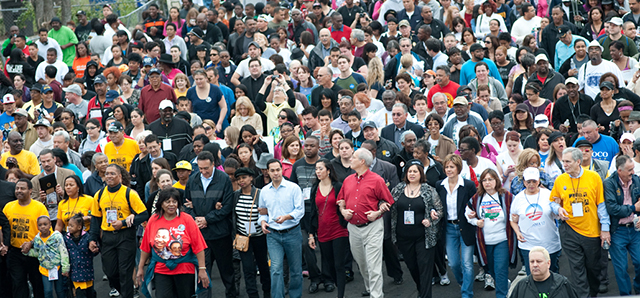
Today, there will be a two-and-three-quarter mile march down San Antonio’s Martin Luther King Jr. Boulevard, with over 100,000 attending. Interestingly, the city’s serpentine Cesar E. Chavez Boulevard starts nearby, just a block westward.

Bay Area events
There are myriad Bay Area events commemorating the life of Dr. King.

If you are on the Peninsula, there is an 8:30am MLK event at the San Mateo Caltrain station, with a “Freedom Ride” to San Francisco at 10am.

If in San Francisco, take part in the annual MLK Day festival, march and parade around Yerba Buena Gardens. Attend a full day of free events, festivals and programs, plus a march and parade, commencing at 11am, from the Caltrain station to Yerba Buena Gardens to commemorate the Selma to Montgomery march.

Conclusion
While there is still much to be done as far as Latino civil rights, the gains made in the past five decades are owed in part to Martin Luther King, Jr.

As King so eloquently stated: “Darkness cannot drive out darkness; only light can do that. Hate cannot drive out hate; only love can do that.”

Words to remember today, and every day.

Read More

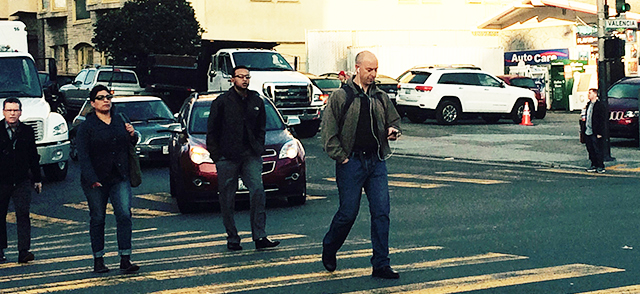
Safety-BlogA stroll through the bustling Mission this morning revealed some scary scenes. A pedestrian texted while crossing at Valencia and 24th streets, oblivious to the cars turning in his direction. A few places north, a bicyclist brazenly weaved in and out of traffic. Over on Mission and 19th, a car sped up, barely make it through the red light, thereby endangering a mother pushing a baby stroller.

These scenes are played out daily in tightly packed San Francisco, with a population density of 17,246.4 per square mile according to the 2013 American Census Survey (second only to New York City). San Francisco is definitely a city where one needs to be careful when heading from Point A to Point B, whether on foot or on wheels.

The numbers are stark: 800 pedestrians were struck by cars in San Francisco last year, with 21 suffering fatal injuries. This is one of the worst records in the nation.

Starting the year off on the wrong note, six-year-old Sophia Liu was fatally run down in a crosswalk at Polk and Ellis streets in the Tenderloin. Her mother and four-year-old brother survived their physical injuries, but were left to deal with the emotional pain of a young girl’s life cut short.

Then there was the case of Priscilla Moreto in late October. The 68-year-old employee of the City Controller’s office was run down by a tour bus in a clearly delineated crosswalk on Polk Street, just outside the steps leading to City Hall. Ironically, city officials had held an event nearby just moments earlier, touting safety upgrades in the Civic Center.

To combat this problem, MPN just received funding, through the San Francisco Department of Public Health, to conduct outreach on pedestrian safety.

The first step will be a grassroots Mission District education campaign done via the MPN’s promotoras/es, community outreach workers.

The goal is to obtain 500 safety pledges by the end of March, as follows:

  • I pledge to slow down and look around, especially at intersections
  • I pledge to know the rules of the road (e.g., pedestrians have the right of way)
  • I pledge to be alert when traveling on city streets
  • I pledge to share this pledge with family and friends

States Avni Desai, MPN Community Health and Safety Program Manager, “Education is a step in the right direction. Our aim is to start a downward trend in pedestrian injuries and deaths in San Francisco. Now is the time to start.”

Please help the community and take the pledge today.

Read More

MPN Latina Teens-BlogAs part of the Promise Neighborhood grant, the United States Department of Education (DoE) mandates that all Promise Neighborhood grantees administer an annual school climate survey, at their target middle and high schools, to understand the impact of the initiative on students. Findings from the first school climate survey for the Mission Promise Neighborhood are now available in a just-released report, entitled Mission Promise Neighborhood (MPN) School Climate Survey: Understanding the experiences of students in San Francisco’s Mission District.

The lead researcher on this study was Dr. Monica E. Lopez, Interim Director of Evaluation at the Mission Economic Development Agency (MEDA), which acts as the lead agency for this federal initiative.

Interview with:

17. Monica E. Lopez

Monica Lopez, MSW, PhD
Interim Director of Evaluation

MEDA: When and where was the survey administered?
ML: The MPN School Climate Survey was administered at two Mission District schools, Everett Middle School and John O’Connell High School. Students were asked about their schooling experience, including feelings of safety at school and traveling to and from school, their use of technology in and outside of school and other issues related to their educational experience. This was a self-administered, 20-minute survey taken in the classroom, with MPN garnering the needed cooperation of principals, teachers and Community School Coordinators.

MEDA: What is the survey’s main purpose?
ML: 
Initially, the survey was conceptualized as a means of capturing data on population-based indicators (GPRAs) mandated by the DoE, essential to tracking the impact of the initiative at a national level over time. Some of these indicators include school safety, consumption of fruits and vegetables, exercise habits and internet access.

We expanded the scope of the survey to include questions about students’ college and career aspirations, perceptions of school climate and social support within the school, and the types of messaging about college that students may be receiving at home.

MEDA: How many students were surveyed?
ML: There were 699 students (82 percent) who responded to our survey. Administration was achieved with the collaboration of teachers, Community School Coordinators and principals at target schools.

MEDA: What statistics were most surprising?
ML: 
There were unexpected differences in students’ responses based on gender where I had not anticipated them. For instance, in terms of school safety, I had expected to find male students feeling less safe at school than females, based on data that tell us that male students in general engage in physical fights at school at higher rates than females. This was not the case, however, and females actually felt significantly less safe at school than males.

Another interesting finding was related to college and career aspirations. More female students reported that they planned to attend a four-year college than male students, yet there were no differences by gender in terms of the type of messages that students received from their parents about college or in their level of confidence in their ability to attend college.

I must note that our data suggest that there may be a gap between college aspirations and actual college attendance. Our survey shows that 57 percent of our target school seniors plan to attend a four-year college. Data from the 2012 National Student Clearinghouse (NSC), however, reported that only 36 percent of students from our target school actually enrolled in a four-year college. Although NSC data are from 2012, their data show that few John O’Connell students actually enroll in a four-year college. We will be able to compare our survey data with data from the 2014 NSC, when it becomes available, to see if there is indeed a gap as data seem to suggest. The next step would be to figure out the root causes for this gap and to see how these can be addressed by our initiative.

MEDA: What do you plan to do with this survey information?
ML: 
These data will be shared with principals, teachers, community leaders, parents and students. The plan is to disseminate the report in educational circles. MPN Family Success Coaches, who work closely with parents at our target schools, will be availed of these data so that they can assist families. The same holds true of the MPN promotora/es, who will be advised about the statistics and given flyers to distribute to families during grassroots outreach. When it comes to the families themselves, the plan is to create informational flyers, based on topic, with easy-to-understand action steps. These data mean nothing without appropriate action to remedy issues in the community.

MEDA: When is the next School Climate Survey?
ML: 
There will be another survey in spring 2015. This will provide an interesting comparison because John O’Connell High School has implemented a lab model, based on the Center for Advanced Research and Technology (CART) paradigm in Clovis, California. CART is organized around four career clusters: Professional Sciences; Engineering; Advanced Communications; and Global Economics. Within each cluster are career-specific labs, in which students complete industry-based projects and receive academic credit for advanced English, science, math and technology. John O’Connell High School has its own tailored version of this model and it will be interesting to see what has changed based on this new school set up.

Read More

Get Connected-BlogWhen code.org devised its first “Hour of Code” grassroots campaign a year ago, they never could have imagined the impact: in a mere two weeks, over 20 million people participated and over 600-million lines of code had been written.

That led to another challenge this December for the week of the 8th to the14th, part of “Computer Science Education Week.” So far, 73 million people (and counting) have participated in 77,000 events held worldwide.

Make that 77,001.

Jacinto Noriega, Mission Promise Neighborhood (MPN) Technology Manger, saw the perfect tie-in to the “Get Connected!” events being held at MEDA’s Plaza Adelante, the Mission neighborhood SparkPoint center. This fourth such event of 2014, held today, was sponsored by Google and Comcast, with involvement from the California Emerging Technology Fund.

“I wanted our bilingual MPN families to have a chance to learn the real language of the future–coding. A Mission community-wide effort made today’s event possible, with great volunteers, MPN partners and MEDA staff all committed, as always. Also, we couldn’t have done this without the participation of Google and Comcast,” explains a thankful Noriega.

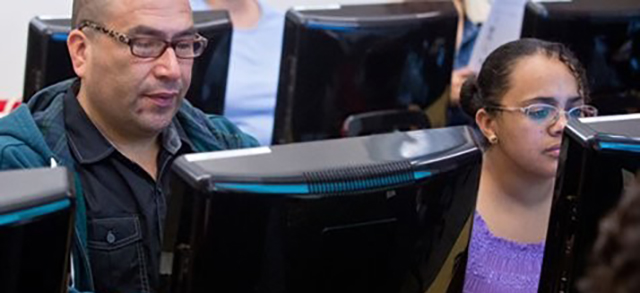
There were five coding classes offered as party of “Get Connected!”: a trio of classes named “Learn How to Code”; and two “Learn How to Make an Android Application” sessions. Participants seemed to soak up the knowledge they were receiving, a new world being revealed.

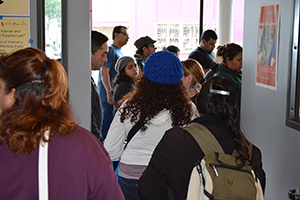
MEDA Get Connected Line 121214Today’s “Get Connected!” event featured other areas of interest to the low-income Latino community MPN and MEDA serve. People queued up to register for low-cost internet via a Comcast program called “Internet Essentials,” with cost starting at just $9.95 per month, plus tax. Erica Castillo, Broadband Coach, could be seen busily signing up event attendees, advising them that any child who receives free or reduced-rate lunch at school automatically qualifies for the “Internet Essentials” program.

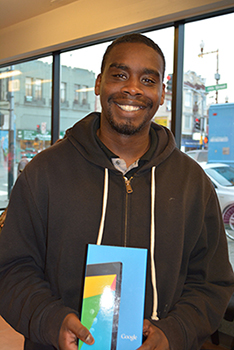
As a bonus, the first 50 to sign up for this low-cost broadband for the first time in their home were the recipients of a brand-new, free Nexus 7 tablet. This was part of a Google donation to help underserved Mission community residents have a computing device at home–an invaluable tool for families to help their children study and do homework and for parents to do everything from pay bills online to seek employment.

Some of these same valuable tablets, along with gift certificates, were raffled off in every workshop.

Since the “Hour of Code” is aimed at those ages four to 104, according to the founders, classes were offered for all age brackets at “Get Connected!” The “Digital Storytelling for Kids” workshop kept the little ones’ rapt attention as parents learned much-needed computer skills in classes geared to their age bracket.

A bevy of MPN partners were tabling, availing the families of services in the Mission. Residents were engaged with these organizations, seeing how their family could succeed and their child achieve at school.

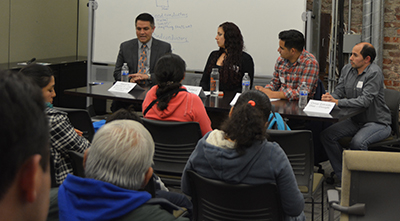
Latino Career PanelTo counsel residents on how they can be part of the tech industry, which is such a large sector of the Bay Area economy, a “Latino Career Panel” spoke to the crowd. This panel was composed of power players in the tech world: Miguel A. Gamiño Jr., City CIO for the City & County of San Francisco/Executive Director, Department of Technology; Omar Estrada Diaz from Google; Juan Salazar from Facebook; and Anna Zulaica of LinkedIn.

Many connections were made today among community residents, the double meaning of “Get Connected!” being showcased: low-income Latino residents being connected to tech; and residents whose paths do not often cross finally interacting, as new tech residents engaged with those that have made the Mission the vibrant neighborhood that today draws so many newcomers.

Sums up Noriega, ”Today was a great day for MPN and the Mission community at large. We look forward to future events that will continue the process of bridging the digital divide and bring the community together.”

Get Connected Google Tablet 121214


Read More

MONTHLY ARCHIVE

Contact

Email
info@missionpromise.org
 
Phone
(415) 569-2699
 
Address
2301 Mission Street, Suite 304
San Francisco, CA 94110

Newsletter
Get the latest news and information on
what’s happening in your neighborhood.

SIGN UP