1988-01212016_CRE-Prop A Money Community Meeting Social Media_blog_640x295px

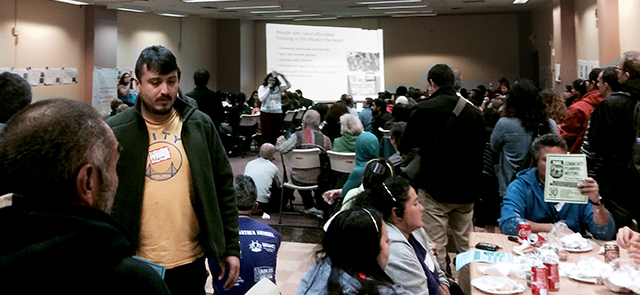
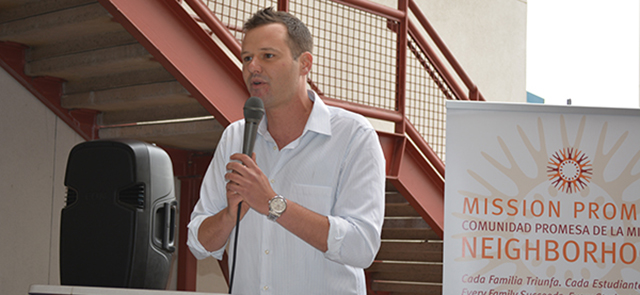
While trendy Valencia Street nightspots were filled as usual last Wednesday night with San Franciscans blowing off steam after work, a community that has been gaining steam for years met at Centro del Pueblo to engage in a historic discussion.

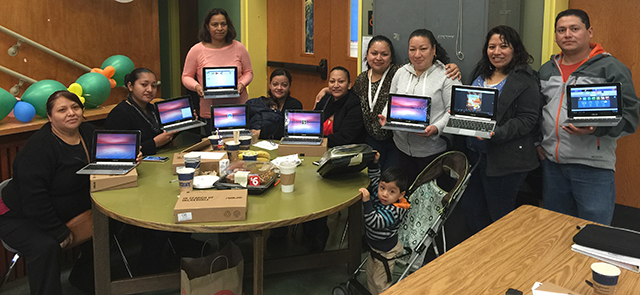
Thirteen community-based organizations – now under the name United to Save the Mission – collectively decided a plan of action with over a hundred residents. The topic: affordable housing. Specifically how the money from Prop A, passed last November with 75 percent of the vote, should be prioritized in the Mission.

The background
Prop A was the first housing bond passed in San Francisco since 1996. The total of this bond – put forth to address housing-affordability issues in an increasingly costly market – was set at $310 million.

Of that money, $50 million was earmarked for the Mission, the neighborhood hardest hit by the housing crisis. As proof of that statement, consider that a mere 7 percent of housing in the Mission’s pipeline is set as affordable, well under the City’s stated target of one-third.

report entitled “An Assessment of Housing and Housing Affordability in the Mission Promise Neighborhood” offered some specific numbers. This report estimated that 2,400 low- to moderate-income residents’ units be retained or replaced to maintain the Mission as a working-class neighborhood and Latino cultural hub.

The goal of last Wednesday’s meeting was to ensure that the community has a say in how this $50 million will be spent, as part of a plan to make the above happen.

The movement
This community meeting also represented three years of community advocacy and solidarity, ranging from street rallies and individual political actions to grassroots organizing and filling City Hall to the rafters to demand aggressive solutions.

MEDA, the lead agency of the Mission Promise Neighborhood, played an integral part by leading the creation of the Mission Action Plan 2020 (MAP 2020). A central piece of MAP 2020 was the implementation of an ongoing series of monthly meetings, since April 2015, that serves as a forum for City staff to directly request community input in funding priorities for affordable housing in the neighborhood.

The clear growth in the community’s power was then demonstrated last summer by the speed in which signatures were gathered for Prop I, the pause on luxury housing in the Mission District. Prop I made it to last November’s ballot, and while the measure garnered major support in the Mission, it unfortunately did not pass because the “Yes” side was vastly outspent by developers on the “No” side. Despite this loss, a movement was solidified.

This momentum of this movement led to a neighborhood having the impetus to put collective pressure on elected officials to allocate more funds to the Mission for affordable housing.

The displacement
The advent of this movement has been loss, real and anticipated, of a community no longer feeling they will be able to remain part of their neighborhood of choice. These feelings are based in fact, as the Mission has seen dire displacement of low-income and working-class residents (8,000 in the past decade, with the majority Latinos).

Those most vulnerable to housing instability are homeless individuals and families, very low-income people, those with children, transitional-aged youth (18– to 24-year-olds), seniors on a fixed income and persons living with disabilities. Many in attendance last night met these demographics. They came because years of action had led to their knowing that they will represented – that they now have a say in their future.

The options
There were four options presented to the community, with detailed explanations given for each and questions answered. This was done via small-group discussions, in Spanish and English.

Based on the group discussions, community members then cast votes for their priorities.

The community decided the priority should be to buy land and build now. The second choice was to buy land and build later. In third was the rehab of existing Single-Room Occupancy (SRO) hotels.

The next step
There is a follow-up community meeting next week to determine how to present last night’s prioritization to the powers that be at City Hall. United to Save the Mission will deliver this message on behalf of the community.

One resident of the Mission, Manuela from Alabama Street in the Mission Promise Neighborhood footprint, was compelled to come to the meeting out of fear of displacement. She explained, “I’ve seen too many of my neighbors have to move. They were all hardworking people who loved their neighborhood. They helped make the Mission what it is. I don’t want to be next.”

Manuela’s voice has been heard … as has a community’s.

____________________________________________________________

About Mission Promise Neighborhood
The Mission Promise Neighborhood is a citywide community partnership that was created to support kids and families living, working, and attending school in the Mission District. It brings together schools, colleges, community organizations and community leaders to help kids graduate and families achieve financial stability.
Read More

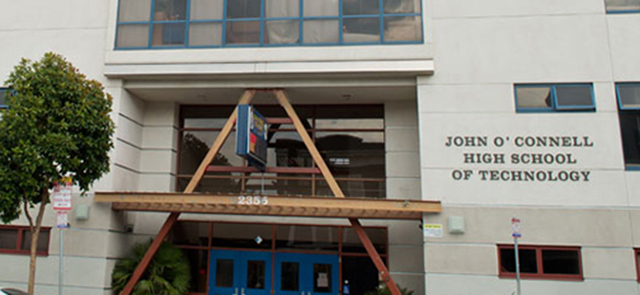
MPN-JOC Exterior-Blog

“We should focus interventions on supporting teen moms so that they stay in school. That way, we would be helping a mother and a baby have a better future, so it’s a double impact,” argued Trevor, a sophomore at John O’Connell High School, as students debated the best solutions and interventions for high school dropout prevention.

The discussion was part of this week’s “College and Career Class,” when students explore their options and make sure they are on track, using the Plan Ahead curriculum. There is a growing conversation about dropout prevention, as the country is celebrating related good news. As highlighted in the December 2015 newsletter of the White House Initiative on Educational Excellence for Hispanics, Latino high school graduation is at an all-time high – 76.3 percent. While this number is still lower than the 82 percent overall graduation rate in the nation, the gap is narrowing, according to the Common Core of Data.

The newsletter also stated that “traditionally underserved populations like English language learners and students with disabilities continue to make gains.”

In California, the overall graduation is now 81 percent, with 77 percent for Latinos – a lesser gap than nationwide.

Working for the Mission Promise Neighborhood, Education Manager Laura Andersen has seen the challenges at John O’Connell High School first hand. These traditional barriers to a high graduation rate range from supporting a high percentage of students receiving special education services, who are from very-low-income families or who are identified as English learners.

Explains Andersen, “John O’Connell, which became a Mission Promise Neighborhood high school in 2013, is tackling the most complex barriers for students every day, moving a community toward making high school graduation possible for all students, one at a time.”

The Latino graduation rate for 2013-14 at O’Connell increased to 78 percent, higher than the national and California rate for that ethnicity.

These numbers show that O’Connell’s strategy is making an impact. Various best practices combine to make this happen.

Start with a 6:1 student-to-staff ratio, which demonstrates a commitment to developing strong relationships with students and the adult community. Teachers also stay with students for two academic years at a time, so as to personalize learning and maintain an atmosphere of consistency for students.

Then there are the high expectations set for students, who are encouraged to pursue AP classes, honors courses and concurrent enrollment in City College of San Francisco. This abets a college-going culture at school, with community partners working to bring this environment into the home, too. This is especially important for Latino immigrant communities, with parents wanting their children to attend college, but needing assistance in how to guide the student in that direction.

Across the board, O’Connell’s curriculum focuses on preparing all students for the future. They learn through an integrated curriculum, project-based learning and group work. This culminates when juniors and seniors solve real-world problems through the lab of their choice: Health Behavioral Sciences; Environmental Technology; Building, Construction and Trades; or Culinary Entrepreneurship.

With an eye on the Latino graduation rate in particular, O’Connell’s Spanish-immersion program develops high levels of English and Spanish proficiency, complemented by literacy, academic competency and multicultural understanding. Those bilingual staff members also provide a consistent communication bridge with families.

Such strategies will continue to make a difference over the years, with an anticipated graduation rate for Latinos – and all O’Connell students – increasing every year.

It’s called community impact.

____________________________________________________________

About Mission Promise Neighborhood
The Mission Promise Neighborhood is a citywide community partnership that was created to support kids and families living, working, and attending school in the Mission District. It brings together schools, colleges, community organizations and community leaders to help kids graduate and families achieve financial stability.


Read More

Matt Haney-Blog

Matt Haney’s expertise about all matters education is well known in San Francisco … and beyond. So, it’s no surprise he was chosen as president of SFUSD’s board, with the official swearing in held on January 12.

In the past, Haney has taken on the role of advisor for the Mission Promise Neighborhood. He also sits on the board of MEDA – the lead agency of MPN – where he counsels on policy concerns for the low-income Latino community.

While Haney is well versed in the latest education topics, his own educational background is vast. Haney has a BA from UC Berkeley, an MA from Stanford University School of Education, a JD from Stanford Law School (with a focus on education law, and where he remains a lecturer/fellow) and an LLM in Human Rights from National University of Ireland, where he was a Senator George Mitchell Scholar. Impressive, indeed.

Currently, Haney works as #cut50 director of policy at Dream Corps, the vision of renowned civil rights leader and former Obama White House advisor Van Jones. Overseeing #cut50 means Haney is spearheading a national, bipartisan initiative to reduce the U.S.’s incarcerated population by 50 percent over the next decade. Haney believes there is a once-in-a-lifetime opportunity to reform the nation’s broken criminal justice system.

At SFUSD, Haney is responsible for determining policy, budget, curriculum, educational goals and standards for all pre K-12 public schools in San Francisco. He has been a national leader on ending the school-to-prison pipeline, including penning landmark policy transforming San Francisco’s school-discipline system.

Mission Promise Neighborhood Director Raquel Donoso knows SFUSD made the right choice, exclaiming, “It is evident that Matt really cares about our students. He has demonstrated leadership in shaping policies that are essential to the families and students of the Mission Promise Neighborhood. I am sure he will flourish in this new role.”

On his Facebook page, Haney stated of his new position as president of the board of SFUSD as follows: “I am excited to serve as president of the school board, alongside my good friend vice president Shamann Walton, and my wonderful, dedicated colleagues. Let’s go to work for the kids!”

Read More

1655-08212015_WFD-Basic Digital Literacy-Blog
It takes a big effort to bridge the digital divide in the low-income community. It takes a strategy for community outreach. It takes a team of staff and volunteers to teach the classes.

It also takes computers.

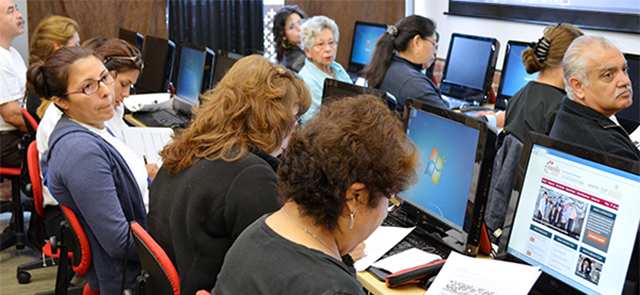
That’s why the recent in-kind donation of 50 PC desktops and two projectors from the University of San Francisco (USF) will take MEDA’s Digital Opportunity Center up a notch. A big notch.

MEDA serves as the lead agency for the Mission Promise Neighborhood.

It seems USF was retiring some computers, but they were still in fine shape and could be put to use. That’s when MEDA’s Workforce Development Program Manager Orrian Willis received an email from USF’s Office of Diversity Engagement and Community Outreach, informing him of the opportunity.

So MEDA Development Officer Alberto Galindo reached out to his alma mater to see if Plaza Adelante could be the new home for these computing devices, with the hope of helping families living in the Mission Promise Neighborhood footprint.

“Having attended USF, I knew that the university is defined by the Jesuit tradition of social justice and commitment to service-learning. These values are shared by the Mission Promise Neighborhood, which is working toward creating a more humane and just world through our commitment to equity and inclusion. These values are exemplified through MPN partner programs that empower underrepresented communities to become financially self-sufficient,” states Galindo.

Besides replacing the aging computer’s in the Digital Opportunity Center at Plaza Adelante, MEDA’s free Mission Techies program will use some of the devices. This program takes 17- to 24-year-olds on the path to a career in tech. These young adults will now use the equipment to optimize their learning while part of the program.

Leo Sosa, technology training coordinator, sees the need to bridge the digital divide every day. He knows how important this donation is to the low-income community. His day-to-day experience is backed up by a Mission Promise Neighborhood Survey (page 23) which uncovered the startling fact that 46 percent of families did not have a home computer with internet access.

This is the tech center of the word: San Francisco. This in the center of the tech center of the word: the Mission.

Explains Mission Promise Neighborhood Director Raquel Donoso of the impact of this generous USF donation: “Many of our families do not have access to a computing device at home. This is an obstacle for family economic success and student achievement, which go hand in hand. On behalf of the Mission Promise Neighborhood. The community cannot thank USF enough for their generous donation.”

____________________________________________________________

About Mission Promise Neighborhood
The Mission Promise Neighborhood is a citywide community partnership that was created to support kids and families living, working, and attending school in the Mission District. It brings together schools, colleges, community organizations and community leaders to help kids graduate and families achieve financial stability.
Read More

MPN-OC-Blog

An initial look at John O’Connell High School, nestled in the heart of San Francisco’s vibrant Mission District, reveals an inviting atmosphere and evidence of plenty of forward-thinking education ideas being put into play for its over 400 students. This innovative school, under the auspices of Principal Mark Alvarado, is the sole high school for the Mission Promise Neighborhood (MPN), a federal initiative to help families succeed so that students achieve.

As an MPN school, O’Connell gets many benefits. These include having a community school coordinator, a family success coach acting as a connector to services, Wellness Center staff and a quality after-school program.

Then there are school partnerships. O’Connell is meeting student needs because of internal expertise and the succor of a community of dedicated partners: Compass Education Group; CUESA Schoolyard to Market; FACES for the Future; Generation Citizen; JCYC Upward Bound; JVS (Jewish Vocational Services); the Mission Economic Development Agency (MEDA); Mission Graduates; Tech21
; UCSF EAOP; Urban Services YMCA; Youth Arts Exchange; and Youth Speaks.

These are the four primary ways student needs at being met:

Safe and supportive environment
O’Connell is a small community school. Its 6:1 student-to-staff ratio demonstrates a commitment to developing strong relationships with students and the adult community. Teachers stay with students for two academic years at a time to personalize learning.

High expectations for students
O’Connell’s student learning outcomes are clearly defined. Students are also encouraged to pursue AP and honors courses, plus concurrent enrollment in City College of San Francisco. O’Connell’s Spanish Immersion program develops high levels of English and Spanish proficiency and literacy, academic competency and multicultural understanding.

Academic excellence
O’Connell’s curriculum prepares students for the future. Students learn through integrated curriculum, project-based learning and group work. Juniors and seniors solve real-world problems through the lab of their choice: Health Behavioral Sciences; Environmental Technology; Building, Construction and Trades; or Culinary Entrepreneurship.

College and career readiness
Students engage in college and career readiness throughout the day. Teachers collaborate with industry professionals in the classroom. Students receive direct support and opportunities from student success coaches, college and career counselors, and Career Technical Education teachers.

Jamie A., a senior at O’Connell, knows she has been prepared for a bright future. She describes her typical day as follows:

“I spend two hours per day in my Culinary Entrepreneurship Lab. I’m an advisor in that, too, so I help with prom and dances, things like that, and the rest of my day is spent in chemistry, statistics, English … the usual classes. During lunch, I go to clubs: Tuesday is Gay-Straight Alliance; Thursday is the Mission Graduates Latino Club, and sometimes I meet with the Book Lovers.

“I check in with my two mentors each week. One is the Young Life area director. The other is a software engineer at Google who I met through Girls Who Code, which I did because the job council at O’Connell got me an internship at Facebook, so I got really interested in engineering. I’m applying to college now and hoping to go to UC Irvine because it’s the only UC with a Computer Science School; otherwise, I’ll probably go to a program at a smaller private school. Yeah, I guess I do a lot!”

A typical day … at a school that is anything but typical. That’s John O’Connell.

Contact information:
John O’Connell High School, 2355 Folsom Street, San Francisco, CA 94110.

Website.

Rebeca Flores, Parent Liaison, Room 103
(415) 695-5470 ext. 1004
Email Rebeca.

____________________________________________________________

About Mission Promise Neighborhood
The Mission Promise Neighborhood is a citywide community partnership that was created to support kids and families living, working, and attending school in the Mission District. It brings together schools, colleges, community organizations and community leaders to help kids graduate and families achieve financial stability.
 

Read More

MPN-Blog

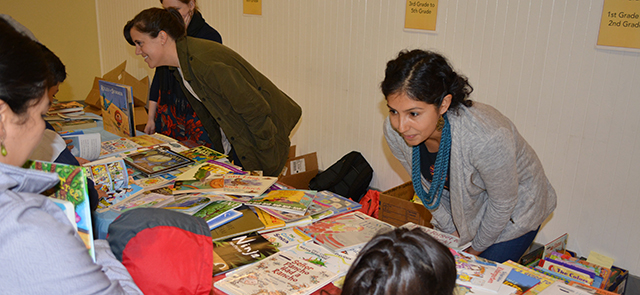
Braving inclement weather as some much-needed rain swept through the Bay Area on Monday, scores of Mission Promise Neighborhood (MPN) families donned rain jackets and streamed into the ornate Women’s Building for some much-needed community support, in the form of books for kids.

Explaining the choice of books as gifts, MPN Family Success Amelia M. Martínez C. stated, “There were a number of community toy drives scheduled in the Mission for the holidays, but MPN chose to make the gifts educational. It’s important for our low-income families to have access to books. Books may not be the first thing parents buy — books can be out of reach when you’re on a tight budget. Today MPN is helping families instill learning.”

Partnering for the event were the San Francisco Public Library and Tandem, both knowing that early learning is strongly tied to long-term academic success. Tandem’s mission to “spark joy and close the opportunity gap” was clearly met, as evidenced by the smiles on families’ faces as they chose their books for holiday presents.

Book offerings ran the gamut from fiction to nonfiction, historical novels to whimsical tales. Age brackets started at newborn and headed up to eighth grade.

MPN Early Learning Family Success Coach Ada Alvarado, who helped coordinate the holiday event, knows the importance of parents reading to their children. “It’s essential to develop a passion for books at as early an age as possible. It’s all about vocabulary building. Parents can do things as simple as asking open-ended questions or pointing things out, so as to elicit responses in their children. Books are the ideal way to facilitate such learning.”

Alvarado’s statement is backed up by myriad studies. Just last year, an American Academy of Pediatrics policy statement, “Literacy Promotion: An Essential Component of Primary Care Pediatric Practice,” claimed that “reading regularly with young children stimulates optimal patterns of brain development and strengthens parent-child relationships at a critical time in child development, which, in turn, builds language, literacy and social-emotional skills that last a lifetime.”

The policy statement also delineated the following incisive data:

  • Every year, more than one in three American children start kindergarten without the language skills they need to learn to read.
  • Reading proficiency by the third grade is the most important predictor of high school graduation and career success.
  • Approximately two-thirds of children each year in the United States, and 80 percent of those living below the poverty threshold, fail to develop reading proficiency by the end of the third grade.
  • Children from low-income families hear fewer words in early childhood and know fewer words by three years of age than do children from more advantaged families.

The Mission Promise Neighborhood Survey in 2014 found that 64 percent of families in the Mission are reading to their children three or more times per week. This is something to celebrate! MPN aims to ensure that the initiative’s partners continue to improve that number and get to 100 percent. Also, it is imperative to start this process as early as possible, since the MPN team knows that this is critical to brain development and vocabulary building.

There were plenty of books, neatly stacked on tables and grouped for age appropriateness, for MPN families to work toward that goal. Hundreds of books, actually.

To garner such a significant donation, it was Children’s Book Project to the rescue. For over two decades, this organization has been replenishing libraries in schools, public health centers, daycare centers, homeless shelters — anywhere there is such need. All books are free, with some new and others “gently used.”

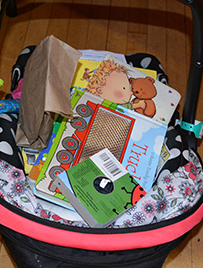
MPN-Carrier with Books-InsideWith arms laden with books — and even one infant carrier serving as a shopping bag, filled to the max–departing families were also offered a gift bag teeming with goodies. This included free passes to a trio of local kids’ venues: the Asian Art Museum; the Bay Area Discovery Museum; and the Cartoon Art Museum.

MPN parents left knowing there would be gifts for the holiday … and that the gift of learning would be part of their kids’ futures.

Read More

Ana Avilez-Blog

Housecleaner Ana Avilez initially learned of MEDA’s Mission Techies program while watching Univision with her family one evening. Then Ana was introduced to MPN at a 7 Tepees resource fair, so she decided to make an schedule time to come to MEDA’s Plaza Adelante. As Ana headed upstairs to her appointment, she saw a Mission Techies flier by the door of the Digital Opportunity Center. Her attention was piqued.

Ana headed into the tech center and was greeted by Technology Training Coordinator Leo Sosa, who explained the free program and asked Ana if she could commit to the time required. After discussing this opportunity with her mother, husband and employers, Ana diligently stuck to the three-month commitment and graduated from the Mission Techies program. “The interesting thing is that ‘Ana’ means perseverance,” states Sosa.

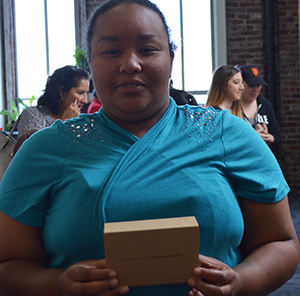
Ana-InsideAs a Mission Techie, Ana (pictured) took the first step into the MPN community. She was referred to Early Learning Family Success Coach Ada Alvarado, who helped Ana enroll one of her daughters in a bilingual preschool in Potrero Hill. Ada noticed that Ana was always prepared and on time to every meeting with Children’s Council and Potrero Kids. As MEDA staff worked with Ana, they recognized the community member’s leadership abilities, eventually referring her to the Mission Promise Neighborhood Community Advisory Council. Ana and other parents now advise the community about Mission Promise Neighborhood’s work and share opportunities to support their children. “I’m fortunate to have been introduced to and work with such a driven person, now on the path to achieve her dreams of academic and economic success for herself and children,” says Alvarado.

When MPN was asked to partner with SFUSD to lead Making Connections—a digital literacy course for parents that teaches how to use myON, an online reading platform for students — Mission Promise Neighborhood Director Raquel Donoso turned to Sosa for a promising, bilingual instructor. With her experience as a mother of two young learners, complemented by her technology background, Ana was chosen for the opportunity. She is now working with MPN Education Manager Laura Andersen to build these courses for parents, closing the digital divide and providing access to supplementary tools at home so that all students can continue building their literary skills. “Ana’s example of accessing the supports she needed, which turned into new personal and career opportunities, has been inspiring. Ana seeks to replicate the strong community she has found, at MEDA and her pre-school, with all of the parents in Making Connections,” explains Andersen.

Welcome to the MPN team, Ana! Keep an eye out for Ana in the community.

Watch a video of Ana’s inspiring story.

Read More

MPN-ESSA Passage-Blog 121515
by Raquel Donoso, Director, Mission Promise Neighborhood

There was some great news on December 10th, as President Obama added his signature to the Every Student Succeeds Act of 2015 (ESSA), now officially the law of the land. ESSA is a reauthorization of the five-decades-old Early and Secondary Education (ESEA) Act of 1965.

The President had pushed for ESSA’s passage before the calendar turned to another year, seeing the bill as a way to address gaps in the No Child Left Behind Act of 2001. The administration explained what needed to be remedied as follows: “The goals of No Child Left Behind were the right goals: Making a promise to educate every child with an excellent teacher. That’s the right thing to do, that’s the right goal. Higher standards are right. Accountability is right … but what hasn’t worked is denying teachers, schools and states what they need to meet these goals.”

Seeking social justice and equity in education, a cadre of community-based organizations worked tirelessly to help get this act passed. This included the Promise Neighborhoods Institute at PolicyLink.

Of ESSA’s 1,061 pages, these specific items pertain the most to the continuing work of Promise Neighborhoods:
• Ongoing funding of existing Promise Neighborhoods (based on performance to date).
• Establishing the Promise Neighborhoods program as a pipeline of services to foster academic achievement for students from underresourced communities.
• Requiring support of existing Promise Neighborhoods, with regards to planning, implementation and evaluation.
• Support for full-service community schools that improve access services for students residing in low-income communities.
• A mandate that three Promise Neighborhoods grants be awarded annually, based on availability of funds, by the Secretary of the Department of Education.

As director of the Mission Promise Neighborhood (MPN), I understand the significance of ESSA’s passage. This is exciting news for all Promise Neighborhoods, as they are now being given the continued opportunity to make long-term impacts in our communities. The Mission Promise Neighborhood, now well into its third year, is starting to see improved family economic success. This is translating to student academic achievement and a college-going culture being created in homes throughout the Mission District of San Francisco.

The MPN team, community partners and our families thank all who worked for the passage of ESSA–a bill that is vital to promoting social equity across the nation.

Read the full ESSA Act.

Read More

MPN-Streetside Stories at Everett-Blog 120815

Imagine being new to this country … as an 11-year-old.  You need to learn the language. You need the learn the culture. You need to just learn, period. To make this process interactive and fun, Streetside Stories and classroom teachers have partnered up to get creative.

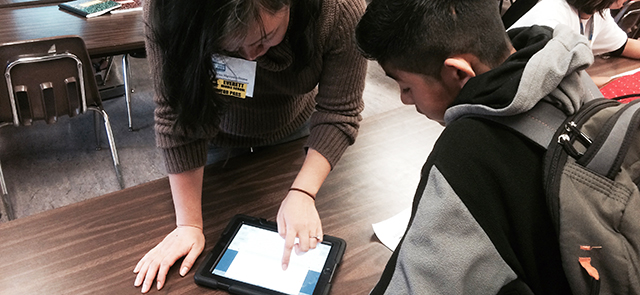
On Tuesday at Everett Middle School, 6th-graders who are newcomers to the U.S. were excitedly working on transforming  narratives into digital form as a science project in Ms. Bautista’s English Language Development (ELD) Science class. A six week, step-by-step process fosters the creation of the final product: a personalized ebook titled “How Do We Survive in our World?” Students must write a narrative, design a storyboard, create images, record voiceovers and edit the final cut.

Ms. Bautista co-developed the curriculum with Streetside Stories’ Van Nguyen-Stone (photo, top). Students develop literacy and arts skills, and begin to close the digital divide. For more than a decade, Nguyen-Stone’s work has encompassed independent filmmaking, complemented by teaching video production for nonprofit organizations.

This innovative duo designed a true learning experience. For example, in the creation of their author page, the students learned a few of the eight parts of speech, as they were asked to fill in the blanks for such questions as “I would describe myself as (adjective),” “I like to (verb)” and “(Noun) inspires me.”

Through their collaboration they also cultivate young people’s voices, using compelling storytelling that values diversity and builds community. Streetside Stories, a valued Mission Promise Neighborhood partner, is up to this challenge and has been succeeding.

A recent National Endowment for the Arts study found that African American, Latino and low-income youth receive significantly less arts education than white and higher-income youth. Streetside Stories is working to close this gap. Their core programs comprise innovative arts workshops that improve literacy via the integration of tech. The programs are aligned with state Visual and Performing Arts (VAPA) standards per the California State Board of Education, as developed by the Instructional Quality Commission.

Streetside Stories’ programs are also aligned to Common Core language arts standards for the state of California. While Common Core guides what students need to know and be able to do, the curriculum defines how students will learn it and is designed by school districts and teachers.

Students in Ms. Bautista’s class will share their final work with peers, families and community members on December 17th. At this event, Everett’s first iBook library of student’s ebooks will be displayed. The middle schoolers will read from their ebooks and describe their creative process via a Q & A session.

MPN-Laura Andersen at Everett 120815Mission Promise Neighborhood (MPN) Education Manager Laura Andersen (photo, left) was on hand today to watch this project come to life. A former kindergarten teacher, Andersen enjoyed helping students practice their oral language skills and think through their ebook content.

Explaining the importance of today’s event, Andersen highlighted the teacher collaboration: “Teaching ELD classes can be challenging; usually there is one fluent English-speaking teacher and twenty students who are trying to learn the language. This model leverages co-teaching to integrate technology with language skills, creativity and science to motivate students. These MPN students are in great hands with Ms. Bautista and Streetside Stories.”

Read More

MPN-Google Get Connected-Blog 102415While most low-income Mission families know the need for being connected, they often don’t know how to get started. This is especially true of immigrants—newcomers to this country with myriad tech options from which to choose. That’s why the goal of today’s sixth “Get Connected!” event, held at MEDA’s Plaza Adelante, was to help parents learn the best ways to keep their children safe online while optimizing the use of educational apps. For the youngsters, the goal was to whet their appetites for all things tech while creating an app in an hour.

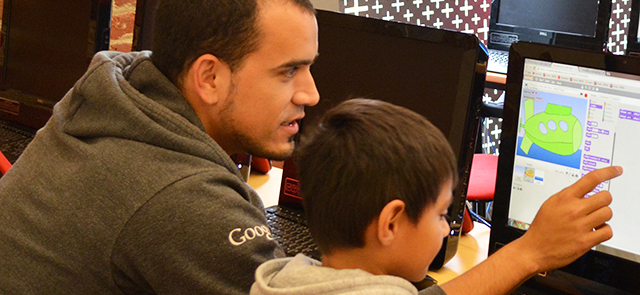
Google presented the event, with volunteers such as Hector Mujica (photo above) teaching a class called “High Seas” in a lab packed with fourth- to eight-graders. “High Seas” focuses on computer science taught in a playful, age-appropriate format.

To combat the lack of connectivity in the neighborhood, families signed up for a high-speed internet plan for as low as $10 a month. One sign-up was by Carmen Ramos, who explained that the $40 price per month she had formerly been quoted by an internet provider was not feasible given her family’s tight budget. A smile crossed Carmen’s face when asked how her being able to sign up today for just $10 per month would change her family’s life. She explained, “My son is a third-grader at Cesar Chavez Elementary, a Mission Promise Neighborhood school. We have been going to the library for the past year, but that takes time. Now my child can study at home, as it should be.”

There was a Technology Career Panel on hand, explaining how they wound up in tech—sometimes via serendipity. The panel comprised: Caitlin Crump, senior data scientist at LinkedIn; Roberto Mejia, IT support engineer at Jones IT; Alberto Melgoza, financial planning and forecasting systems tech lead and solutions architect at Google; and Kamilah Taylor, senior software engineer at LinkedIn.

Raffles for six laptops were held, with four elated young winners hardly able to tote the computer they were handed. Of the two adult winners, one was Carmen Ramos, excited that she now added a computing device to the low-cost internet for which she had signed up earlier in the day.

Google Cardboard-InsideThere were also 10 Google Cardboard certified viewers raffled off. This innovative product offers virtual reality on your smartphone once an app is downloaded.

Lunch was generously donated by Pollo Campero, with hearty plates of chicken, rice and beans served up by DoubleDutch volunteers.

In addition to Google’s Presenting Sponsorship for “Get Connected,” there was additional sponsorship from LinkedIn, DoubleDutch and Microsoft.

Mission Promise Neighborhood partners were on hand to avail the community of their free services. Partners included Causa Justa :: Just Cause, Good Samaritan Family Resource Center, Mission Neighborhood Centers and Support for Families.

Stay tuned for details on the next “Get Connected!” event, and connect your family to tech.

Read More

MONTHLY ARCHIVE

Contact

Email
info@missionpromise.org
 
Phone
(415) 569-2699
 
Address
2301 Mission Street, Suite 304
San Francisco, CA 94110

Newsletter
Get the latest news and information on
what’s happening in your neighborhood.

SIGN UP